OPENING AT JANCOU, GENEVA ON JANUARY 19TH FROM 6-9
"The Garden of Forking Paths is an enormous riddle, or parable, whose theme is time… The Garden of Forking Paths is an incomplete, but not false, image of the universe as Ts'ui Pên conceived it… He believed in an infinite series of times, in a growing, dizzying net of divergent, convergent and parallel times. This network of times which approached one another, forked, broke off, or were unaware of one another for centuries, embraces all possibilities of time. We do not exist in the majority of these times; in some you exist, and not I; in others I, and not you; in others, both of us.” -Jorge Luis Borges, "The Garden of Forking Paths," 1941
It is with great pleasure that Jancou announces The Garden, an exhibition of new work by British artist Ross Chisholm. Taking its title from the Jorge Luis Borges story, “The Garden of Forking Paths” (1941), the show will be Chisholm’s third solo exhibition with the gallery and his first in Geneva. Opening on January 19th during Geneva's "Rentrée du Quartier des Bains," it will be on view through March 10th.
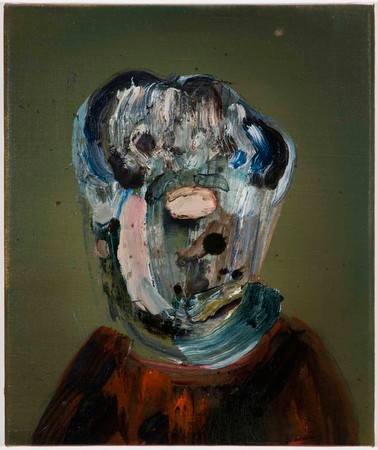
In this body of paintings, drawings, and altered found photographs, Chisholm takes as his starting point imagery mined from centuries of British visual culture: source materials range from 18th-century society portraiture by Allan Ramsay and Joshua Reynolds to photographs of 20th-century families on vacation collected at flea markets. He painstakingly recreates these original images using the lush techniques of Old Master painting, then disrupts our historical and narrative associations with his subjects through various formal means. In some works, the appealing legibility of traditional portraiture is obscured by splattered paint drips, thick globs of pigment, or unexpected injections of geometric abstraction. In others, recognizable characters from art history are layered with the figures of their fellow countrymen who lived centuries later. By conflating these disparate historical moments and modes of portraiture, the artist draws attention to the shifting conventions of, but sustained urge for, self-representation.
Also evidenced in these works is Chisholm’s ongoing use of repetition and motif to explore the temporality of the painted surface. In his new multi-paneled pieces, the artist repeats his source image time and time again, executing each re-creation on the same scale but with variances ranging from subtle changes of palette to dramatic inversions of the figure. These ever-changing manifestations of the same image make material the physical and conceptual processes of painting: we see the picture as it unfolds over time, at various degrees of finish, and witness the potentially infinite number of decisions made by the artist during its creation. By laying bare the subjective nature of this process, Chisholm destabilizes the authority of the image, subverting these iconic pillars of art history and the versions of the past they present. As in Ts'ui Pên’s labyrinthine novel at the heart of Borges’ story, in which all possible outcomes from an event are allowed to occur simultaneously, these works present a moment in which, “Time forks perpetually toward innumerable futures.”
Born in 1977 in the United Kingdom, Chisholm currently lives and works in London. He studied painting at Brighton University before attending Goldsmiths College. Recent solo exhibitions include Man Directing Water (2010) at Grieder Contemporary, Berlin and On the Banks of the Dorsal Stream (2009) at IBID PROJECTS, London. A monograph on the artist published by JRP | Ringier is forthcoming this year.
-
«Le jardin aux sentiers qui bifurquent est une énorme devinette ou parabole dont le thème est le temps; Le jardin aux sentiers qui bifurquent est une image incomplète, mais non fausse, de l’univers tel que le concevait Ts’ouei Pen. Il croyait en des séries infinies de temps, en un réseau croissant et vertigineux de temps divergents, convergents et parallèles. Cette trame de temps qui s’approchent, bifurquent, se coupent ou s’ignorent pendant des siècles, embrasse toutes les possibilités. Nous n’existons pas dans la majorité de ces temps ; dans quelques-uns vous existez et moi pas; dans d’autres, moi, et pas vous ; dans d’autres, tous les deux.» -Jorge Luis Borges, « Le jardin aux sentiers qui bifurquent » 1941
C'est avec grand plaisir que la galerie Jancou présente Le Jardin, une exposition des oeuvres de l'artiste britannique Ross Chisholm. Tirant son titre d'une des nouvelles de Jorge Luis Borges Le jardin aux sentiers qui bifurquent (1941), cette exposition sera sa troisième exposition personnelle en collaboration avec la galerie de New York et la première à Genève. Le vernissage aura lieu le 19 janvier à l'occasion de la Rentrée du Quartier des Bains et l'exposition sera visible jusqu'au 10 mars.
Dans ce corpus de peintures, dessins, photographies retrouvées et endommagées, Chisholm prend comme point de départ une imagerie minée par des siècles de culture visuelle britannique: allant de portraits du XVIIIe siècle par Allan Ramsay et Joshua Reynolds à de récentes photographies de vacances dénichées dans des marchés aux puces. Il recrée assidûment ces images originales en utilisant les techniques picturales des Vieux Maîtres. Par la suite, il perturbe ces associations historiques et narratives avec ses sujets. Pour certaines oeuvres, la lisibilité du portrait traditionnel est obscurcie par des éclaboussures, des coulées de peinture, d'épais amas de pigments, ou encore d'inattendus jets de peinture rappelant l'abstraction géométrique. En confrontant ces modes de représentations et ces temporalités disparates, l'artiste attire l'attention sur les conventions changeantes et sur l'irrépressible attrait de l'auto-représentation.
Il ressort au travers de ces pièces un usage constant de la répétition au travers duquel Chisholm explore les différentes temporalités de la surface peinte. Dans ces nouveaux polyptyques, l'artiste reprend son image source et la répète maintes fois en exécutant chaque re-création à la même échelle mais avec des écarts allant de subtils changements de palette, à de dramatiques inversions de la figure. Ces manifestations toujours changeantes de la même image rendent matériel le processus physique et conceptuel de la peinture: nous voyons l'image telle qu'elle se déploie au fil du temps, à des degrés divers de finition, témoin du nombre potentiellement infini de décisions prises par l'artiste lors de sa création. En mettant à nu le caractère subjectif de ce processus, Chisholm déstabilise le pouvoir de l'image, subvertissant ainsi, ces piliers emblématiques de l'histoire de l'art et ces versions du passé qu'ils présentent. Comme dans le roman labyrinthique de Ts'ouei Pen au cœur de l'histoire de Borges, tous les résultats possibles d'un événement sont autorisés à se produire simultanément. Ces œuvres présentent un moment où "le temps bifurque perpétuellement vers d'innombrables futurs."
Né en 1977 au Royaume-Uni, Chisholm vit et travaille à Londres. En 2000, il obtient son BA à l'Université de Brighton et reçoit en 2004 son diplôme de troisième cycle en beaux-arts à l’Université Goldsmiths de Londres. Parmi ces récentes expositions on compte, Man Directing Water (2010) à Grieder Contemporary, Berlin et On the Banks of the Dorsal Stream (2009) à IBID PROJECTS, Londres. Une monographie de l'artiste publiée par JRP | Ringier est à paraître dans le courant de l'année.