John Currin 02 April - 07 June 2008 69 South Audley Street, London W1
Keith Sonnier 15 May - 21 Jun 2008 55 Central Street, London EC1 (HQ off-site)
Frank Benson 21 May - 28 June 2008 35 Heddon Street London W1
Andreas Slominski 12 June � 5 July 2008 69 South Audley St London W1
John Currin
02 April - 07 June 2008 69 South Audley Street, London W1
Sadie Coles HQ is presenting a major new series of paintings by American painter John Currin whose subjects range from the domestic to the overtly erotic. These exceptionally refined and gloriously engaging paintings continue the intense debate within Currin�s work that combines art historical technique with contemporary reference. While some of Currin�s new paintings are of flowers and exquisite china, most are depictions of hardcore eroticism taken from European pornography.
Pornography is functional and almost by definition an unembellished celluloid or digital idiom. Indeed, one of the primary uses of photography is porn, and a painting would struggle to claim to be as immediate or undeniably in the moment as a photograph.
Currin�s use of pornographic subject matter is both a challenge to these conventions and an acknowledgement of the spectral presence of photography for the contemporary painter. Currin renders the pornographic in luscious oil paint, evoking the technique of historical painters as various as the magisterial Jean Auguste Dominique Ingres, Gustave Courbet, Christian Schad or Otto Dix. Currin�s appropriation of daring images and their transformation through the medium of paint knowingly mimics the four-hundred-year-old practice of erotic paintings commissioned for private viewing by wealthy patrons. His imagery does away with the elevation of the subject through mythical role play and these girls and boys are what they are, 20th century porn stars, but they are promoted purely through their rendering in oil paint. And when the pictures are not explicit they are laced with innuendo. One picture in the exhibition, Pushkin Girl, depicts a plump young woman looking up from her book in order to gaze at the viewer, the expression on her face suggesting that something indecent may be going on outside the crop of the image. Another painting, a still life of delft china, is seen in this context as fetishistic and as dogged in its mastery as Currin�s rendering of the sex act.
From early on in his career Currin was known for his distinctive depictions of women of various ages and sizes � dour menopausal women, pretty young girls, buxom maidens � and men of dubious sexual ability, and he has been alternately spoken of in terms of mannerism, caricature, and conservatism. But throughout Currin�s compositions is a morphology of academic realism entwined with lively contemporary caricature, with the work allowed to triumph by the pure splendour and the staggering ability of his painting.
John Currin was born in Boulder, Colorado, in 1962 and obtained a B.F.A. from Carnegie Mellon University (1984) followed by a M.F.A. from Yale University (1986). He lives and works in New York. In 2003, a travelling exhibition of drawings was organised by the Des Moines Art Center and in the same year MoCA Chicago initiated a mid-career survey of his painting which travelled to the Serpentine Gallery, London and the Whitney Museum of American Art, New York. His work has also been included as part of What is Painting?- Contemporary Art from the Collection, MoMA- Museum of Modern Art, New York, 2007; Painting Now! - Back to Figuration, Kunsthal Rotterdam, 2007; In the Darkest Hour there may be light: works from Damien Hirst�s Murderme Collection, Serpentine Gallery, London, 2006. A major monograph on John Currin was published by Rizzoli in 2006.
Keith Sonnier
15 May - 21 Jun 2008 55 Central Street, London EC1 (HQ off-site)
The final exhibition in our series at the off-site space in Clerkenwell is by American artist Keith Sonnier, and is curated by Clarissa Dalrymple.
Dis-Play is a spectacular installation work characteristic of Keith Sonnier�s innovations and controlled experiments in which light and space are treated as tactile materials rather than simply optical devices. Made of a range of materials such as foam, glass, strobes, ultraviolet tubes, and fluorescent pigments, Sonnier transforms Central Street into a throbbing, censorial den that engages all five senses. A re-staging of a piece from 1970, Dis-Play is one in a series of Sonnier�s complex explorations of material phenomenology, a convergence of technology, Modernist aesthetics and transcendentalism. Revisiting this work almost forty years on brings into sharp focus Sonnier�s role in the now accepted blurring of the distinction between painting and sculpture as well as highlighting the foundations he laid for the interdisciplinary practices that abound today.
Accompanying Dis-Play is a number of wall sculptures, examples of Sonnier�s pioneering work into sculpture-as-drawing in which he uses limited materials to create enormous visual presences. Sonnier has had a career-long practice of working in series, a process he sees as being essential to his creative energy and one that allows him to revisit his early forms and materials in order to manipulate and reinvent his sculptural language. Included here are works from the 1960s File Series, as well as works from the mid-1990s Cohla Junction Series. The name of the File Series refers to the altered shape of a nail emery board file, although the fabrication of the series focuses on the sensation of touch and utilises old-fashioned upholstery techniques to dictate the forms. Mindful of the three decades of investigation into neon and light sculpture, the more recent Cohla Junction Series, while drawing on African or Aboriginal themes, is made up of non-objective works which focus on the integration of architectonic electrical housing and sculptural elements. Throughout, as seen in works from the Cat Doucet and Depose Series from the mid-1990s, Sonnier�s roots in rural Louisiana play an important part in his work. The sculptures here relate directly to childhood themes as well as a perceived anthropomorphism in nature, their inflated forms suggestive of a type of figuration which seems to move in time and set up its own narrative descriptions. Keith Sonnier (born 1941, Mamou, Louisiana) is a minimalist, performance, video and light artist. He emerged in the 1960s as part of a generation of sculptors that included Dan Flavin, Michael Heizer, Richard Serra, Robert Smithson, and James Turrell, among others and was included in the seminal exhibition When Attitudes Become Form curated by Harald Szeemann for Kunsthalle Bern which travelled to the Institute of Contemporary Art London in 1969. Sonnier lives and works in New York.
Frank Benson
21 May - 28 June 2008 35 Heddon Street London W1
Frank Benson�s spring 2008 show at Sadie Coles HQ presents a series of refined presentations of pre-existing abstract forms, each one arrested in motion. Two of the sculptures replicate actual chocolate fountains, highly associative objects of desire and consumerism. Cast in stainless steel to maintain a material harmony with the object that inspired them, the fountains are polished to be almost inconceivably reflective. The apparent invitation to try and disturb their flow is overwhelming. But as with other work by Benson, such as Human Statue that was shown at the Serpentine last year, the pieces remain in the realm of the spectacle: these sculptures are static, abruptly frozen, always resisting the viewers intervention. With their repetitive geometric and iconic shape the reference to Constantin Brancusi is clear; their extreme and polished realism becomes entwined with a kind of universal abstraction. The illusion of fluidity in the fountains is echoed in the tables that support them. Concertina-like bases made of aerospace materials are a direct translation of Benson�s foam core maquettes and introduce space, air and upward motion to the closed and inert form of the fountain. The base turns the totemic monument of the chocolate fountain into an unstable phallus, something that asserts its masculinity at the same time as it risks its own demise.
The nonchalance of these sturdy bases is also found in two furled MDF pieces that are positioned on the floor. These works appear casual, as though they might flop back to their original form, but like the fountains their construction means that they are in fact the opposite. Made by means of a lengthy process in a furniture-making workshop involving jig construction, lamination and trimming, high levels of production as a means to the distillation of movement are as central to these pieces as in the chocolate fountains. Benson says �I enjoy backtracking through the manufacturing and distribution process which produces the readymade and intervening one or two steps before the object would become available to the public...�. Furthering the idea of manufacture, Benson has specifically made two of each sculpture in order to �suggest the possibility of multiple, if not infinite, variations on each form.�Benson�s photographic works are similarly occupied with the suspension of movement in both the form and function of the object. The image that is part of this exhibition shows a halted multiple CD-changer, presented as an architectural monument, its functionality as bypassed as a Blossfeldt flower. In other photographs a foam-spraying can deposits its contents into the air, the nodular forms frozen, and a plastic party cup melts to form a plate but stops just short of losing functionality. Through this series of photographs, as with the other works in the show, Benson aspires �to force the viewer to form their own conclusions about each of the work�s state of being and acceptability as an art object.�
Frank Benson was born in 1976 in Virginia, USA. He studied at Maryland Institute College of Art, Baltimore, and Master of Fine Arts, University of California, Los Angeles. His work was recently included in the world-touring Uncertain States of America - American Art in the 3rd Millennium curated by Daniel Birnbaum, Gunnar B. Kvaran and Hans Ulrich Obrist which came to the Serpentine Gallery last year.
Andreas Slominski
12 June � 5 July 2008 69 South Audley St London W1
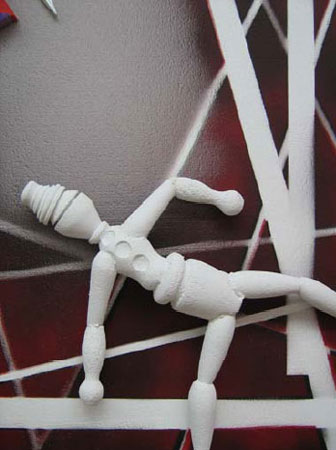
Andreas Slominski's show at Sadie Coles HQ will comprise of a new series of polystyrene pictures. Sculpted from wall-size slabs of Styrofoam and spray-painted with a primary and fluorescent palette, these paintings skirt around definitions of painting and sculpture. Evocative of the everyday, they incorporate polystyrene renderings of objects as diverse as a saucepan of egg yolks, skis, a wood-working tool, and boat-objects, all ofwhich suggest a hidden iconography linked to earlier series of sculpture by the artist. Their tropical colours and souvenir-like qualities are reminiscent of a strange journey, one that Slominski reveals through constructed mementos and literal imprints. Made by means of layers, from the engraved polystyrene up, these pieces are contained in heavy steel frames. Framing these pieces in such a way might suggest the completion and compression of the action illustrated inside. As in other work, Slominski upsets his viewer's stable footing by proposing a mystery to be solved. In this way, Slominski has created a new way of engaging the viewer in favour of impression over documentation. Although aesthetically dissimilar to his previous work, the performative actions and conceptual roots remain.
Slominski is perhaps best known for his traps. These traps, whether conventional, constructed or invented, show Slominski's fanatical mindfulness to detail. Although much of his work is characteristically impractical in its completion, his custom-made traps for individual animals reveal an efficiency-driven side. Like a great deal of Slominski's work, the humour lies in the extreme attention to detail.
Much of Slominski's work is deliberately painstaking. His absurd methods are characterized in work like Cough Syrup Transport System, 1998, which entailed placing a spoonful of cough syrup into a Cardan's suspension apparatus used to keep mariner's compasses horizontal. This was then secured within a vibration-resistant safe, placed in a van and transported from one end of Berlin to the other, completing its journey at the Deutsche Guggenheim at Unter den Linden. All the viewer sees is the spoonful of cough syrup, but his clues reveal a deliberately painstaking route. Photographs and text clearly document his progress. With these new polystyrene pictures, the final conclusion is more ambiguous.
Andreas Slominski was born in Meppen, Germany in 1959. Between 1983 and 1986 he studied at the Hochschule f�r bildende K�nste, Hamburg. Recent solo shows have been held at MMK, Frankfurt am Main, 2007, Museum Boijmans Van Beuningen, Rotterdam, 2007, and at the Serpentine Gallery, London, 2005. He has contributed to numerous international group shows including ...5 minutes later at KW Institute for Contemporary Art, Berlin, 2008. He has been the subject of many monographs including Andreas Slominski (MMK, 2007) and Andreas Slominski (Germano Celant, 2005). He lives and works in Hamburg and Werder, Germany.