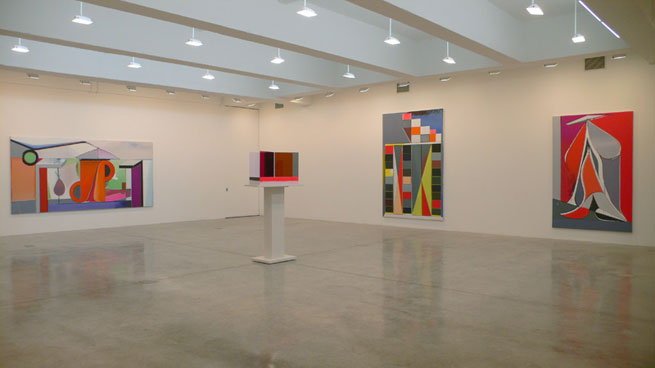
Thomas Scheibitz, Missing link in Delphi 27 Feb 2009 - 18 Apr 2009. Installation View Tanya Bonakdar Gallery, New York Image � Thomas Scheibitz, Courtesy Tanya Bonakdar Gallery, New York
Rachael Thomas WELCOME TO THE JUNGLE Catalog: about 90 elements / TOD IM DSCHUNGEL, 2007 Edited text by Rachel Thomas Click here for full version and further text
{..}
Like all of Scheibitz�s titles, there is a dialogue here between science and art, fact and popular fiction. His work abounds with both contemporary and historical references. Cartoons, Hollywood movies, lifestyle magazines, 15th-century etchings, artists and personalities like Philip Guston, the Melvins, Lester Bangs - all inform his work. Born in Radeberg, Germany, in 1968, Scheibitz, a student of Professor Ralf Kerbach in Dresden, started painting in 1990 and quickly gained international recognition. His early works were wooden reliefs and plywood sculptures, and, surprisingly, a compilation of film trailers. These disparate elements show the idiosyncratic nature of his visual world. He has archives of clippings kept in overstuffed folders. Scheibitz�s archive is not a collection of meaningless blips in the cultural miasma but a crosssection of our shattered visual world.
Music, particularly rock music, is integrated into both Scheibitz�s work and the way he works in his Berlin studio. This relationship between rock and roll and painting could very well, on the face of it, be seen as something of a clich�, but, as J�rg Heiser has quite rightly said, ��there is an almost uncanny resemblance between the discourse around the status of contemporary painting and rock music. The techno-factions in both art and music have repeatedly buried the canvas and guitar for good, and time and again both have risen from the grave, claiming that their time has not come, that there is still something substantial to say about them.�4 ( J�rg Heiser, in Painting at the Edge of the World, exh. cat. (Minneapolis, Minn.: Walker Art Center, 2001).
In the 21st century, painting is no longer a purely formal project with a cultural and historical framework. The much heralded �death of painting� has been proclaimed by critics from Yve-Alain Bois to Arthur Danto, who argue that the immediacy of current technologies has eclipsed the act of painting itself. Yet this critical discourse only serves its rebirth. Thomas Scheibitz�s work is part of this reclamation as he questions the status of representation and, in doing so, affirms the validity of painting. In about 90 elements / TOD IM DSCHUNGEL Scheibitz renders his �plan� in high relief by juxtaposing painterly sculptural forms against expansive backdrops, themselves layers of colour and form, to create a dialogue between painting and sculpture.
His focus on the relationship between function and ideal form in the contemporary world can be seen in his fascination with the �The Glass Chain� or �Crystal Chain�, also known as the �Utopian Correspondence�. This was a chain of correspondence between architects initiated by Bruno Taut that formed the basis of Expressionist architecture in Germany. �Light seeks to penetrate the whole cosmos,� the poet Paul Scheerbart said of Taut�s Glass House of 1914, �and is alive in crystal.� The exuberant Expressionist projects quite consciously allude to an esoteric iconography, which is a quality that can be said to permeate the works of Thomas Scheibitz. A further link, and a coincidental one, is found in Scheibitz�s sculpture A place in the sun (2007, p. 112), which could be said to be beautifully shaped into a letter �M�. The graceful, classical arches and sun-bleached tones are reminiscent of Bruno Taut�s work Grotesque Region (1918, p. 198). Scheibitz came across this work and noticed the echo in the bottom right of the work, which clearly displays the architecture and colourings of his own A place in the sun. Here one clearly sees how history acts as an osmosis exchange. That Thomas Scheibitz has grasped a form that already existed in Taut���s work creates an unspoken affinity.
Thomas Scheibitz has been greatly influenced by the late Blinky Palermo (1943 - 1977). �For me what was particularly striking and unusual, perhaps because it is an area that is rarely covered by contemporary artists,� Scheibitz says of Palermo�s work, �was the translation (as I call it) of things such as times of the day, calendar days or cardinal points, things that appear to be quite fundamental or simple things. Palermo�s work displays a strong inner necessity, whereby the pleasure of regarding a girlfriend who is drawn sitting on the edge of the bed, or of making a large-format picture out of lengths of cloth, is simultaneously revealed as a pictorial concept.�6 Palermo�s work, from what Scheibitz has to say about it, clearly strikes a chord. First, the work of both artists defies, rather appropriately, easy categorisation. What links Scheibitz and Palermo is a similarly expressive style. If one looks a little more closely at the affinity between the works of these two artists, Scheibitz can certainly be said to share Palmero�s desire to throw the world into question, particularly the ways in which man has seen fit to measure it.
Palermo�s approach can be said to display a process of reduction whereby every allusion to human figure and form vanishes and, as a result, all that is left are fields of stark colour. The aim of his work was to arrive at a point where a sequence or chord of colours gets, as it were, to the root point or the elemental basis of the visual forms he wished to express. Palermo�s work Points of the Compass I (1976, p. 198) shows four separate works that are all related in their colour and composition. This minimal work makes reference to the four corners of the world and, more importantly, the ways in which its inhabitants orientate themselves upon its surface. If we compare Palermo�s work to Scheibitz�s painting 90 Elements (2007, fig. 11), we can see that there is a resemblance between the two inasmuch as both artists wish to express something of the enormity of the world, its boundlessness, in an abstracted microcosm. Scheibitz�s painting does this wonderfully well with a series of minimal, highly geometrical, cube-like formations that have a sense of movement and fluidity. Both Palermo and Scheibitz delight in conveying the underlying principles of the world that, in turn, reveal something of the terror and beauty that lies beneath. Both artists utilise the resonance of reduction, which serves to heighten the tension of the painting.