Frieze Magazine
Thomas Scheibitz
At Monika Spr�th Philomene Magers, Berlin, Germany
Published on 04/11/08
by Sarah James
Thomas Scheibitz was a savvy inaugural choice for Spr�th Magers� new space in Berlin. Scheibitz is a very popular artist right now: having represented Germany in the 2005 Venice Biennale, he has amassed an enviable list of major solo international exhibitions and � as a multitude of flattering reviews attest � even more fans. Scheibitz could be said to be something of a painter�s sculptor, or a sculptor�s painter. His colourful, quasi-abstract, neo-Pop works riff on the relationship between art�s two traditional genres. However, this show, playfully entitled �The Goldilocks Zone� � apparently in astronomical terms a region of space where conditions are favourable for life (not too hot, and not too cold, just like the blonde-locked lady liked her porridge) � limits itself to an exploration in sculptural form. And the gallery�s vast, shiny space, formerly both a ballroom and a university lecture hall, plays home to 25 of Scheibitz�s multi-media works.
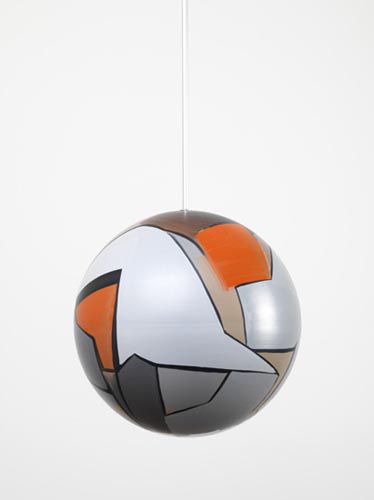
The first room, the smaller of the two, is occupied by the show�s title piece, Goldilocks Zone (2008), a steel globe painted with orange, grey and white oils, and, next to that, 69.512 (2008), a light installation made from MDF that looks a little like a deconstructed Union Jack. But dominating the room is Masterplan Table (2008), a brilliant work � a sort of counter to the artist�s vitrine, more a chemist�s bench � that acts as a kind of meta-thesis on Scheibitz�s practice. An arrangement of curious and vernacular objects are made into abstract forms; architectural wooden frames and tiles sit next to speakers and hard-drives, transformed with shiny modulated ceramic surfaces. Scheibitz�s sculptures are just as charismatic and confusing as his paintings. Based upon the artist�s index of forms, accrued from the everyday, mass media and art history, objects become part of a structuralist play on meaning, and sculptural form exists as the point of articulation between hermeneutics and appearances.
The next space is much more riotous. Twenty-two brightly coloured sculptures, of various scales and constructed from MDF, resin, Plexiglas, wood, fabric and steel, form a sort of three-dimensional canvas. The works seemingly reference the post-painterly abstraction of Frank Stella or Kenneth Noland, the Pop and deconstructed forms of Richard Smith, with a kind of dishevelled nu-rave aesthetic. These lively, generic forms appear clean and mass-produced, strangely close to the anonymous and collective aesthetics of public sculpture, logos, font design, graphics manuals � the debris of consumerist symbolism. But in most cases, as soon as you get closer you see that the seemingly homogenous surfaces are stained in lacquer and uneven painterly washes that defy the expected perfection of abstraction, and instead gesture to something far more interesting. Scheibitz grew up in communist East Germany and apparently his father is a monumental mason. I can�t help thinking this is important to his work. Scheibitz�s sculptures are like contemporary culture�s semantic gravestones; art for a post-utopian world.
Sarah James
|
|
|
Web Links
thomasscheibitz.de
Tanya Bonakdar Gallery, New York
Produzentengalerie, Hamburg
Monika Spr�th Philomene Magers, Berlin / London
diamondpaper, Berlin
Camden Arts Centre, London
Thomas Scheibitz on wikipedia
|
|

 SIGN UP for ARTIST MEMBERSHIP
SIGN UP for GALLERY MEMBERSHIP
SIGN UP for ARTIST MEMBERSHIP
SIGN UP for GALLERY MEMBERSHIP