The Artistic Practice of João Maria Gusmão and Pedro Paiva, by Natxo Checa
In the search for a meaning for the world, based strongly on a philosophical, literary and enduring scientific research, João Maria Gusmão and Pedro Paiva’s work questions the experience of the real, with empirical experimentalism. Rejecting the idea of an image, current on the contemporary artistic scene, this artistic duo rehearses a kind of “recreational metaphysics” (Fernando Pessoa), with derision as an affirmation of their thoughts.
In the early days of their career, João Maria Gusmão and Pedro Paiva focused their attention on occurrences related to perception mechanisms and to the unconscious. The DeParamnésia series (2001-2002) sprang from the common idea of “déjà vu”, addressing physical experiences that limit the behaviour of sight, spatial reference and time awareness, thus originating strategic perceptions that reveal an unconscious reality.
The second moment was developed, as a proposal for research, from the reading of “The Man that Laughs”, by Victor Hugo, and named the Eflúvio Magnético episode.
This series of works (2003-2006) addressed, the double impossibility in a sea storm: descriptive – the type of magnetic influence activates the complexity of the occurrence – and existential – the condition of death (shipwrecked person) revealed to the individual that is present. The possibility of examination of the occurrence is revealed here, with the help of the artifice of the potential of experimental fiction, therefore denying what is strictly rational.
In their most recent research, the duo has adopted the term Abissologia, a neologism created by René Daumal, to describe the science that studies the abyss. In the context of their artistic practice, Abissologia proposes a fiction that is focused on
literary composition, specific of a science of the bodies. As in the theory developed by the Atomists, these theories refer to a certain metaphysics directed to a cautious approach to the profoundness of the real. To make visible an apparently obscure topic, to reveal “the thing” identifying the shadow, to show a positive with the inversion of the negative, are some of the aspects proposed.
Employing as a device the overlapping of layers of fiction, both literal and metaphoric, the two artists build a series of “truthful narratives” into their works. To understand nature as one of the primordial questions, they have created an architecture of philosophical items that has translated itself into an elaborate notion of the transitional. From the perspective of the knowledge of the self – ontology – and the understanding of the events – phenomenology – we can observe in these works, the presentation of the minimum visible, the indiscernible, in a word, processes that employ exception as a procedure.
The display of the duo’s work, evocative of a museum environment, typical of natural and human sciences, is based on an induced scenographic route. Despite the outdated look, sometimes documental, sometimes “parascientific”, the viewer is confronted with a contemporary proposal that produces a real collection of ideas.
Natxo Checa_curator
|
João Maria Gusmão and Pedro Paiva
Lisbon
Portugal
Europe
T:
F:
M:
|
|
Web Links
Galeria Graça Brandão, Lisbon
Galleria Zero, Milan
Galeria Fortes Vilaça, São Paulo
Portuguese Pavilion – 53rd La Biennale di Venezia
|
|

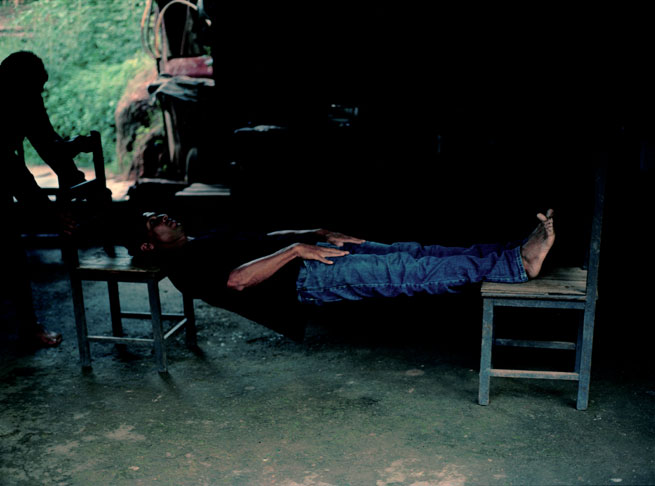 Photograph, 95 x 135 cm. Co-produced by: Centro Cultural Inhotim, Minas Gerais
 SERVICE OVERVIEW
SIGN UP for ARTIST MEMBERSHIP
SIGN UP for GALLERY MEMBERSHIP
NEWSLETTERS & ANNOUNCEMENTS
NEWSLETTER SCHEDULE
ARTIST OPPORTUNITIES
POST ARTIST OPPORTUNITY
SERVICE OVERVIEW
SIGN UP for ARTIST MEMBERSHIP
SIGN UP for GALLERY MEMBERSHIP
NEWSLETTERS & ANNOUNCEMENTS
NEWSLETTER SCHEDULE
ARTIST OPPORTUNITIES
POST ARTIST OPPORTUNITY