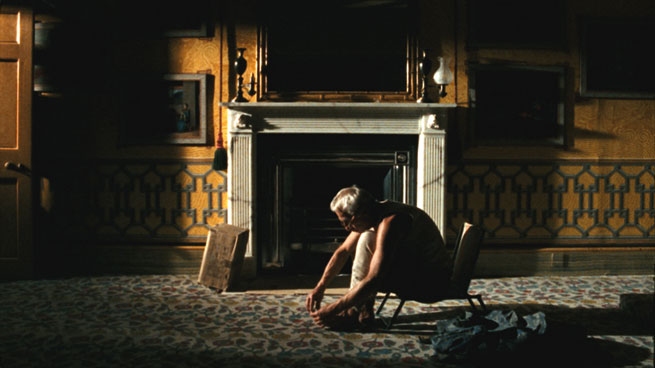
Fiona Tan - A Lapse of Memory, 2007 HD installation, loop duration: 24 min, colour, 5:1 surround Image � the artist, courtesy Frith Street Gallery, London
Other facets of the same globe A conversation between Fiona Tan and Saskia Bos contd
SB: How do you relate to your own bio-geography: have you been deliberately articulating places and periods in your life by visually (re)constructing stories and situations or did the works �surface� as if you were reliving your own memories? Or is it somewhere in between?
FT: The answer changes at different times. That�s the nice thing about years passing: the older I get, the larger my body of works becomes and I see the positioning of each work and the relationships between the works steadily shifting and developing. When I worked those three years on May You Live in Interesting Times , I was in my late twenties. I have since realised, thanks to some of my students and to films I have seen over the years, that it is a relatively common reflex to go through an identity crisis and to seek answers to the personal question of �Who am I and where did I come from?� at that age. Soon after that, I engaged in works involving archival footage, mostly of an ethnographic nature. This was an attempt to deal with the larger framework around such images. With works such as Smoke Screen , I felt my partially Asian background to be a help, as the question of where I stood was not at all straightforward. Was I �us� or was I one of �them�? There is this desire to be looking at camera-based and time-based images, not only in an intellectual way but also in other ways. Physically, haptically, emotionally: these may be some of the types of looking to which I am referring.
SB: Some films you make seem to exist in a suspended realm: figures are stylised and framed, movements are slowed down or people are asked to pose or sit, which creates anticipation both in the eyes of the beholders and in those of the sitters, who seem to be staring straight back.
FT: Empowerment is a key word. Cinema and photography have a lot to do with manipulation: framing automatically means that the gaze is confined and there are things off-screen that are left out. With montage, the editing and cutting of a film, the director not only dictates the order in which scenes are presented, but also their exact length. The impact of sound, be it spoken word, music or ambient sound, is much greater than many people realise. I am interested in exposing and exploring all of these mechanisms. I want to empower the subject, empower the viewer, and to bring aspects to the surface, to create a certain visibility, if you like, to foster awareness of our interpretation of the images that surround us.
SB: Many shows have been based upon notions of archive, where art questions the document as a fragment of collective memory and the manipulation thereof. Is the meta- language of your use of found footage �true life�?
FT: Document is for me inextricably linked to documentary film. I am really happy that I ended up living in a country where the tradition of documentary film is much stronger and better than that of moviemaking. Grandfathers of the Dutch documentary film, like Joris Ivens, Bert Haanstra and Johan van der Keuken, were my �teachers�; I learnt so much from studying them, as I did from my extended encounters with the wonderful archives of early film from the Nederlands Filmmuseum. The Dutch national film archives are, in my opinion, more interesting because of the early documentary footage that they have kept and have thankfully preserved and restored than for any movies they might contain. There is of course a lively, if at times tedious, discussion in the film world about where (artificial, staged) film stops and where documentary film starts. There are actually quite a few renowned documentary filmmakers who rehearse with the people they film, who instruct their real-life subjects and who happily film multiple takes of so-called spontaneous scenes. The idea of the fly on the wall, of cin�ma v�rit�, is arguably impossible. Whatever action or scene a camera lens points at is changed by the presence of the camera and camera operator, however subtly. Similarly, the boundaries of cinema have blurred, even if only on the surface. The handheld rough camera work that smells of true-to-life documentary has become very popular in recent movies. And then there is the document as it is found in the archive. Whether or not documents are accessible hinges upon the system of the archive, on how and why an archive came into existence and the way it is structured and organised. I do not think that documentary, archival footage is �true life�. It is, as any image is, a �take� on life, a subjective view, a limited and manipulating viewpoint. Nevertheless, like any viewer, I make snap judgements as to the truth of a film or a photograph, as to how realistic a representation we sense it to be. I am all for the stimulation of creative archival techniques � I mean this also in a poetic way. For fresh approaches to where and how we file away the images in our memory, in our mind, in our view of the world.
SB: Your titles are often about time, time lapses, repetition, and transformation, while the works themselves play with time by slowing it down, speeding up movement, or suspending it. In Provenance, a woman swings back and forth like a pendulum. What is time for you: a friend or a foe?
FT: Time is most definitely a friend. In many works I overtly deal with this � in Rain , in n.t.(Leidsestr.) , in Linnaeus� Flower Clock . Time, history, memory, they are all connected; they are facets of the same globe. As an artist working almost exclusively with time-based and lens-based media, time is one of my major tools. No, perhaps I can be more precise than that � time is both tool with which to shape and chisel and material to fold, distort and configure. I am thinking here in particular of my most recent work, Rise and Fal l; a memory is a fold in the fabric of time.
[��]
SB: Let�s come back to the piece you are working on at the moment. Within Disorient, the pavilion-based project, you are focusing on a world of objects, goods, trophies, and in a different view you disclose its deconstruction, or the fact that we have been looking at a stage. Is the process of the making of a film, an installation, of interest to you here? Or is it more its metaphorical meaning, from riches to rags?
FT: Right now, at this very moment in its development, I am experiencing a great deal of stress due to setbacks in the preparations for this piece. But that too is all part of the process! I am not interested in this work illustrating an idea of �the making of�. That is not what I am trying to get at with the twofold presentation structure I have chosen for this work. Between two apparent opposites a gap comes into view and the piece extends beyond a simple dialectical juxtaposition of rich and poor, positive and negative. The interpretation of this �opening� or hiatus is more complex and challenging. I am interested in investigating and, if necessary, undermining persistent paradigms of thought, of the way we perceive the world, even if they originate from many hundreds of years ago.