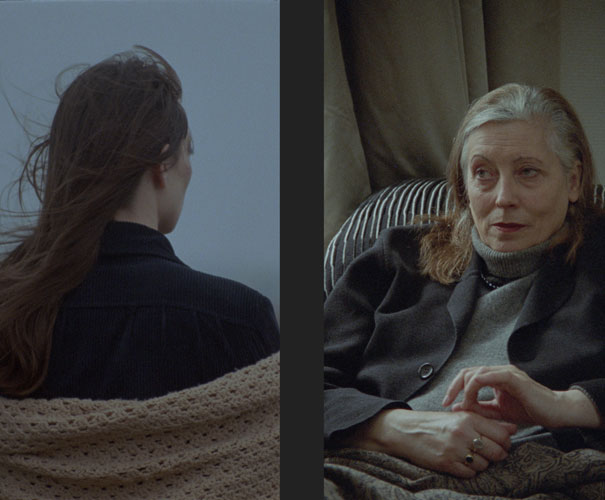
Fiona Tan - Rise and Fall, 2009 HD installation, colour, stereo, 2 vertical 16:9 screens, 2 HD projectors Image � the artist, courtesy Frith Street Gallery, London
Interview transcript Other facets of the same globe
A conversation between Fiona Tan and Saskia Bos
Saskia Bos (SB): Fiona, you told me you stopped making works that could be characterised as �post-colonial� about three years ago, after having touched on such issues for ten years or so. Many people still view your work in terms of a search for identity, of finding cultural roots, and although your recent works are not that far removed from this, the search for identity seems to have shifted towards an unravelling of memory. In A Lapse of Memory, you seem to be in pursuit of what is recollection, as it determines and influences our fleeting identity. How do you see the connection with earlier works?
Fiona Tan (FT): A Lapse of Memory was born out of a chance encounter with a highly unusual building � the Royal Pavilion in Brighton. As one of the finest examples of eastern-style architecture in the West, this building and its interior are a wonderful homage to fantasy. It was an unexpected feeling � I felt that I just had to do something with that place. My own hybrid background straddling East and West and my personal questions relating to �Chineseness� were for me personally linked to that building. It was over ten years since I had made May You Live in Interesting Times and I felt I had left �all that� � meaning my post-colonial roots/routes � behind me. But here, all of a sudden, was this building, which refused to go away. It felt like full circle, like a way of completing a sentence. Ten years later, I felt that a conclusive explanation was required of me. And I felt a need for closure. For once and for all, or so I liked to pretend, I would deal with these matters and then put them behind me. It was only after I completed the piece that I could see that in some ways the character I created to inhabit this empty building was not only a certain personification of the building itself, but also had links with me personally. Identity and memory are undeniably linked. That is the great tragedy for patients with Alzheimer�s disease or senile dementia. By losing their memory, they lose themselves and their family, and loved ones lose them too.
SB: Does the work deal more with cultural recollection as a part of collective memory than with individual memory?
FT: That I was in pursuit of cultural recollection is a nice way of putting it. Although it felt like an impossible undertaking, I was attempting to look at things on a larger scale. Not just my personal history or identity confusion. I wanted to tackle the persistent paradigms of �East� and �West�. It will not surprise you to hear that whilst I was working on the script for A Lapse of Memory I read not only Edward Said�s Orientalism , but also Ian Buruma and Avishai Margalit�s Occidentalism . I see clear connections between A Lapse of Memory and earlier works like May You Live in Interesting Times and Linnaeus� Flower Clock . Because the piece required this, I worked with an actor in front of the camera for the first time. This perhaps seems unexpected, but it grew out of a natural progression of works. For The Changeling , I worked intensely with several actresses to record the voice-over and it was this experience that made me feel that this was the right way to go. Looking back at my development, I see a steady progression, in formal terms, from initially a documentary mode of working towards an increasingly controlled and staged representation. This is a development I see continuing on into the piece I am working on now for Venice � a piece called Disorient .
SB: Your new work is inspired by the geo-strategic position Venice once had through its connections to the Middle East and Asia.
FT: I intend the piece to have a specific in-situ character � both geographically and temporally speaking. For this work, Venice is my point of departure and of return, literally and figuratively speaking. Venice was a lively and wealthy trading port in medieval times. Its wealth came mainly from goods brought back from the Middle East and Asia, which is why the city was traditionally portrayed as the bride of the sea. I have been researching the subject and have focused particularly on a book that was written over seven hundred years ago. The author was a Venetian merchant who left home at the tender age of seventeen and travelled extensively for the next twenty-five years. His name is Marco Polo. Arguably, Marco Polo undertook his epic journey twice. The second time, he journeyed through his memories � languishing in prison, recalling and remembering with as much detail and accuracy as he could muster every memorable episode from a quarter of a century of travel.
SB: The search for the self in A Lapse of Memory was a psychological journey into the construction of identity. This time you seem to be taking a more sociological approach, as you focus on Venice and how people relate to its cultural history.
FT: The tenuous relationship between sight, memory and knowledge, the unreliability of visual memories, is something I have been concentrating on in recent works. I am still exploring these ideas in this new work, as I continue to experiment and develop a filmic language that could perhaps be described as simultaneously constructing and deconstructing � employing the tricks of the trade and at the same time exposing them, laying them bare. I am interested in the juxtaposition of word and image, in conflicting and contradictory relationships between the two and between fact and fiction, in the displacement of text and image. I am also interested in the slipperiness of truth or truths and the many versions of Marco�s account. I have always tried to imagine what the world would look like without this dominating paradigm of East and West (which all too often implies East versus West), without the traditional dichotomies of dialectical thought. One of the things that bothered me about the whole multicultural/post-colonial discussion in art is that it became a discussion only about politics and political positions, particularly during the last decade of the last century. The visual side of things was too often neglected. Images (and as an artist I consider myself an image-maker), their role, their importance, their ambiguities seemed to play too minor a role. It is easier to write and talk about ideas than it is to talk and write about images, I guess. But ultimately that is what visual art is hinged on: images � whether they are three-dimensional, figurative or abstract, multi-dimensional, time-based or even invisible. I also find it ironic that my work as an artist is still pigeonholed, filed away in the post- colonial box, whilst the idea of the whole debate was to do away with such categorisations and the need to categorise at all.