|
While distinctly holding historical references, the work also engages with the contemporary discourse around manipulation, of analogue versus digital and how in turn this affects photography�s status and relationship to reality.
By permanently removing unwanted aspects of the negative with a scalpel, an irreversibility comes to the fore which is not present in current digital manipulation where one can �undo� an action repeatedly and maintain an original �master� file. It is this irreversibility and the slight idiosyncrasies caused whereby the two negatives meet and overlap that I am interested in; how the areas around the incisions flare up, leaking light and creating certain
|
|
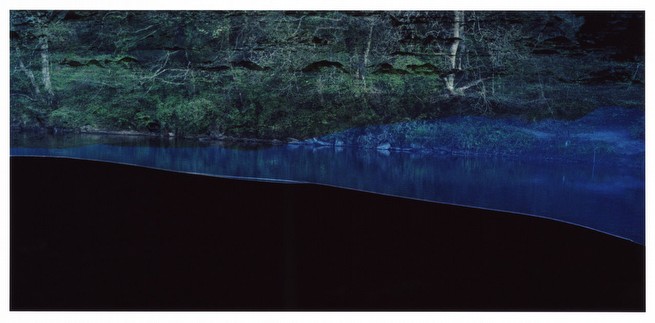
Untitled, from Constructed Landscapes, 2009
stains around the edges going beyond the frame. On a conceptual level, the violent and destructive connotations of the act of cutting and removing certain elements of a negative could be perceived as a political and environmental metaphor, referring to the destruction of land and nature.
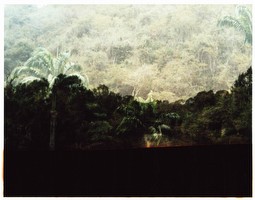
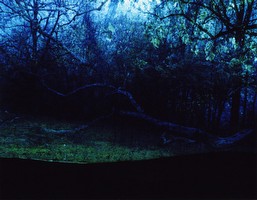
Where only one layer of negative remains, an interesting visual effect and metaphor is created. When printed, the one-layered area is transformed into a black stain. The black area becomes an obstruction and opening simultaneously. It can be read as an element of landscape in its own right such as a river or a geological cut (depending on its placement within the image), or in a more metaphorical or abstract way. Even though it is a black space that can be perceived as a void, it refers�through its absence�to what was once there or to what is actually there but hidden from view. The elements mentioned above- the black stain, idiosyncrasies and imperfections- also point to the manual intervention and provide a fitting juxtaposition to the mechanical aspect of photography.
It seems important to discuss the decision of working specifically with colour rather than B&W; film. The overlap of B&W; negatives is a familiar and traditional process whereas the overlap of colour negatives presents very particular challenges. When overlapping two colour negatives-especially when two films
|
from different manufacturers such as Kodak and Fuji, that have different tendencies, are used - an interesting conflict arises. Rather than being able to attain the �correct� filtration that is such an intrinsic part of colour printing, one ends up having to find a compromise and accepting what could be deemed as an �incorrect� colour cast.
Aside from the visual effect and air of artificiality the colour casts create, I am interested in how this need to compromise on the so-called �correct� colour filtration could be read as a political metaphor. This seems particularly relevant considering the original locations of the photographs. The subject of land is loaded in itself but even more so considering some of the recurring merged locations in Constructed Landscapes are Britain and Israel (a former British Mandate).
Even though I speak of the connotations these specific locations hold (in this case focusing on the political), so far, in the majority of the work, man-made elements have been cut out of the negatives in an attempt to �neutralise� and remove clues or connotations these elements may provide to a certain location. It is this precise contradiction and conflict, of attempting to avoid specificity versus the loaded connotations of land or place inherent in these photographs, which I find interesting and am continuing to explore further.
Untitled, from Constructed Landscapes, 2011
|