Dafna Talmor
Page 1 | 2 | 3 | Biography
|
|
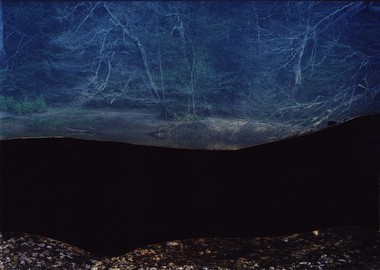
Untitled, from Constructed Landscapes, 2009
|
|
metaphorical way. Following on from my previous work, Constructed Landscapes is interested in creating a space that defies specificity, refers to the transient and to the blurring of space, memory and time.
Passing through different locations on a regular basis points to the accumulation of memories (both individual and collective). The spaces created could be anywhere, they are �real� yet virtual and imaginary; they are a conflation. One could say this conflation transforms place into space, a specific place that is initially loaded with personal meaning, memories and connotations to a space that has been emptied of subjectivity and becomes universal.
Constructed Landscapes allows me to engage the loaded histories of landscape photography. The technical aspect of the
|
|
|
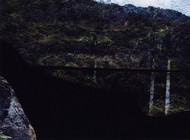
Untitled, from Constructed Landscapes, 2009
|
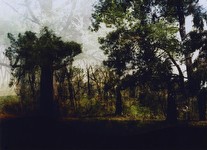
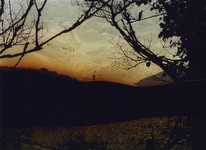
Constructed Landscapes transforms colour negatives of landscapes initially taken as mere keepsakes through the act of slicing and splicing. The resulting photographs allude to an imaginary place, idealised spaces or as Foucault states, �a virtual space that opens up behind the surface�.
The work stems from a frustration with photographing landscape, something I refer to as photographic agoraphobia. For years, my work consisted
|
|
Untitled, from Constructed Landscapes, 2012
|
|
Untitled, from Constructed Landscapes, 2011
|
|
Untitled, from Constructed Landscapes, 2012
|
|
|
of photographs taken in interior spaces, with suggestions of outside space, as seen through the ongoing body of work entitled Obstructed Views. As soon as I stepped outside with my camera, I felt overwhelmed with the possibilities and became aware of the lack of limitations (provided so neatly by an interior space).
My practice is based on an obsessive preoccupation with home. As a result of this obsession and despite my ambivalence, whenever I travelled, I found myself taking pictures of landscapes. These photographs were taken out of a purely personal need and desire to �take� a piece of that land or place with me. As the photographs were initially taken with no conceptual agenda, I felt the very loaded history of the photographic genre of landscape impeded me from finding a use or purpose for the resulting images. I therefore found myself with rolls of film I was utterly disappointed with; the negatives sat and accumulated for years in boxes, neglected of any artistic function.
I have always found limitations inspiring and so what was initially a cause of frustration and disappointment, led to the idea of merging different places of personal meaning to create idealised and utopian landscapes, of giving meaning and function to these
|
|
seemingly defunct negatives. As a result, photographs taken over several years in my country of birth (Israel), where I was raised (Venezuela), across the UK (where I currently live) and the US (where my sister resides) have formed the basis of this ongoing project.
The act of physically merging landscapes from different parts of the world refers to the transitional aspect of our contemporary world in a
|
Untitled, from Constructed Landscapes, 2009
|
work is very consciously in direct conversation with the history of photography, or more specifically with pictorialist tendencies of combination printing and the use of multiple negatives. Inevitably, this creates a link to painting and the ongoing dialogue painting and photography continue to share in terms of constructing an image and different modes of representation.
Aside from referencing early photographic manipulation, the work is in dialogue with more modern tendencies of experimental photography and film techniques such as montage, collage, multiple exposures, etc.
|
|
|
|
Click on the map to search the regions
|