
|
Espacio Minimo presents JUAN LUIS MORAZA – trabajo absoluto Archive | Information & News |
||||
|
JUAN LUIS MORAZA
trabajo absoluto From January 16th to March 5th, 2016 From January 16th to March 5th, 2016 “/> |
|||
|
||||
|
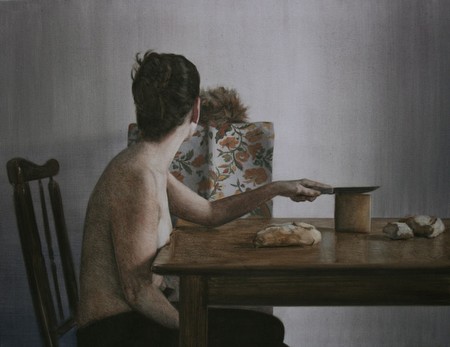
JUAN LUIS MORAZA trabajo absoluto From January 16th to March 5th, 2016 Opening: Saturday, January 16th, from 12pm onwards trabajo absoluto is the first solo exhibition of sculptor JUAN LUIS MORAZA in Espacio Minimo Gallery. It presents a development of previous series, as implejidades (2010), software (2011) or republic (2014), evoking a crossroads where the body, the subject, their tools, their relationships and their organizations, mingled their duties, losing their identity and fusing their experiences. While receiving the privilege of a non-alienated dedication, work is a pleasure for an artist. The natural industriousness of life intensifies where the need exceeds the desire. The preparation, effort, dedication, stress, concentration, planning, intensity, difficulty, sacrifice, take part of a way of being which is the consequence of doing. But if art becomes work as the protagonist, did not refer only to its own work, but through what professions, occupations and even experiences. Synonym of effort, hopes and repudiations are celebrated in work; that’s what is avoided when it afflict us and what is desperately seeking when it is lacking; it is what makes us and destroys us. Productivity dismisses the excellency of work. Today it has implemented a concept of “absolute work” applied to every aspect of our lives indistinctly: we work the emotions, our bodies, our relationships, our ways of rest, we work our image and our future. It is not the natural industriousness of the real, but the instrumental and accelerated capitalization of experience; and for each area of this hard life, there are experts, schools and companies that contribute to improve and increase our industriousness. More and more we are forced to be productive even in our rest, and we compete in a wide market where the experience is right now fully quotable. We let admitting a progressive extension of time and work space, delocalized and without timetables; but the process time is replaced by immediacy of the result; and we have learned to make our lifetime on a sacrifice without payment. If not contribute to an increase of wealth, live is considered a form of laziness. From the power we learn to delegate work; and in consumption, we train in the redistribution of wealth to their owners, as if we were just a labored missing link between the money we earn and the money we spend. But actually, industriousness, nobility of hard work, dedication, joy and caring, the love of well done work, holdthe social life more than any law. The financial economy dissolves the work, which does not mean that humanity stops working, but work remains omnipresent without any of its advantages. The exhibition consists of four complementary works: LA FIESTA COMO OFICIO. The labour day in an expanded field, is spatial, temporal, functional, with a psychological indiscernibility between work and leisure, between the joy and anguish, between what is not prohibited and what is required. In that pyre, the whole life is consumed and its consumed. (Installation.) CALENDARIO DE FIESTAS LABORALES. The labour day extends to the 366 days of the year, and each day includes an aphorism about absolute work. (Tear-off calendar and deployment of its 366 pages.) EROSIS (offices of enjoyment). What we lack is what binds us, and what we are is what is missing us. Being it is simultaneously being open and friction, eros and erosion. (Anthropometric worn figures. Plaster) NOFONDOS. The logic of the sign requires a certain contrast between figure and ground; when writing saturates the image, eliminating the background, just a blurring can work as writing. (Black chalk boards bleached) JUAN LUIS MORAZA. Sculptor. Professor at the University of Vigo. Showed exhibitions since 1980, including the last one in Reina Sofia Museum, titled “republic” (2014). His work is part of prestigious collections, both public (Guggenheim, Reina Sofia, Artium, etc.), and private (Helga de Alvear, Rona Hoffman, Dona & Howard Stone, Coca-Cola Foundation, etc.). He has curated numerous exhibitions, as “El retorno de lo imaginario” (Reina Sofía, Madrid, 2010), Incógnitas. (Guggenheim Bilbao, 2007), etc.. And he has published several books as Corduras (2007), Ornamento y Ley (2007), Las formas del límite (2006), etc; and numerous magazine articles and collaboration books. For further information or images please do not hesitate to contact the gallery Espacio Mínimo Doctor Fourquet, 17 E-28012 Madrid (Spain) Tf: 34 91 467 6156 E-mail: [email protected] http://www.espaciominimo.es |
||||
|
||||
International contemporary art
SIGN UP FOR NEWSLETTERS
 SERVICE OVERVIEW
SIGN UP for ARTIST MEMBERSHIP
SIGN UP for GALLERY MEMBERSHIP
NEWSLETTERS & ANNOUNCEMENTS
NEWSLETTER SCHEDULE
ARTIST OPPORTUNITIES
POST ARTIST OPPORTUNITY
SERVICE OVERVIEW
SIGN UP for ARTIST MEMBERSHIP
SIGN UP for GALLERY MEMBERSHIP
NEWSLETTERS & ANNOUNCEMENTS
NEWSLETTER SCHEDULE
ARTIST OPPORTUNITIES
POST ARTIST OPPORTUNITY
Click on the map to search the directory