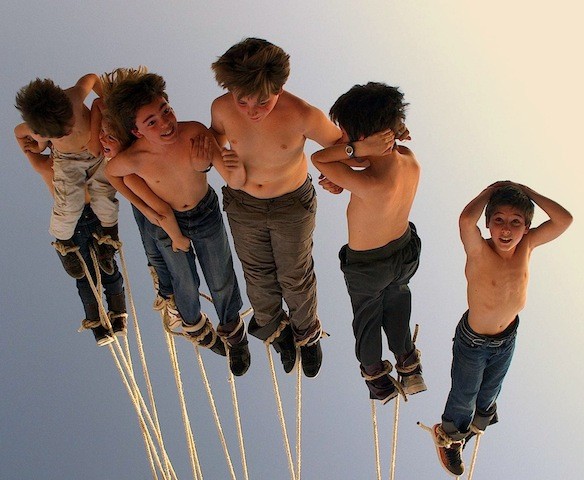
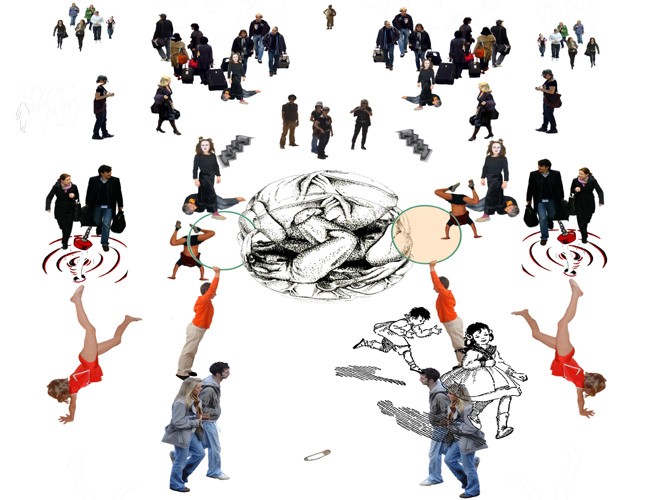
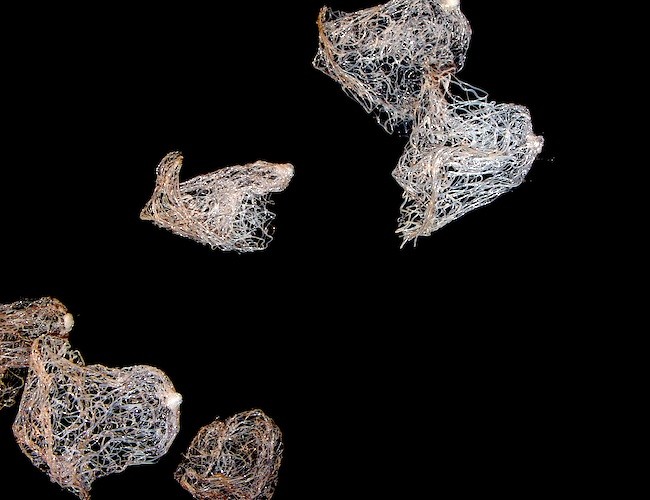
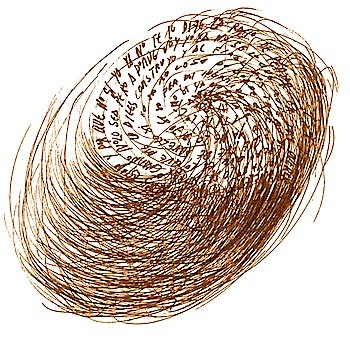
PHE10 Y CÁMARA ABIERTA 2.0: "El tiempo congelado" From Serie: invertidos, aprendiendo a relaccionarse.diendo a r Action: 100 people hanging up from their feet in different groups.
Life is full of fleeting moments that build it. This moments define with great precision, what we are, because are full of feeling, intensity and emotion. The reality is not measured with a clock, on the contrary from moments that are immortalized in our mind, heart, intestines, skin, retina, memory ...
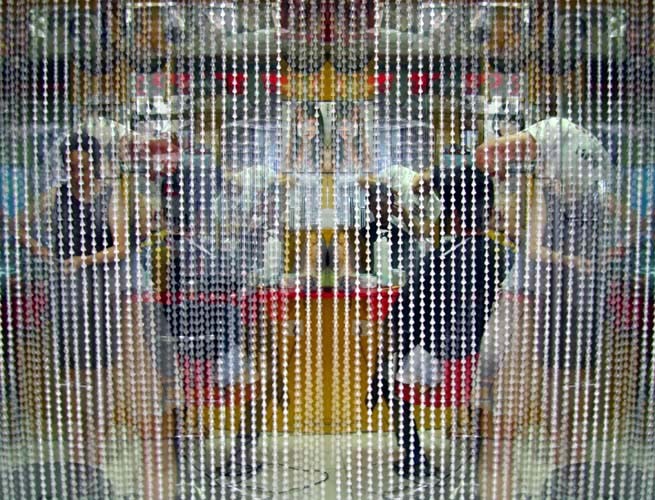
Filtered Perception. Palimpsests
All established approaches generate prejudices and limit our freedom to develop. That is why society needs to generate "curtains", in order to protect the masses from reality, it is easier to conceal reality blinding light. The problem is that those curtains make us see a biased reality, it appears strange and distant to us, a world in which we cannot find ourselves and where we feel both scared and curious.
It is important to break this curtain and to trangress worlds. It is paradoxical how we feel participants of one or other place depending on which side of the curtain we are. But we cannot avoid the contradiction of wanting to stay at our side and going on watching the reality we see although it is filtered, from our anonymity safety we want to trangress the limit and become a part of the other reality as a knowledge and understanding process.
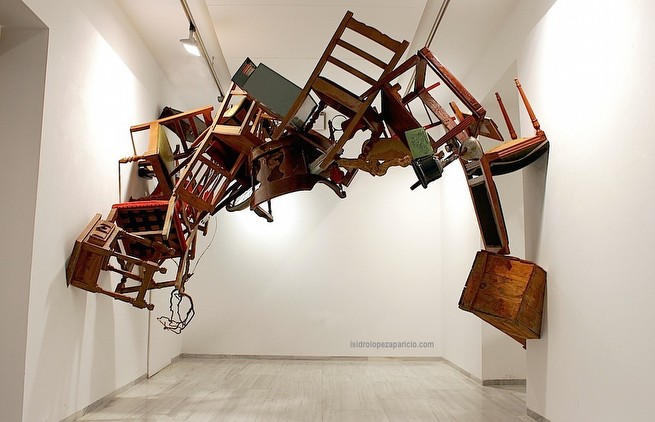
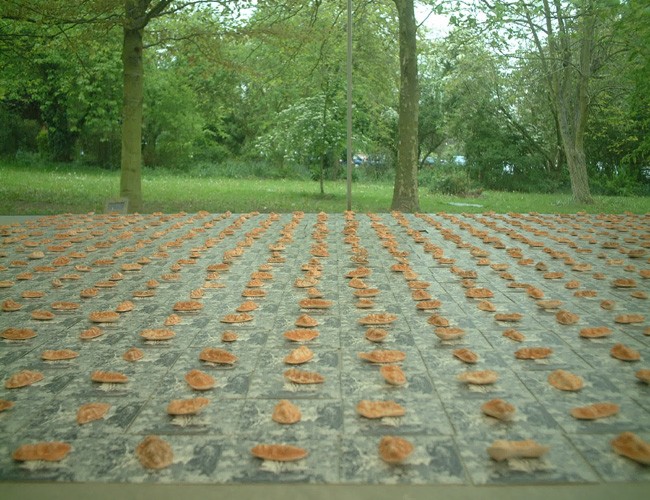
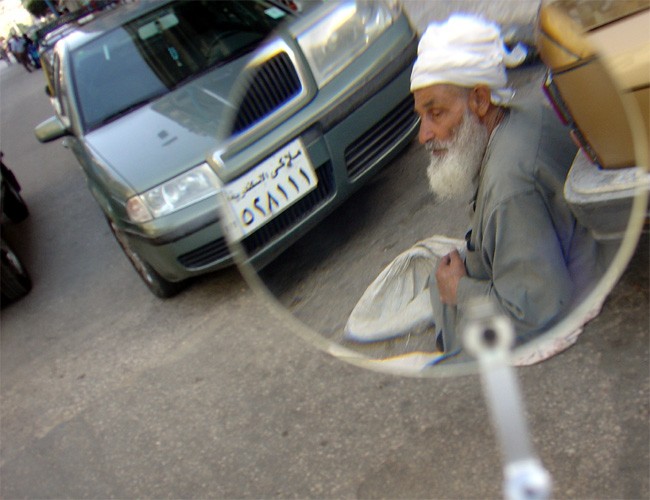
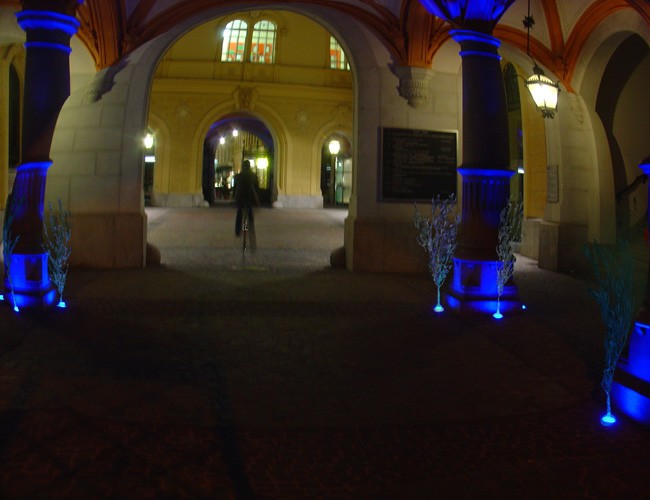
Images are superimposed like our memories and they are turned upside down in a way they create a new world. Reality, memories and oneiric live together in these works as a part of our perception of the world. The images are built with a structure of palimpsests in which some images are shown on the others, fanciful relations with present are made by persistence of memory, creating certain uncertainty in front of what is noticed and known. ........................................................... Isidro L Aparacio is an artist who deals in phenomenon, the stuff of reality, what and how we experience being in the world. From a simplistic perspective the exterior world is made of materials actions and objects while the interior world consists of images, thoughts and feelings. Aparacio explores the role of the artist in negotiating between these two worlds, the interior and the exterior, internalising and processing the exterior and conversely externalising the interior world, giving it form in the material world.
Artists in this sense deal with the translation of reality as experienced…. now there is a tricky word, ‘reality’…what is real? Perhaps that is the essential question and there in lies the deepest function of Aparacio’s practice….to test what is real and to give his informed perception of reality a form which impacts on our intellect and emotions.
We live in a partial awareness, if we were to be fully aware we would be driven mad by the overwhelming intensity and complexity of reality. In this sense normality, what we call reality, is only a social agreement which allows us to reside in the world without being overwhelmed. The intensity of the world is held at bay, filtered by reasonableness, moderation and routine and above all mediated in the contemporary world through the media of television and film. From a phenomenological perspective what we collectively perceive of reality is severely limited by the constraints and conventions of our patterns of perception, both physically and intellectually the visible and audible spectrums we perceive are only a minimal part of the whole spectrum. Our capacity for understanding is limited by our prejudices and the emotional need for security and stability.
In the face of these social preoccupations the role of the creatively open artist is often seen to be unreasonable, outlandish and in defiance of the socially agreed sense of the real. Aparacio’s practice is evidence in full of the valuable social and psychological role of the independent artist. His work documents a restless improvisation and creative play which reveals unpredictable patterns of relationships, patterns which disrupt the agreed norm and forestalls the closure of social agreement as to the real. He uses the strategy of incongruous juxtaposition, symmetry and asymmetry, displacement and re-contextualisation of the familiar. Paradoxically these methodology are employed to allow the familiar to be seen in all its full intensity and complexity, His strategy is to dislocate and re-present the world, to shock us anew with its infinite complexity and fluidity. In his seminal book ‘ The Hidden Order of Art’ Anton Ehrenzweig posits the theory that the artist reaches a level of de-differentiation, that is that they have the capacity to suspend the normative patterns of perception which differentiate one form from another, categorising the world into taxonomies, distinguishing positive from negative etc. In applying strategies that engender a state of de-differentiation there in lies the possibility of a more fluid creative and poetic relational play, that has the capacity to generate and reveal a more poetic level of understanding of relationship. To the unsympathetic eye work generated in this state of visual and conceptual openness is a descent into chaos, but in reality it is a submergence within a more complex and subtle level of order which extends beyond the social norms of familiar patterns of relationship.In this sense a serious artist resided in territory beyond the easily explicable and is only readable from a corresponding point of openness on the part of the viewer. What is easily explicable in art is never the true substance of the art form. It is the inexplicable sense of otherness and the disquiet of being confronted by a mysterious and compelling presence that is the hall mark of art of substance, transcending concept and technique it is perhaps most valuable as an affirmation of the mystery of existence itself and is not to be casually explained away.
In this sense of fluidity of relationship artists who adopt this creative strategy are often wrongly perceived to be immoral or lacking in moral boundaries. This begs the question as to the role of the artist. The artists role is not to propagandise, no matter how laudable and worthy the social outcome, rather the more purposeful role of the artist is to engender a questioning relationship and to offer the viewer the possibility to re-see or re-align their perceptions, expectations and prejudices. This is the true pleasure of Aparacio’s work that it impacts on the imagination and requires the active engagement and participation of the viewer to unravel the conundrum and complexity he presents.
Aparacio is a multi media artist, a printmaker who moves between 2D performance, time based and installation based practices. While he is sure footed in his aesthetic control of media and meticulously attentive to the visual detail, the work is always directed beyond the aesthetic. The aesthetic is a tool, a vehicle to access relationships between the world as phenomenon and the conventions of language, between the art and the viewer and inexorably to take the viewer to a point of contemplating the nature of being and the social constructs and conventions we use to organise and manage being in the world. For this reason the apparently disparate conceptual and visual forms and projects that Aparacio has engaged in, on further enquiry, coalesce into a coherent body of work, unified by the conceptual thread of a consistent and ernest level of penetrating enquiry.
His enquiry bridges the social and the aesthetic and is not afraid to use the poetic, the absurd, the contradictory or the banal. In fact he delights in the mischief and potential of the novelty of his juxtapositions. Putting one thing with another generating a third reality, prompting and activating the imagination as the bridge between apparently disconnected realities. In this sense too Aparacio has a wider purpose
isidro lopez-Aparicio
C. Maestro Moya, 9
18193 Monachil
Granada
Spain
Europe