|
Thomas Dane Gallery presents Alexandre da Cunha - Free Fall | Lari Pittman - Nocturnes Archive | Information & News |
||||
|
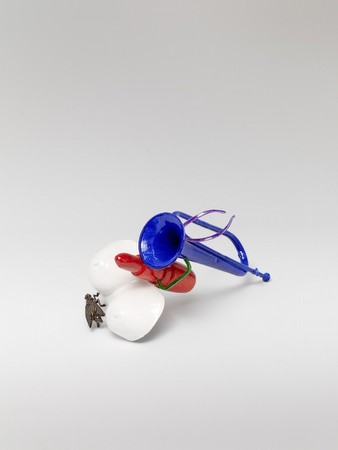
Alexandre da Cunha, Free Fall I, 2016
Image courtesy the artist and Thomas Dane Gallery, London |
|||
|
||||
|
Alexandre da Cunha: Free Fall 21 Jan - 5 Mar 2016 Private view: 20 January, 6 - 8pm Exhibition dates: 21 January - 5 March, 2016 Alexandre Da Cunha has referred to his practice not as 'making' but as 'pointing'. Pointing at existing objects, somehow, in plain sight, and highlighting or revealing new and unexpected facets or meanings within them. This approach has allowed him to unpick our preconceptions and instinctive responses to things and re-direct them into new areas of seeing and understanding, giving way to a lush potential, not only in interpreting his work, but also in everything we subsequently see in the world. Household cleaning objects suddenly conjure spiritual significance and lofty art historical precedents are echoed by hitherto mundane industrial ready-mades. Thomas Dane Gallery are delighted to present Free Fall, in which da Cunha will present a new group of monumental works that reveals the artist's innate understanding and manipulation of the language of materials and objects. On entering the gallery the viewer will be met by a large concrete sculpture. This is an appropriative motif that the artist has often worked on, using large-scale concrete civic sewer pipes. This new work disrupts this habitual tubular symmetry and presents an awkward geometric 'off-the-shelf' pre-cast element rocked on to its side, rendered unrecognisable. The second large-scale sculpture in the show: Free Fall I, made from a colourful full-size parachute draped over a segmented, tubular framework system made from flagpoles. At once a ceremonial garment, national flag or symbolic talisman, the parachute, in contrast to the concrete, is the most un-sculptural of materials, being designed to stop a free fall: aero un-dynamics. Da Cunha is examining, as in all his work, a conceptual exploitation of objects: twisting their meaning, quality and connotations: heaviness and weightlessness, the theatrical tragicomedy of the deflated parachute. Da Cunha's work is currently on display at MCA Chicago where four monumental works are being shown as part of their 'Plaza Project' exhibition series outside the front of the museum and in the lobby area. He is one of the artists included in the current touring British Art Show. He is also currently undertaking various public and private commissions both in UK and abroad. Da Cunha was born in Rio de Janeiro in 1969 and lives and works in London. He has exhibited widely throughout the Americas and Europe and is included in major collections around the world including Tate (UK) and Inhotim (BR). --- Lari Pittman: Nocturnes 6 Feb - 19 Mar 2016 Private view: 5 February, 6 - 8pm Exhibition dates: 6 February - 19 March, 2016 “I want to offer a painting that somehow the viewer has to stand in front of it and almost not believe it. But in the act of not believing it, what they’re actually seeing, they get swept away in it.” – Lari Pittman Lari Pittman’s paintings are truly like no other: hyper-flat and yet intricately layered; seemingly chaotic and yet meticulously structured; puzzling and yet rigorously codified. His works have, for over thirty years, re-invented and re-vitalised turn-of-the-20th century Symbolism, through a pictorial language that borrows with ease from such heterogeneous idioms as Pop, Rococo, Pattern-And- Decoration, Folk and Decorative Arts. And yet, Pittman’s style is more Esperanto than Patois, as he seems more drawn into creating - and conveying - a universal and self-ruled form of artistic expression than speaking introspectively. The Pittman jargon takes us into different realms every time. Four years ago, in his first show at Thomas Dane Gallery, he presented his chapter of ‘Thought-Forms’ – a lavish meditation on life and death populated by bells, mandorlas and mandalas that broached on notions of mysticism and animism. This time, he has imagined a suite of ‘Nocturnes’, as a series of paintings accompanied by a giant hand-painted book, his own contemporary revisiting of a Medieval ‘Enluminure’. The palette has been purposefully toned down to more elementary, austere, and Camaïeu-like pairings of pistachio greens and earthy yellows; silky mauves and chalky browns. And this restraint brilliantly succeeds in emphatically highlighting the background of the compositions - a uniformly dark primer with sprayed night skies, constellations and galaxies. As never before, Pittman’s paintings seem to be looking outwards to a world we clearly do not understand. Populated by robotic figures and cabalistic signs, the Cosmos-according-to-Pittman is meant to look and behave like the original, orderly and self-determined system it might once have been. The stencilled letters - part evanescent Morse-Code, part primal sound - dance around in a choreography at times derisory, and often sinister. The idea of the ‘Nocturne’, is indeed deeply romantic and inherently musical. It has resonance in the work of Debussy, Fauré, or Ravel. And in painting, we think of Whistler. It aims at locating and sketching the contours and essence of a very particular Site – a place that instigates but also receives, where yearning and melancholia crystalize and dissipate. --- For exhibitions and sales enquiries please contact Tom Dingle: [email protected] For press inquiries please contact Saskia Coombs: [email protected] Gallery Hours: Tuesday to Friday 10am-6pm, Saturday 12pm-6pm or by appointment Admission: Free Tel: +44 (0) 20 79252505 Nearest Tube: Green Park or Piccadilly Circus |
||||
|
||||
re-title.com
International contemporary art
SIGN UP FOR NEWSLETTERS

 SIGN UP for ARTIST MEMBERSHIP
SIGN UP for GALLERY MEMBERSHIP
SIGN UP for ARTIST MEMBERSHIP
SIGN UP for GALLERY MEMBERSHIP
Click on the map to search the directory