|
Drawing Room: Graphology - 10 May 2012 to 30 June 2012 Current Exhibition |
||||
|
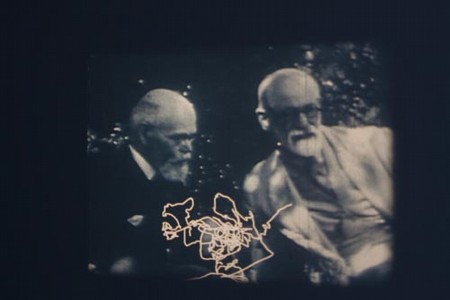
Pierre Bismuth, Following the Right Hand of Sigmund Freud 2009
16 mm Film 01:30 min, silent Courtesy Jan Mot, Brussels |
|||
|
|
||||
|
Graphology William Anastasi, Carl Andre, Fiona Banner, Anna Barham, Pierre Bismuth, Juliana Borinski, Marcel Broodthaers, Steffan Brüggemann, Tony Conrad, Sigmund Freud, Mekhitar Garabedian, Dean Hughes, Wim Janssen, Peter Kubelka, Anthony McCall, László Moholy-Nagy, Brian O’Doherty, Man Ray, Paul Sharits, Thomas Zummer Curated by Edwin Carels (KASK / HoGent) Private view Wednesday 9th May 6 – 8pm 10 May – 30 June 2012. Gallery open Tuesday - Saturday 12 – 6pm. Admission free.Saturday 16 June 2012, 2 – 6pm: Performances by Anna Barham, Pierre Bismuth and Peter Kubelka. Film screenings and book launch of Graphology: drawing from automatism and automation. Book online: www.graphology.eventbrite.com Graphology explores a genealogy of automated drawing from a contemporary perspective. The scope of the exhibition reaches back to the beginning of the 20th century and includes artists working today to question the status and impact of a trace, produced through the interaction of man and machine. Under investigation are the techniques that translate direct experience into different forms of systematised representation, between the trace and the sign, between writing and drawing. Graphology investigates the ways in which drawing intersects with typography, photography, film and computer-graphics. Automatic writing spans a long tradition, with an obvious strong moment during the heyday of Surrealism, as illustrated by the image of the typewriter on the cover of the first issue of ‘La Révolution Surréaliste’ (1924). This is typical of the range of techniques that have been employed by artists and writers to visualise their ideas, allowing for a particular tension between the hand and the medium, between automatism and automation. The term ‘graphology’ implies a strong awareness of both medium specificity and human agency. A medium mediates, it is an agent; it sets its own standard, implies its own logic, it induces its own message. But so does the eye of the beholder. The exhibition focuses on the human hand as a living seismograph of inner life, but with extra attention to the ‘mechanical unconscious of the machine’ which imposes itself on the human eye. It considers how graphic techniques of reproduction, including those of the moving image, start to live their own lives. Graphology is conceived by Edwin Carels (curator, M HKA, Antwerp and researcher in the arts KASK/Hogent). Chapters 1–4 formed a series of exhibitions at M HKA, Antwerp, Belgium, during 2011. This exhibition, chapter 5, evolved in collaboration with the Drawing Room as will chapter 6,Graphology: drawing from automatism and automation, a book that will be co-published with MER Paper Kunsthalle, Gent and M HKA, Antwerp, in June 2012. It will include images from all chapters of Graphology and essays by Edwin Carels, Ed Kr�ma and Thomas Zummer. The exhibition explores the link between drawing and typography through works that use a diverse range of methodologies, from the type-written concrete poetry works produced by Carl Andre in the 1970s to work being produced today such as Fiona Banner’s ‘Mother’, an interactive work that includes a reconstructed typewriter and a ream of paper. The work references both the roots of language and the frustrations associated with its short-comings. Dean Hughes’ plinth-based work consists of strewn staples that, variously distorted through use and in disarray, begin to resemble a cryptic language. Stefan Brüggemann’s ‘Make See’ (2009) is a work consisting of neon letters that are sprayed black each time they are exhibited, leading to the gradual obliteration of legibility. In works that range from hand-woven carpets to wall-drawings, Mekhitar Garabedian adopts his half-learned native Armenian language to collapse the distinction between legible words and image. The parallels between photography and drawing are examined through the work of Pierre Bismuth and William Anastasi. Bismuth has made a series of ‘Left Hand Tracing’ works which fuse still or moving images of famous people with furiously scribbled lines. Graphology will include the 16mm film, ‘Following the Right Hand of Sigmund Freud’ (2009) in which these scribbled lines, which follow the movements of Freud’s hand, are drawn with light, a reference to the origins of photography. William Anastasi’s ‘Pocket Drawings’, which are a continuation of the ‘Subway Drawings’ he began in 1964, are presented as a series of modular, framed scribbles that are produced in the artists’ pocket (a makeshift darkroom) as he takes a walk of a pre-determined duration. The employment of electronic mediation and of generative procedures is explored through the contemporary work of Anna Barham and Wim Janssen, alongside work produced in the 60s by the Structuralist film-maker Paul Sharits and the artist and theorist Brian O’Doherty. O’Doherty’s ‘Boxed Duchamp’, (1967-8) is part of a suite of works derived from mechanically produced ‘cardiogram drawings’ of Duchamp’s heartbeat. The durational unfolding of drawing, its linearity and capacity for rhythm, tie it inextricably to film. Anthony McCall’s ‘Pencil Duration’ (1973) is generated through the setting of a simple task. The simplicity of means (household paint applied to cheap paper) used by Tony Conrad to produce ‘Yellow Movie, 1/12-13/73’ (1973) generates a movie that unfolds imperceptibly slowly and indefinitely. The presentation of Man Ray’s ‘La retour à la raison’ (1923) as a strip of film that is displayed on a light box brings it back to its original drawn condition. |
||||
|
||||
re-title.com
International contemporary art
SIGN UP FOR NEWSLETTERS

 SIGN UP for ARTIST MEMBERSHIP
SIGN UP for GALLERY MEMBERSHIP
SIGN UP for ARTIST MEMBERSHIP
SIGN UP for GALLERY MEMBERSHIP
Click on the map to search the directory