|
MAUREEN PALEY: SARAH JONES | THE HIDDEN � group show - 19 Jan 2008 to 24 Feb 2008 Current Exhibition |
||||
|
Image: Sarah Jones
|
|||
|
||||
|
||||
|
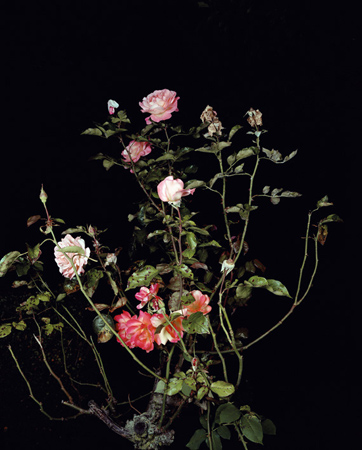
SARAH JONES 19 January � 24 February 2008 Maureen Paley is pleased to present new photographs by Sarah Jones. This exhibition follows her solo show at the National Media Museum in Bradford, on view until February 17, as recipient of the Bradford Fellowship in Photography 2006-7. This will be Sarah Jones� fourth solo show at the gallery. Photography was once referred to as �Daguerre�s Mirror�. ROSES Jones� rose displays, shot in London parks, have an inexplicable presence. Some flowers seem to be staring in our direction, although we cannot be certain. Others are certainly turning their heads away from us. This is the animism of literature. Think of Marcel Proust�s curtains, clocks, desks and especially his pink hawthorns. This is the animism of fairy-tale flowers. Recall Antoine de Saint-Exup�ry�s The Little Prince: �Good morning�, he said. It was a blossoming rose garden. �Good morning�, said the roses. The little prince gazed at them. All of them looked like his flower. �Who are you�? he asked, astounded. �We�re roses�, the roses said. Jones� roses are sometimes shot from the other side of the display, hailing Lady Hawarden�s 1862 stereoscopic photograph of her daughter�s turned-away head, framed to emphasise the loveliness of the back of her head: her coiled and braided hair. Jones gives us the other side of the looking glass: the part of the display we are not meant to see, shot from the back. I want Jones� roses to speak to me, but they are caught in a pregnant pause (and so am I). I am pricked, spellbound, waiting for something to happen, something that may never happen. In Oscar Wilde�s The Nightingale and the Rose, the self sacrificing white Nightingale promises to build the young Student a red rose out of her own body: the price is death. In tune with the illusion of Jones� rose gardens (lit to allude to the night), the act takes place at dark. Likewise, the photograph blossoms at night, like a night-blooming cereus. The night-blooming cereus blossoms only once and only at night, slowly, like the strained click of a camera shutter in the dark. With the light of the day, the night-blooming cereus fades, just like Cinderella�s carriage turns back into a pumpkin, her horses back into mice, and her beautiful gown back into wilted rags. Similarly, George MacDonald�s fairy tale, The Day Boy and the Night Girl, which tells the story of Photogen (a boy who would know no darkness) and Nycteris (a girl who would know no light) is also a trope for the essence of photography and its relationship to flowers. When Photogen and Nycteris find themselves in a garden at night, under the moonlight, they are confused by the flowers they see. Nycteris had never seen an open daisy and Photogen had never seen a closed one. BLUE FLOWER One of Jones� roses Wild Rose: Blue Flower (I), 2007, is a particularly wild rose, full of thorns, no flowers to be seen, taken at the end of the season (suggesting the end of Briar Rose�s 100-year spell). This garden rose stands apart from the others: it was taken in Nycteris black and Photogen white. Silvery, Jones� Blue Flower is the colour of a mirror, hailing photography�s connection to Daguerre�s Mirror and to alchemy and precious metals. As Roland Barthes writes in Camera Lucida, Photography is �the loved body�immortalized by the mediation of a precious metal, silver (monument and luxury): to which we might add the notion that this metal, like all the metals of Alchemy, is alive�.) COUCHED: WAITING TO TRAVEL Waiting on the analyst�s couch is �to be moved from one place to another�. (On Translating a Person, Adam Phillips). At the beginning of analysis. Freud would send his patients travelling (on the couch): �say whatever goes through your mind. Act as though�you were a traveller sitting next to the window of a railway carriage and describing to someone inside the changing views which you see outside.� (On Beginning the Treatment) Jones� colony couches take me to abstract places of intense blue colours. I look at them and hear bluebell sounds. I hear �the prose of a shade of blue.� (On Being Blue, William Gass) Violets are blue. Roses are red. I find myself on Jones� gorgeous, impossibly red consulting room couch; Analyst (Couch) (I), 2007. This one a real analyst�s couch, from an analyst�s office in London. Carol Mavor, Professor of Art History and Visual Studies at the University of Manchester extracts from The Photography of Sarah Jones in the National Media Museum publication archive no. 10. October 2007 Sarah Jones has had recent solo exhibitions at the National Media Museum in Bradford and Anton Kern in New York. In 2007 her work was included in Northern Lights: Reflecting with Images in Modena, The 7th Internationale Foto Triennale, in Esslingen, and Garden Eden, The Garden in Art Since 1900 at the Kunsthalle Emden. She will also be included in the forthcoming exhibition Street & Studio: An Urban History of Photography at Tate Modern. special thanks to METRO IMAGING THE HIDDEN - group show including SEAN DACK, GRAHAM DURWARD, DICK EVANS, LARS LAUMANN, DAVID RATCLIFF, DASH SNOW 19 January � 24 February 2008 Maureen Paley is pleased to present The Hidden, a group exhibition including work by Sean Dack, Graham Durward, Dick Evans, Lars Laumann, David Ratcliff and Dash Snow. We are drawn to the shadow. That which is hidden can be more compelling than that which is known. SABI includes the notions: ancient, respectable, antique, mature, melancholic, lonely subdued, seasoned etc. But Sabi also implies a feeling for the transitory nature of things�which are beautiful precisely because they are fleeting. WABI includes the notions: simple, lonely, melancholy, quiet, desolate, impoverished and unpretentious. It is the subjective impression evoked by a picture representing a lonely fisherman�s shack buffeted by a storm on a grey winter day. It presents an undefined mournful impression that is filled with the enjoyment of the magic contained in the most simple things. Wabi is a feeling the simplicity and naturalness of things. Together sabi and wabi convey an impression of quiet serenity. YUGEN includes the notions: dark, obscure, mysterious, uncertain, profound, subtle. It is a subjective picture, for example, the moon shining behind a veil of clouds or a mountain hidden by the morning mist. W.B. aesthetic concepts, Suiseki, 1969/ 2000 Sean Dack is represented by Daniel Reich Gallery in New York and David Kordansky Gallery in Los Angeles. His work was included in Uncertain States of America which toured widely internationally including the Serpentine Gallery in London. Graham Durward is originally from Scotland and now living and working in New York where he had a solo exhibition in a White Room at White Columns in 2007. This will be Dick Evans� third show at Maureen Paley following his inclusion in the group exhibition The Black Album in 2004, and his solo exhibition in 2006. Evans is currently working on a curatorial project for Foxy Productions in New York, as well as a forthcoming group show at September Gallery in Berlin. The video by Norwegian artist Lars Laumann included in The Hidden, Morrissey Foretelling the Death of Diana, was also shown at White Columns in New York and then selected for East International 2007 by Matthew Higgs and Marc Camille Chaimowicz. David Ratcliff has had recent solo exhibitions at Tomio Koyama Gallery in Toyko and at Team Gallery who he shows with in New York. The New York based artist Dash Snow is represented by Rivington Arms and has had recent solo shows at Contemporary Fine Arts in Berlin and Peres Projects in Los Angeles. He was also included in USA Today at the Saatchi Gallery in 2006 and in a group exhibition at the Ellipse Foundation in Portugal, curated by Andrew Renton. |
||||
re-title.com
International contemporary art
SIGN UP FOR NEWSLETTERS

 SIGN UP for ARTIST MEMBERSHIP
SIGN UP for GALLERY MEMBERSHIP
SIGN UP for ARTIST MEMBERSHIP
SIGN UP for GALLERY MEMBERSHIP
Click on the map to search the directory