
|
Gavin Brown’s enterprise: Nick Relph – 3 Mar 2010 to 4 Apr 2010 Current Exhibition |
||||
|
|
|||
|
||||
|
||||
|
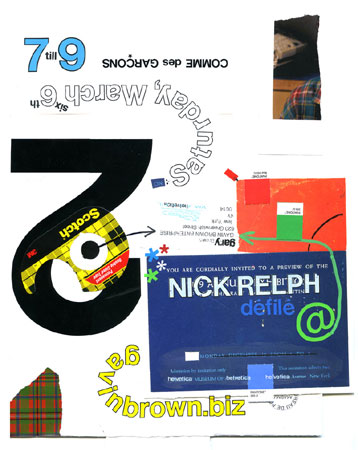
NICK RELPH March 6 – April 3, 2010 Opening March 6, 7-9PM Gavin Brown’s enterprise is pleased to present the first solo exhibition of Nick Relph. The show comprises video, collage, and works on paper. Since 2000 Nick Relph has made work with his collaborator Oliver Payne. Their solo exhibitions together include Kunsthalle Zurich (2004); Serpentine Gallery, London (2005); and Confort Moderne, Poitiers (2008). In 2003 they were awarded the Golden Lion at the Venice Biennale, and their work is included in the collections of Centre Georges Pompidou, Paris; Tate, London; and the Museum of Modern Art, New York among others. For more information contact Parinaz Mogadassi. http://www.gavinbrown.biz/files/file_upload/NR.GBE-10.pdf A LIST OF INCORRECT THINGS The leaves of the subtropical shrub Indiofera Tinctoria when carefully harvested, soaked and fermented produce the dye Indigo. India was the first country to cultivate the plant and master the labor-intensive process that resulted in textiles dyed with a blue color so deep it almost reaches into black. The richness and depth of the color seem commensurate with the effort exerted in its production. This quality of color proved extremely desirable and India supplied the powdered dye to the Greco-Roman world and the Middle East. After shipping routes to India were successfully established by the Portuguese in the late 15th century, trade began with other colonial powers, among them Great Britain and France. The British presence was represented by a group of merchants who, having been granted a Royal Charter by Queen Elizabeth I, arrived under the auspices of the East India Trading Company. The company began importing silk, tea, spices and indigo back to Britain which embraced the rare blue in a rush of exoticism and power. The demand was such that European colonial powers, using slave labor, expanded Indigo plantations beyond India and into other territories with suitable climates, the Spanish in Central America, the French in Haiti and Louisiana, and the English in Jamaica and South Carolina. Concurrently, Spain was exporting a red dye from Mexico that was similarly popular in Europe, which had failed to produce a red that was stable and bright. Made from the dried and crushed insects of the same name, Cochineal (aka Carmine) produces a vivid red that would have seemed especially seductive in Europe owing to the relative scarcity of the color. Because of this and the cost of harvesting tens of thousands of insects for a tiny amount of dye, wearing a true red became a marker of wealth and status. Whilst true in civilian life this distinction was also codified within the British Army itself, where someone of a higher rank such as an officer, would wear a jacket dyed with cochineal, whereas the majority of soldiers wore jackets using the dye of the madder root. Furthermore, indigo would come to be used for naval uniforms and is likely the root of the color now known as navy blue. It follows that both of these prized dyes would be put to use for the flag of Great Britain, the Union Jack. The Union Flag and, prior to the Acts of Union, the St Georgeʼs cross, also featured within the canton of the East India flag together with alternating red and white stripes across the length. The company flag is identical to the Grand Union Flag, the precursor of the American flag, and it seems reasonable and fitting to assume that this served as the model for the Stars and Stripes. Perhaps in the light of the competition spurred by the European discovery of Indigo, Spain made every effort to keep the source of Cochineal a secret. This worked for the time, in part because of the structure of the economy and how information was exchanged. The guild system worked by controlling and protecting the skills and knowledge particular to a craft in order to ensure a measured ascent from apprentice to master craftsman and to maintain a monopoly within the region it operated in. The dyers guild kept the origin of the brilliant red to themselves and anyone who might do otherwise was threatened with death. But by the eighteenth century developments in technology had given rise to an increasing number of people interested in studying the world via scientific means who actively encouraged and engaged in the exchange of information, and many members of this scientific class were intent on understanding just what the origin of cochineal was and how its unique properties of color came to be. One of these men of science, the Scottish Physicist James Clerk Maxwell, was interested less in the qualities of a particular dyestuff than in the way in which we perceive that color information. The groundwork for Maxwellʼs work in optics was based on the trichromatic theory proposed by Young-Helmholtz which suggested the human eye contained three types of sensors that were each receptive to different parts of the spectrum of visible light. These photoreceptors are most manipulated by wavelengths that are perceived in the brain as red-orange, green and blue-violet, which when mixed create white light. This blending of colored light to produce secondary colors and white is called the additive color model (as opposed to subtractive color in which colors are combined to create black). Maxwell demonstrated these principles in an 1861 lecture at the Royal Institute in London. He did this by taking three black and white photographs of a tartan ribbon, each time with either a red, green or blue filter placed in front of the lens. At the lecture these black and white slides were projected through the same filters again which, once properly aligned, combined to form an image of the tartan in full color. The Royal Institute lecture was an unintentional advance in what was by then a decade long saga of various attempts at documenting, and sometimes constructing, a history of tartan and leaving an accurate color record of the woven patterns, or setts. Originally a cottage industry, tartan would have been made by a weaver who would supply their i mmediate locale with whatever they were making at the time. With the onset of the industrial revolution mills were producing large amounts of tartans in an array of patterns and colors and needed a system of classification to order to differentiate them all. The largest tartan manufacturer of the 19th century, Wilsonʼs of Bannockburn, initially simply assigned a number but gradually began the practice of naming tartan for no other reason than to evoke famous events, areas or names. This coincided with a burgeoning romantic revival of highland culture that was in part spearheaded by the Highland Society of London, a group who encouraged clan chiefs to send them their ʻclan tartanʼ in a misguided attempt to conserve a clan-tartan system that had never actually existed but which was now perceived to be under threat. Clan chiefs, having no idea what a clan tartan actually was, nonetheless responded to these requests either by writing to a supplier such as Wilsonʼs or choosing one from the many differing opinions offered by members of the clan. Either way the result was confusion, and coupled with the visit of George IV to Scotland in 1822 for which Walter Scott encouraged people to don traditional highland wear, a tartan fad ensued among those hungry for history, or the illusion of it. Wilsonʼs records hold a letter from a vendor that reads ʻPlease send me a piece of Rose tartan, and if there isnʼt one, please send a different pattern and call it Rose.ʼ Enter John Sobieski Stuart and Charles Edward Stuart, two reportingly dashing brothers who were rumored to be the grandsons of Bonnie Prince Charlie and managed to charm their way into Scottish society with tales of their colorful history and their claiming to own a manuscript dating back to the 16th century which documented over seventy clan tartans. They eventually published a version of this manuscript in a small edition entitled the Vestiarium Scoticum, illustrated using a curious method called Mauchline machine painting. The technique used a variant on the pantograph, a device that uses a number of arms to copy the movement of a line being traced and mechanically reproduce the line either to scale or enlarged. The Mauchline system had modified this process to layer strips of color in an effective mimicry of the warp and weft and in so doing developed a lucrative business in tartan branded souvenirs. Recent Study has revealed the book to be an elaborate hoax and most of the tartans contained within are thought to have not existed prior to its publication. But many of these tartans had already been accepted as ʻofficialʼ clan tartans and put into production and eventually sold to a public eager for sartorial authenticity. Another book published during the same period, The Clans of the Scottish Highlands, laid the ground for more confusion albeit unintentional. The technique used in the lavish, fantastical illustrations of clansman looking wistfully over the moors or engaging in swordfights was a black and white lithograph that was then hand painted. This, along with the fading of some inks over time resulted in variations in color accuracy in each copy of a book that would be used as a reference for historians and weavers alike. Despite the faltering attempts of these publications, the mills themselves were able to standardize and expand their range of colors thanks to the nascent chemical dye industry, pioneered by William Henry Perkins discovery of the dye mauve created using coal tar, a byproduct from gas light technology. This innovation sparked off fierce competition within the chemical business that developed, manufactured and marketed synthesized dyestuffs that were increasingly colorfast and increasingly cheap. This was the emergence of corporate color. In addition to the wealth of new shades that emerged on the market, scientists also managed to replicate exactly the chemical structure of natural dyes. In 1868 two German chemists working for BASF learned how to synthesize Alizarin, a pigment present in madder dye. This, and later the discovery of synthetic indigo, virtually destroyed the market for natural dye and cemented Germany as the market leader (BASF is now the largest chemical company in the world). On the cusp of the nineteenth century, nearly forty years after Maxwellʼs key lecture, the world of color photography was full of competing color techniques. Along with the Lumiere Brotherʼs Autochrome other methods used colored screens in differently configured patterns, some of which resemble the Bayer mosaic of colored filters layered atop photosensors and found in nearly all commercial digital cameras today. The new world of motion pictures initially worked with color in two ways – the first came from experiments with painting directly onto the print and evolved into the stencil method belonging to the Pathe film company. This involved a series of stencils, each one for a given color, that were cut out frame by frame to allow for the color to be applied. Up to seven colors would be layered onto the print which once projected conveyed an impression of color. Using aniline tints, a compound distilled from Indigo that had been essential in the creation of synthetic dye, a 600 strong mostly female workforce colored films such as La Creation du Petit Monde and Le Lis du Japon in a half mechanized half labor-intensive operation reminiscent of the garment trade. Around the same time a system called Kinemacolor emerged in the UK that utilized a spinning wheel sat behind the lens that was fitted with red, green and blue filters. Each black and white frame recorded one of the color values dictated by the filter, and the developed print would then be projected through the same spinning wheel again, each frame in synch with its appropriate color. The film passed through the projector at three times the normal speed, in order for the rapid succession of red green and blue images to be read by the brains of the audience as a naturally moving, full color scene. This resulted in parallaxed image with a disturbing flicker that was almost painful to watch, and the system was modified to use just an orange-red and bluish-green, which together could convey an approximation of the now absent blue. A further impediment was that at the time film stock was only sensitive to the blue and green range of the color spectrum, and to make a wholly panchromatic stock the unexposed film had to be bathed in a series of chemical dyes imported from Germany. Kinemacolor was co-devised by George Albert Smith who had previously found success as a mesmerist performing in the music halls of London and the South East. In one of his acts, Smith would pretend to relay information about various objects (volunteered by the audience) using his mind alone. Smith called his act a demonstration of ʻsecond sightʼ. In 1909 Smith announced the first public screening of Kinemacolor films with the subheading ʻAnimated Scenes and Moving Objects Bioscoped in the Actual Tints of Natureʼ. Many of the programs films such as ʻView of Brighton Frontʼ, ʻRiviera Coast Scenesʼ and ʻWater Carnival at Villefrancheʼ were filmed at tourist spots across the UK and abroad to complement the feeling of transformation and wonder at seeing moving color film for the first time. In his travels Smith visited Scotland where he shot ʻTartans of the Scottish Clansʼ as a test of the color reproducing capabilities of the two-filter camera. Filmed in one continuous take the film shows tartan in full frame together with their corresponding clan names. Although we cannot see the blue of the Gordon tartan it registers in the mind the same way as when we see the word blue. After a few seconds the piece of tartan is slowly removed by an unseen hand to reveal a new tartan beneath, a succession of colored fabrics evocative of Kenneth Angerʼs ʻPuce Momentʼ. |
||||
International contemporary art
SIGN UP FOR NEWSLETTERS
 SERVICE OVERVIEW
SIGN UP for ARTIST MEMBERSHIP
SIGN UP for GALLERY MEMBERSHIP
NEWSLETTERS & ANNOUNCEMENTS
NEWSLETTER SCHEDULE
ARTIST OPPORTUNITIES
POST ARTIST OPPORTUNITY
SERVICE OVERVIEW
SIGN UP for ARTIST MEMBERSHIP
SIGN UP for GALLERY MEMBERSHIP
NEWSLETTERS & ANNOUNCEMENTS
NEWSLETTER SCHEDULE
ARTIST OPPORTUNITIES
POST ARTIST OPPORTUNITY
Click on the map to search the directory