|
B21 Gallery: REZA ARAMESH : BETWEEN THE EYE AND THE OBJECT FALLS A SHADOW... - 14 Apr 2009 to 7 May 2009 Current Exhibition |
||||
|
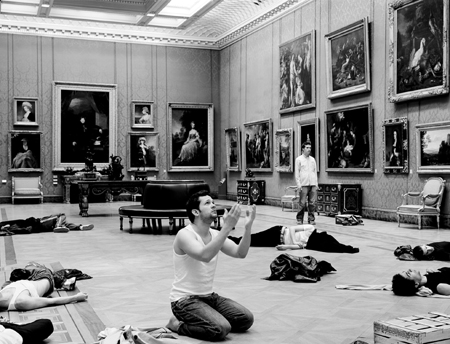
REZA ARAMESH, Action 44. Baghdad September 10 2004.
B & W silver gelatin print 124 x 157 cm, ed. of 3, 2008 |
|||
|
||||
|
||||
|
REZA ARAMESH BETWEEN THE EYE AND THE OBJECT FALLS A SHADOW... 14 April � 07 May, 2009 Private view: Monday, 13 May, 7.30 � 9.30 PM Conflict is the material from which Reza Aramesh crafts his work. Such conflict may reside in social rejection or alienation, in the uncomprehending meeting of cultures, in the affirmation of discordant stereotypes, in the imposition of gender roles, in recourse to armed violence. Aramesh�s work is not autobiographical by intention or in fact, nor does it provide a visual history of conflict. Rather, his pieces draw on recent history, as reported by the media and filtered through an individual sensibility, to make palpable the tensions, contradictions and overt or implicit violence that are ubiquitous in the world of the early twenty-first century. Aramesh was born in Iran and is working in London. After studying Chemistry he obtained a Masters Degree in Fine Art at Goldsmith�s College, London, first turning his attention to painting and text pieces. Since 2001 he is engaged in a series of works which he refers to as Actions. He sets up scenarios or devises events that may or may not be witnessed by audiences, and which in all cases survive as still photographs or multi-screen video projections. The current exhibition is devoted to Aramesh�s most recent series of works, begun in 2008 and collectively bearing a title Between the eye and the object falls a shadow�. Western art history provides the point of departure as Aramesh comprehends these photographic works as an extension of the Disasters of War by Francisco de Goya created in the 1810s. Goya�s aquatint prints form a caesura in the history of the depiction of war. In some of his most extreme sheets, Goya creates compositions from mutilated bodies and body parts more akin to the animal carcasses in seventeenth-century still life painting than to the explorations of the narrative and pictorial potential of warfare as they are common in the history of art. The photographic tableaux created by Aramesh are akin to Goya�s sheets in that specific narrative content is drained from them, but they differ from most of Goya�s prints in minimizing references to motion being performed, violence being perpetrated as we look. There are no weapons, nor are there any instruments of torture or confinement. We do not witness aggression, we observe characters frozen in their respective gestures, of oppressor, of oppressed, by situations of conflict. His photographs display a stillness commonly associated with still life painting. Aramesh�s scenarios are staged indoors, in homes ranging from affluent modern apartments to lavish historical mansions. The suggestion that wealth and financial interests are fundamentally intertwined with warfare is thus a common feature of all works of this series. His photographs are based on imagery provided by news agencies, sourced from daily papers and the internet. Each photograph bears as its individual title the caption of its photographic source, from which the artist choose some figures and make some compositional decisions. Nonetheless the image appears subtly but significantly transformed, first and foremost by the lavish setting. Furthermore, the characters, of different ages in the source image, are now young men of approximately the same age. All participants wear casual street clothing which, in the case of the two �guards�, replaces their uniforms. None of the �guards� holds a gun, and the �captives� are no longer blindfolded, creating a tension between the words of the title and the image. Whilst the positions of the �guards� show few modifications, all the �prisoners� in the final version are given more erect postures, imbuing their act of submission with energy and urgency. Reza Aramesh�s work has had solo exhibitions in London�s Platform Gallery (2002), Lawrence O�Hana Gallery (2004), Mathew Bown Gallery (2007), Zoo Art Fair (2008). His group shows include �Into Position� in Vienna and �Metropolis Rise� in Beijing (2006), �Making a Scene� in Haifa Museum of Art in Israel (2006), �The Politics of Fear� at the Albion Gallery, London (2007), and the �Best of Discoveries� at ShContemprary 08. Adapted from catalogue introduction by Thomas Frangenberg (art historian) For general enquiries, hi-res images, artist complete CV or an interview please contact Tessa by phone 04 340 39 65 or 050 5025778/ by email tessa @ b21gallery.com About B21 Gallery B21 Gallery opened its doors in November 2005 and is located in a warehouse in Al Quoz, an industrial area near the centre of Dubai. Since then, the gallery has showcased more than 25 exhibitions, all emphasizing the importance of risk-taking in contemporary art and challenging its visitors and collectors to unfamiliar terrain. Focusing on the emergent and innovative artists of the Middle Eastern region, B21�s primary goal is to discover the future rising talent. As a nexus of such artistic development, B21 Gallery continues to provide unique opportunities for collectors. Al Quoz 1, near The Courtyard, opposite Spinneys warehouse. Sat-Thu 10am-7pm; Fri closed. Our exhibitions are supported by Ruinart |
||||
re-title.com
International contemporary art
SIGN UP FOR NEWSLETTERS

 SIGN UP for ARTIST MEMBERSHIP
SIGN UP for GALLERY MEMBERSHIP
SIGN UP for ARTIST MEMBERSHIP
SIGN UP for GALLERY MEMBERSHIP
Click on the map to search the directory