|
Gallery Isabelle Van Den Eynde: FARSHID MALEKI - He Who Came and Disappeared - 16 May 2011 to 20 June 2011 Current Exhibition |
||||
|
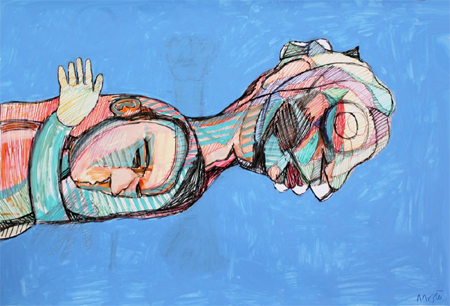
Farshid Maleki, Untitled (L10-10)
Magic marker and acrylic on paper 100 x 145 cm, 2010 |
|||
|
||||
|
||||
|
FARSHID MALEKI He Who Came and Disappeared May 16 � June 20, 2011 Gallery IVDE is proud to present 'He Who Came and Disappeared', a new exhibition of work by Tehran painter, art professor and pioneer, Farshid Maleki in a show running between May 12 � June 09, 2011. An artist with over 30 years professional practice, as well as an illustrious teaching career in Tehran's art schools, Maleki's influence on successive waves of contemporary Iranian artists is irrefutable. He has exhibited across Iran and today, remains an inspiration and mentor to countless artists, working successfully worldwide. Maleki's teaching style echoes his own approach to art � eschewing clich� and predictability and instead, employing rapid, deceptively simple techniques to capture and articulate the very complex essence of the artist's soul. The resulting rawness is pure, unadulterated and brutally honest. Inspired by the characters and situations he encounters in his daily life, Maleki's works are executed in vivid outbursts, driven by a spontaneous urgency and creative energy. Figures, loosely based on family, friends or acquaintances, are distorted and twisted within tableaux that question and challenge relationships and social dynamics. These echo the artist's own personal perceptions of his world, yet through his mercurial creative process, Maleki manages to evoke an internal rhythm and structure, in which perspectives and placements assume a key narrative role. Intrinsic to the structure of a Maleki, artwork, lies the artists' own personal journey. Gripped by a unrelenting momentum, Maliki approaches his canvases without a clear, defined end in sight. Compositions grow from a starting point, shifting, evolving and repositioning through the rapid execution� in an ever-evolving parade, of warped, expressive figures. Describing his fluid, intense practice, Maleki draws parallels to the ever-shifting circle of friends, family and acquaintances that flit through his own social sphere. 'People come and go,' he comments. 'Now they're here, now they're not. In general, I depict the chaos in my own mind'. Maleki's radical style is not defined by content but by the ritualistic gesture of drawing itself. The overlapping of hundreds lines and colours of magic markers shape characters in states of perpetual metamorphosis, originating from the artist's own mythology. Vast and plain colored spaces are rudely thwarted by complicated networks and graffiti-like textures that eventually reveals defiant and distorted forms. Through these themes � omnipresent in his work � Maleki's oeuvre describes a reality whose central preoccupation is of the man's relationship to the world. FARSHID MALEKI (No) Improvisation June 22 � July 23, 2009 The faculties of imagination and emotion are more important to Maleki than that of mere sight. Maleki's radical style is not defined by content but by the ritualistic act of drawing itself, as if urgently executed in a continuous fit of impulsive scribble. This seemingly unedited free flowing spontaneous style is just like the thought process, delving into a subconscious memory that taps into primal and daily issues. The result is a world of imagination, where colours and shapes hint at recognizable forms but spin off into wild abstractions of line and layering, eluding definition. From the hand of a man well into his sixties, the drawings are characterized by simplified, irregular shapes rendered in a vivid array of magic markers, lending a sense of instability but instilling a palpable vitality. Fresh and agile, these graffiti-filled frames with funky black and magical colours pull one's attention inwards towards a storm of colour and form. The first impression is of an abstract, scribbled chaos of stripped forms. Discs, circles and concentric circles creating apertures and grids mix with various visual incongruities whilst hands and feet are obsessively represented in all the works. At second glance, human and animal figures depicted in a primitive primal state emerge from the field of lines and shapes, and leave imprints as an echo of the central subject. Through his shapes and their mutations, Maleki delivers a conception of form that is bound to 'gesture'. The relationship between form and gesture fuse and make each shape the result of a sudden eruption. Then, it is the 'interaction' between the components and the energy they release that obsess Maleki. In his tiny studio hardly allowing him to step back from his works, Maleki explains that what he aims to reach is a suitable dialogue (his exact words) between the personages, forms and the colours. Through these themes � omnipresent in his work � Maleki's oeuvre describes a reality whose central preoccupation is a man's relationship with the world. GALLERY ISABELLE VAN DEN EYNDE Al Quoz 1, street 8, Al Serkal Av. # 17, Po. Box 18217 Dubai, UAE T: + 97 1 (0)4 323 5052 E info @ ivde.net |
||||
re-title.com
International contemporary art
SIGN UP FOR NEWSLETTERS

 SIGN UP for ARTIST MEMBERSHIP
SIGN UP for GALLERY MEMBERSHIP
SIGN UP for ARTIST MEMBERSHIP
SIGN UP for GALLERY MEMBERSHIP
Click on the map to search the directory