|
Galerie Rupert Pfab: Katharina Fritsch / Alexej Koschkarow - 7 Sept 2012 to 3 Nov 2012 Current Exhibition |
||||
|
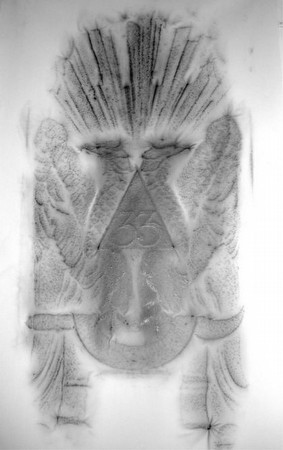
Alexej Koschkarow, Pavian, 2012
Smearing (Graphit/Stoff) 73 x 82 cm |
|||
|
||||
|
Katharina Fritsch / Alexej Koschkarow September 07, 2012 - November 03, 2012 In 1999, Katharina Fritsch and Alexej Koschkarow presented their works together for the first time in the exhibition Damenwahl (Ladies’ Choice) in the Kunsthalle Düsseldorf. For the current exhibition in the Galerie Rupert Pfab, these two internationally renowned artists have once again conceived a joint presentation. Both artists are presenting sculptures and works on paper, which explore the theme of historical, semi-public and private memory. For their works, they make use of generally accessible motifs and thus address the issue of collective memory. Katharina Fritsch was born in 1956 in Essen and studied under Fritz Schwegler from 1977 through 1984 at the Academy of Art in Düsseldorf. Since 2010, she is professor for sculpture at the Academy in Düsseldorf. She gained international acclaim with her iconic, life-sized sculptures. The artist generates memorable images, which, although they can be understood by everyone, are not completely understandable at first glance, since there is always at least one level of meaning in addition to the most obvious one. As a result of the monochrome coloration, the sculptures are reduced to mere form. The colour serves as a bearer of mood and emotion and functions as a metaphor for particular characteristics. The artist finds her motifs in images from the consumer world, as well as in allusions to dreams and myths. Here, she makes use of mental pictures that are fixated in the subconscious, such as, for example, the idea of childhood. In the exhibition, Katharina Fritsch presents a sculptural still life with a skeleton hand, a mussel and the bust of a girl. The objects are fragments of memories, as well as being decorative objects of a generation which is dying out. The hands were part of a petty bourgeois German „family altar“. The skeleton hands also refer back, however, to the famous drawing of praying hands by Albrecht Dürer from circa 1508. The mussel on the commode could also be found in numerous German households, either as a small present from a grandchild or as a souvenir from a vacation on the seashore. The bust of the young woman is inspired by a sculpture from the farm of relatives, whom Katharina Fritsch often visited as a child. By reducing the sculpture to merely the bust, it becomes an autonomous work, which, taken out of its original context, merely suggests its historical character. The bust points to the biographical and, at the same time, serves as a reference to the unknown sculptor who created the original artefact. In addition to the still life, the artist is also presenting four silkscreen prints from the series Nachttisch (Bedside Table) from 2009, which are presented together on the wall as a block. The prints depict motifs appropriated from the walls of the artist’s own children’s room. The silkscreen print 11. Postkarte (Essen) [11th Postcard (Essen)] from 2006 connects the sculpture with the wall piece. With her “Postcards” series, the artist appropriates existing picture postcards. She strips the ready-made motifs of their colours and prints them as enlargements on thin plastic in one monochrome colour or, in some cases, limited to only a few colours. The motif thus becomes a picture. The work on view in the exhibition depicts the artist’s hometown and thus represents her private-historical approach to abstract points of reference such as the concept of “place of origin”. The sculptor Alexej Koschkarow (born in 1972 in Minsk) also studied under Fritz Schwegler in Düsseldorf, from 1993 through 1999. He now lives and works in New York. Schtetl, 2012, is the first sculpture that he created there. The work is the model of an ideal city, in which people feel „at home“. Small houses are concentrated around the central town square, quite in contrast to the planned, gridded city of New York. In the centre of the flat sculpture is a tree stump, in the middle of which an iron axe is stuck. The monument on the main town square thus refers to the process of origin of the schtetl. The wood that the artist uses here comes from the floor of his studio. In addition to the origins of the material, the localization of the studio in Brooklyn is significant here, since it is located in a Hasidic neighbourhood, thus providing the work with a further historical component. “Schtetl” is the Yiddish word for a settlement with a large Jewish population – villages, small towns or, in some cases, also neighbourhoods – which could be found in Eastern Europe up into the first third of the 20th century. The artist thus comes full circle back to his place of birth in Belarus and makes reference to a romanticizing concept of “home”. With his Smearings, Alexej Koschkarow addresses ornaments patterns and symbols, which decorate buildings in the public space. Although he calls these drawing-like works Smearings, their precise compositions have nothing to do with the term for which they are named. With these frottage works on a special support material (a mixture of paper and canvas), he positions himself within the American metropolis. They are “photographs without a camera”. The motifs presented in the exhibition are taken out of their architectural context – wrested from the city and their usual surroundings, they become independent motifs with their own statement. Although they do indeed capture the mood and atmosphere of the metropolis, it is almost impossible to spot them within the cityscape. In some cases, the artist and his assistants have to go to great efforts to be able to rub the ready-made motifs high up on facades of the city’s buildings. Through the process of manually rubbing the motifs, which the artist developed himself, each Smearing becomes a unique work of art. The traces of the working process remain evident as imprints or schlieren of the hands. The pictorial nature of the architectural motifs is underscored by the descriptive titles of the works, such as Pavian (Baboon), 2012. The interweaving of history and contemporary life is a central theme in Koschkarow‘s art, just as the works of Katharina Fritsch harbour personal experiences that can be seen as exemplifying collective memory. In the exhibition in the Galerie Rupert Pfab, both artists refer back to autobiographical aspects, which stand in for historical and universal-private experiences. Representative for the current generation, they convey a sense of time, which is based on archaic perceptions and fixated within the subconscious. Starting from 28.09.2012 the works of both artists can be seen at the Cit Art Foundation exhibition in the New Museum Nuremberg, Germany |
||||
|
||||
re-title.com
International contemporary art
SIGN UP FOR NEWSLETTERS

 SIGN UP for ARTIST MEMBERSHIP
SIGN UP for GALLERY MEMBERSHIP
SIGN UP for ARTIST MEMBERSHIP
SIGN UP for GALLERY MEMBERSHIP
Click on the map to search the directory