|
Galerie Max Hetzler Paris: RAYMOND HAINS - 22 Oct 2015 to 21 Nov 2015 Current Exhibition |
||||
|
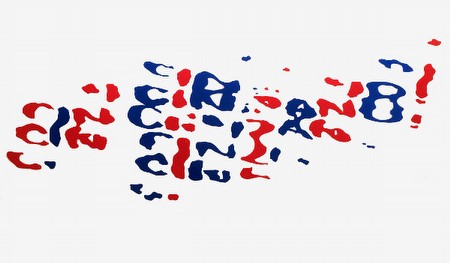
Raymond Hains, Cin Cin Cinzano (La Biennale �clat�e), 1968
plexiglas relief, 150 x 240 cm |
|||
|
||||
|
RAYMOND HAINS 10 October–14 November 2015 Bleibtreustraße 45 Goethestraße 2/3 10623 Berlin Preview 10 October, 6–8pm 22 October–21 November 2015 57, rue du Temple 75004 Paris Preview 22 October, 6–10pm Galerie Max Hetzler is pleased to announce a career-spanning exhibition of French artist Raymond Hains (1926-2005), opening in October 2015 in the two venues of Galerie Max Hetzler in Berlin, and in Paris. In collaboration with the artist’s estate, the exhibition features major works and presents an exceptional opportunity to discover or rediscover the artist’s development over nearly six decades, beginning with his photographs of war destructions and first abstract photographs from the mid-1940s and concluding with his neon works from the early 2000s, based on the Borromean knots by Lacan. Raymond Hains is widely regarded as one of the most important and challenging French artists of the second half of the twentieth century. An unclassifiable personality, often associated with Nouveau Réalisme and close to European post-war avant-garde movements Lettrisme and Situationnisme, Raymond Hains is mainly well-known for his torn posters and palissades (board fences) found in the streets, starting in 1949. Constantly imagining new forms and media during his career, as the “Giant Matchboxes” (pop sculptures signed by two fictional artists created by Hains in the 1960s), the “Hypnagogic glasses” (eyewear made of ribbed glass), the “Sidewalk Sculptures” (found and photographed in the streets) or the “Macintoshages” (computer-based manipulations), among many non conformists creative processes, Hains’s oeuvre is always stimulating the viewer’s eyes, experience, memory and imagination. His experimental works on photography, film, painting and objects opened the way to a singular, precursory and influential vision of the world: Hains’s art is indeed mainly based on language, with references to literature, history, mythology and his personal own biography towards linguistic speculations. Using all the poetic, playful and visual possibilities of the language, in what has been called an “aesthetics of coincidence”, Hains built a complex, joyful and captivating Oeuvre to decrypt. “I am myself a kind of Web. I am working on a spider’s web, or a piece of Brittany lace,” Hains said in an interview in 2000. The exhibition features key-works from different periods, all displayed in a non-chronological dialogue with each other, intending to offer an exploration of the infinite and pleasurable Hainsian web. The three spaces, independent and interconnected, highlight three facets of the artist: - “Raymond la science” in Berlin Bleibtreustrasse (with a focus on the experimental aspect of Hains’s Oeuvre), - “Raymond l’abstrait’ in Berlin Goethestrasse (with a focus on the strong visual aspect and the chain of spiraling topics) and - “Raymond le disert (disert = loquacious)” in Paris (where the language and the logic of association takes its power). The exhibition will be accompanied by a catalogue. This exhibition has been organised in collaboration with Thomas Hains, the representative of the artist’s family. Raymond Hains (1926-2005) participated in major international exhibitions such as The art of assemblage (MoMA, New York, 1961), Paris-Paris (Centre Pompidou, Paris, 1982), Documenta IV (Kassel, 1968) and Documenta X (Kassel, 1997). His first survey exhibition in a public institution took place in 1976 in Paris. Between 2000 and 2002, retrospective exhibitions have been organized at Centre Pompidou (Paris), MACBA (Barcelona), Foundation Serralves (Porto) and Moore College of Art (Philadelphia). His work can be found in the collections of important museums, among them the Musée national d’Art Moderne, Centre Pompidou (Paris), Musée d’Art moderne de la Ville de Paris, Fondation Cartier (Paris), Modern Art Museum of Forth Worth (Texas), Sprengel Museum (Hanover), Foundation Serralves (Porto), Berardo Museum (Lisbon), MACBA (Barcelona), MuMOK (Vienna), Des Moines Art Center (Iowa), etc. |
||||
|
||||
re-title.com
International contemporary art
SIGN UP FOR NEWSLETTERS

 SIGN UP for ARTIST MEMBERSHIP
SIGN UP for GALLERY MEMBERSHIP
SIGN UP for ARTIST MEMBERSHIP
SIGN UP for GALLERY MEMBERSHIP
Click on the map to search the directory