|
GALERIE JAEGER BUCHER: FERMIN AGUAYO - Inhabited Presence - Reflected Presence - 11 May 2012 to 13 July 2012 Current Exhibition |
||||
|
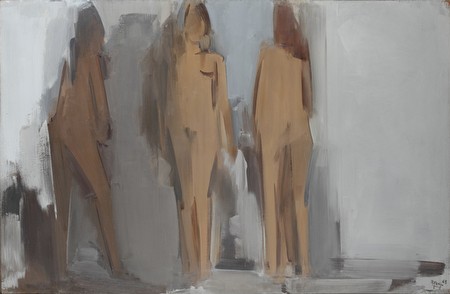
Fermin Aguayo, Trois nus pour un espace, 1968
Oil on canvas, 74,80 x 114,17 inches. 190 x 290 cm Photo David Bordes |
|||
|
||||
|
The Fermin Aguayo’s exhibition entitled Inhabited Presence, Reflected Presence retraces the itinerary of a great painter who died prematurely in 1977 at the age of 51, and whom the gallery has promoted ever since the 1950s. Following the retrospective dedicated to him a few years ago at the Centro de Arte Reina Sofia in Madrid, this exhibition is the first in France to bring together such a large number of major works by the artist. The historical space of the gallery rue de Seine, will exhibit the first pictural phase of the artist with an abstract predominance composed by paintings inspired by the fertile native ground of the artist throughout atmospheres of corridas, castillan and earthly landscaped grounds or chosen reference to old masters which allowed him to build himself as a self taught artist. His second pictural phase, with a figurative predominance is exhibited rue de Saintonge with a choice of works showing his exploration of the constants of the human condition. Throughout this parcours of major works, this double exhibition, in its abstract or figurative phase, reveals to a wider public the work of an artist who assumed his destiny as a painter and who sought - with nobility and self-restraint - neither to please nor to convince. In the judgment of Dora Vallier, formed in her approach to painting by Christian Zervos, “Aguayo is to painting what Giacometti succeeded in doing in sculpture.” Born in 1926 in the old Castilian town of Sotillo de la Ribera, Fermin Aguayo’s childhood was marked by the horrors of the Spanish Civil War. Silent, discreet and solitary Aguayo is an entirely self-taught (contrarian) who pioneered an abstract style of painting uncommon at that time in Spain (represented by the creation of the Grupo Portico of Saragosse in the late 1940s), a style that transposes, in a metaphorical and restrained manner, the violence and dramatic situations of the Civil War. With his move to Paris in 1952 Aguayo began to experiment with a style of painting composed of layers of paint spread more or less thickly on the canvas. In their density, in their evocation of Castilian landscapes and their judicious blending of warm and cool colors. Little by little, however, the fleshiness gives way to an absence of thickness; and the paintings take on a fluidity, indeed a transparency, as if Aguayo were trying to lay a veil over the landscapes of his childhood, transforming and elevating them into landscapes of the mind. By distancing himself from his subject matter Aguayo is able to dominate what possesses and animates him. As Jean Planque so aptly describes him, Aguayo is an “inhabited” painter, and this quality is palpable in the interiority of his paintings. The inner distance and withdrawal, achieved through the unremitting effort of a painter in search of both himself and of his means of expression, makes possible a return to figuration and inaugurates a way of seeing reality unlike that of any other painter. Although Aguayo is far removed from the style of his contemporaries Picasso, Balthus or Hélion, he is even further removed from Pop Art and the New Realists. He is neither a figurative nor a descriptive artist but a painter of perceiving and of presence. Aguayo began in the 1960s to look back to the master painters through the centuries such as Velasquez, Rembrandt, Titian, Tintoretto, Ribera, Goya, Manet and Van Gogh. His kinship with these great painters of the past is apparent in the deeply felt sense of reality he shares with them and in the transformation of matter into something like a living presence, as Aguayo would say. With his acute sense of space, color and light Aguayo makes the fullness and void of his paintings vibrate. These paintings expose and reveal pictorial states of consciousness, they are the truths of an instant. |
||||
|
||||
re-title.com
International contemporary art
SIGN UP FOR NEWSLETTERS

 SIGN UP for ARTIST MEMBERSHIP
SIGN UP for GALLERY MEMBERSHIP
SIGN UP for ARTIST MEMBERSHIP
SIGN UP for GALLERY MEMBERSHIP
Click on the map to search the directory