|
Galerie Christian Lethert: KAI RICHTER TROCKEN - 31 Oct 2009 to 19 Dec 2009 Current Exhibition |
||||
|
Kai Richter
TROCKEN |
|||
|
||||
|
||||
|
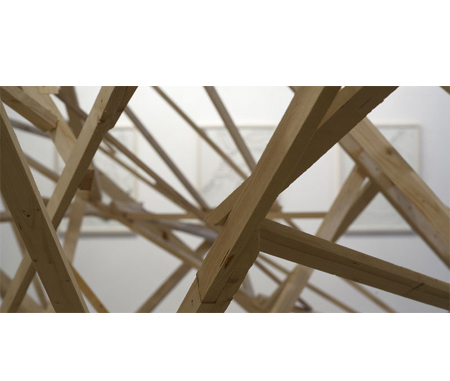
Kai Richter TROCKEN Er�ffnung: Samstag, 31. Oktober 2009, 18 bis 21 Uhr Dauer: bis 19. Dezember 2009 Wir freuen uns, die erste Einzelausstellung von Kai Richter in unseren Galerier�umen anzuk�ndigen. Kai Richter baut dreidimensionale �Skulpturen� in Kontakt und Auseinandersetzung mit den jeweiligen Raumgegebenheiten; er reagiert auf sie, ver�ndert sie, akzentuiert sie � und macht so die R�ume als R�ume neu und anders erfahrbar. Es geh�rt zu den Merkw�rdigkeiten der kunsthistorischen Begrifflichkeit, dass mit �Konstruktionen� meist geistige Planungsleistungen gemeint sind und nicht die Prozesse des Zusammenf�gens selbst, die materielle, k�rperliche und sinnliche Aktionen sind � so auch im bildhauerischen Werk von Kai Richter. Richter konstruiert im Wortsinne (lat. construere = bauen, errichten) seine Arbeiten; dabei geht es ihm nicht um Planerf�llung, sondern um ein freies Arbeiten mit den spezifischen Eigenschaften seiner Materialien und den Eigenheiten der Ausstellungsr�ume. Die Architektur ist das Paradigma des Konstruierens; dies gilt in gewissem Ma�e auch f�r Kai Richter. Was Konstruieren wirklich ist, kann man besser auf den Baustellen studieren als an den fertigen Bauwerken. Was der K�nstler als die �zeitlose Sch�nheit� der Baustellenkonstruktionen bewundert und wovon er einiges f�r seine k�nstlerische T�tigkeit gelernt hat, ist der pragmatische Gebrauch der Werkzeuge und Materialien, vor allem aber die Ehrlichkeit und Klarheit im Umgang mit dem ganz eigenen plastischen Vokabular, das sich dort zeigt. Der �sthetische Reiz von Richters Arbeiten ist kein Selbstzweck, sondern ergibt sich gleichsam nebenbei; er entsteht aus dem freien und f�r Improvisationen offenen Umgang mit seinen oft spr�den und sperrigen Materialien. Eine Arbeit wie �Doka�, die wie eine freie, zeitgen�ssische Et�de zum uralten Thema �B�ndelpfeiler� wirkt, verweist schon im Titel auf ihr Basismaterial: die gelb gef�rbten Schalungstr�ger der �sterreichischen Firma Doka. Als plastische Form spannt sich �Doka� zwischen Boden und Decke, st�tzt den Raum metaphorisch statt tektonisch und thematisiert so auf lakonische Art den Bezug zwischen Plastik und Architektur, Form und Raum. Was an Richters Arbeiten immer wieder verbl�fft, ist die Tatsache, wie viel Poesie, Witz und Leichtigkeit er seinen prosaischen Mitteln, den Bauh�lzern, Ger�ststangen, Rigipsplatten mitgibt. Wie ein Jazzmusiker, der die Harmoniefolgen einer Melodie zwar streng einh�lt, sie jedoch in improvisatorischer Leichtigkeit umsetzt, geht Richter mit den plastischen Elementarthemen Volumen und Masse, Schwerkraft und Statik sowie mit der Dialektik aus St�tze und Last um. Bei Kai Richter gibt es keine fein ziselierten Formkonstruktionen mit Ewigkeitswert, sondern gro�z�gige offene Gesten, ein klares Erfassen der Raumsituationen und die entsprechende plastische Reaktion darauf. Diese Auffassung von Bildhauerei gewinnt ihre ganz eigene Kraft dadurch, dass in ihr plastische Wucht und Sensibilit�t, Raumgef�hl und Materialsinnlichkeit zusammenkommen. KAI RICHTER TROCKEN Opening Saturday 31 October, 2009 6-9pm Until: 19 December 2009 We are pleased to announce the first solo exhibition of Kai Richter at our gallery. Kai Richter builds three-dimensional �sculptures� in connection with and response to the respective room conditions: he reacts towards them, changes them, highlights them�and in doing so, allows us to experience them as rooms differently and in a new way. One of the oddities of art historical terminology is that the word �constructions� largely implies intellectual planning achievements and not the processes of assembling itself, which are rather material, physical, and sensual actions�such as we find in the sculptural work of Kai Richter. Richter constructs his works in the literal sense (Lat. construere = to build, erect); in doing this, his concern is not for carrying out the plan, but for working freely with the specific characteristics of his materials and the peculiarities of the exhibition rooms. Architecture is the paradigm of constructing; this applies to a certain extent to Kai Richter as well. What constructing really means may be studied better at construction sites than when the buildings themselves have been finished. What the artist admires as the �timeless beauty� of construction site constructions, from which he learned a lot for his own artistic creations, is the pragmatic use of tools and materials, but above all the honesty and clarity in treating the wholly individual plastic vocabulary revealed there. The aesthetic attraction of Richter�s works is not a self-serving purpose, but arises incidentally; it comes about as a result of the free treatment open to improvisations of the often brittle and awkward materials. A work such as �Doka�, which seems like a free, contemporary etude on the age-old theme of �bundled columns� already indicates in its title the basic material used: the yellow-colored concrete form supports made by the Austrian Doka Company. As a plastic form �Doka� spans from the floor to the ceiling, supporting the room metaphorically instead of tectonically, thus laconically making a theme of the relationship between sculpture and architecture, form and space. What continues to surprise us about Richter�s works is the fact of how much poetry, humor and lightness he suffuses into his prosaic means, the construction wood, scaffolding poles, and plasterboards. Like a jazz musician strictly adhering to the harmonic sequences of a melody while transporting them into improvisational lightness, Richter treats the plastic elementary themes of volume and mass, gravity and statics as well as the dialectics of stress and support. With Kai Richter there are no finely-chiseled form constructions built to last an eternity, but rather generous, open gestures, a clear grasp of the room situations and the corresponding sculptural reaction to it. This understanding of sculpture gains its wholly individual power from the fact that in its plastic force and sensitivity, the feeling for the room and sensual aspects of the material merge together. |
||||
re-title.com
International contemporary art
SIGN UP FOR NEWSLETTERS

 SIGN UP for ARTIST MEMBERSHIP
SIGN UP for GALLERY MEMBERSHIP
SIGN UP for ARTIST MEMBERSHIP
SIGN UP for GALLERY MEMBERSHIP
Click on the map to search the directory