|
Galerie Christian Lethert: Jorinde Voigt with Patric Catani and Chris Imler �Matrix & Lemniscate� - 14 Nov 2008 to 21 Dec 2008 Current Exhibition |
||||
|
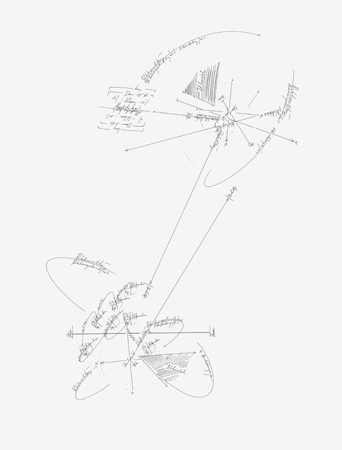
Jorinde Voigt, Matrix-Studie 19, 2008
77 x 57 cm Pencil, Ink on Paper, Unique Piece |
|||
|
||||
|
||||
|
Jorinde Voigt with Patric Catani and Chris Imler �Matrix & Lemniscate� Galerie Christian Lethert is excited to present Matrix & Lemniscate - a unique collaboration between the artist Jorinde Voigt, and composers Patric Catani and Chris Imler. The lemniscate is, fundamentally a mechanism for the infinite. A lemniscus or �ribbon� that chases itself in a figure of eight describes the repeated and unending journey of the unbounded. Early Indian thinkers were quick to assert the abstract powers of infinities by recognising that when adding or removing parts to infinity, infinity would always remain. Jorinde Voigt draws structures energised by real and imagined possibilities to investigate finite boundaries of systems. She frames and moderates these investigations with spatiotemporal data, information on speed, volume, and an overlaying of sequences. Her notations embrace the concept that elements of equal value co-exist in a logic and proportion of their own. It is interesting to note then, that the lemniscate�s form derives itself from an ellipse, a figure wherein the sum of its distances to two fixed points is a constant. The French philosopher Descartes, turned these spatial observations into the grounding principles of his Cartesian system of thinking which saw the merging of algebra and geometry. For Voigt, whose earlier drawn notations were reminiscent of equations, her current work has developed to propose a highly inventive form of �situational geometry�, where patterns of cultural behaviour are put into relative position to geographical properties of space. As Cartesian thinking influenced not only mathematics but also the science of map drawing, Voigt�s drawings or �scores,� have left the paper for the Lemniscate project and begun to take place in space and time. Following Voigt�s concepts, composers Patric Catani and Chris Imler, have laid the �lazy 8� of the infinity motif into the gallery space in the form of an acoustic �cluster�. The looped composition formed of 16 chapters, snakes around 7 points realised using a multi-channel arrangement of 5 loudspeakers and thus describes the shape of a lemnsicate through pure sound. With their insight into musical forms, Catani and Imler made both field recordings that included the surrounding cityscape of Berlin and also initiated their own sources of sound. These tones and frequencies have then been layered at varying speeds and rhythms to construct a shifting musical �swarm� (evocative maybe of the flocks of multiple elements in Voigt�s drawings). Standing in the centre of this work, the effect is of an architected, geometric form - sensed but not seen, and entirely physical in its scale (the cluster of sound existing between the ground and head height). At the core of the Lemniscate composition is Catani and Imler�s structural break up of a tonal construction as the various layers shift and chase themselves around a physical space. Within this physical space, Voigt�s works on paper: Schwarm and Matrix also co-exist alongside the Lemniscate installation. Existing in their own right, the drawings serve to have initiated discussions about principles of collective movement, challenging Catani and Imler with a creative platform through which to develop Lemniscate. The large scale Schwarm series concerns itself with many features of Voigt�s previous notations: kisses, detonations, wind speeds, the flight of eagles, but examines how these singular events may take place in a larger course of action. These works deal with the duplication of forms within plural forces such as energy, wind force and collective direction. Dynamic processes are inherent in these notations. Totalling 40 works on paper, Matrix proposes an extended system of the Schwarm series, whereby clustered elements of this large series are isolated and matrixed. It is in these drawings that Voigt gives an intimate treatment to these actions and the notion of the point of view is prevalent. In answering the classic paradox �what happens if an unstoppable force meets an immovable object?� Isaac Asimov1 hints at both forces transferring their infinite energies into one another. Voigt, Catani and Imler may offer up the alternate question �what happens if the mortal individual is confronted by unending flux?�. Matrix & Lemniscate speaks both of our material and animal existence in the face of an ever advancing immaterial world and of the micro and finite condition of the human, in relation to an overall and infinite passing of time. Andrew Cannon 1 Russian-born American author and professor of biochemistry (1920- 1992) Lemniscate was created (in part) at Watermill � a laboratory for performance 2008 Die Galerie Christian Lethert freut sich Matrix & Lemniscate ank�ndigen zu d�rfen � die erste und bislang einzige Zusammenarbeit der K�nstlerin Jorinde Voigt mit den Komponisten Patric Catani und Chris Imler. Eine Lemniskate ist im Wesentlichen ein Instrument des Unendlichen. Ein Lemniscus oder �Band�, das sich selbst in Form einer Acht in den Schwanz bei�t, beschreibt eine sich unendlich wiederholende, grenzenlose Bahn. Fr�he indianische Denker sahen in der Tatsache, dass die Unendlichkeit unver�ndert bestehen bleibt, gleichg�ltig ob man ihr etwas hinzuf�gt oder nimmt, eine Best�tigung der abstrakten Kraft eben dieser Unendlichkeit. Jorinde Voigt zeichnet Strukturen, die von realen und imaginierten Ph�nomenen gespeist werden, um die Endlichkeit der Grenzen von Systemen zu untersuchen. Sie gestaltet und variiert diese Untersuchungen durch r�umlich-zeitliche Daten, Angaben zu Geschwindigkeit und Lautst�rke sowie �berlagerungen von Sequenzen. Ihre Notationen basieren auf dem Konzept, dass gleichwertige Elemente in einer ganz eigenen Logik und Verh�ltnism��igkeit nebeneinander bestehen. In diesem Zusammenhang ist es interessant, dass sich die Form der Lemniskate aus der Ellipse ableitet, einer Figur, bei der f�r alle Punkte die Summe der Distanz zu zwei vorgegebenen Fixpunkten eine Konstante ist. Der franz�sische Philosoph Descartes nutzte dieses r�umliche Ph�nomen als Grundprinzip seines Kartesianischen Systems, in dem Algebra und Geometrie miteinander verschmelzen. Voigt, deren fr�here Arbeiten an mathematische Gleichungen erinnern, hat in ihren aktuellen Arbeiten eine h�chst kreative Form �situativer Geometrie� entwickelt, in der Muster kultureller Verl�ufe mit geografisch-r�umlichen Ph�nomenen in Beziehung gesetzt werden. So wie das Kartesianische Denken nicht nur die Mathematik sondern auch die Kartographie beeinflusst hat, haben auch Voigts Zeichnungen oder �Partituren� beim Lemnsicate-Projekt das Papier verlassen und begonnen, sich Raum und Zeit zu erobern. In Anlehnung an Voigts Konzepte haben die Komponisten Patric Catani und Chris Imler die �liegende 8 (∞)� des Unendlichkeitssymbols als akustisches Cluster in den R�umen der Galerie entstehen lassen. Die aus 16 St�cken bestehende Komposition windet sich um sieben Punkte, wobei ein Multikanalsystem von f�nf Lautsprechern zum Einsatz kommt. So entsteht nur durch reinen Klang eine Lemniskate. Aus ihrem musikalischen Formverst�ndnis heraus haben Catani und Imler sowohl Feldaufnahmen wie z.B. aus der Stadtlandschaft Berlins als auch eigene Quellen der Tonerzeugung genutzt. Diese Kl�nge und Frequenzen �berlagern sich in unterschiedlichen Geschwindigkeiten und Rhythmen, um einen variablen musikalischen �Schwarm� entstehen zu lassen. Zentral platziert entsteht eine konstruierte geometrische Form, die empfunden aber nicht gesehen werden kann und dabei in ganz physischer Form daherkommt (der Klangcluster bewegt sich zwischen Boden und oberhalb des Kopfes). Catani und Imler brechen in Lemniscate die tonale Struktur auf, indem sie verschiedene Klangschichten gegeneinander verschieben bzw. diese durch den Raum jagen lassen. Diesen Raum teilen sich Voigts Arbeiten auf Papier - Schwarm und Matrix - mit der Klanginstallation Lemniscate. Die Auseinandersetzung mit Schw�rmen / Boids und die akustische Ann�herung an dynamische Massen sowie die bereits existierenden Zeichnungen und die Parameter der r�umlichen Verortung haben Catani und Imler u.a. zu Diskussionen �ber die Prinzipien kollektiver Bewegung inspiriert und als Plattform genommen, auf deren Basis Lemniscate entwickelt wurde. Die gro�formatige Zeichnung Schwarm befasst sich mit den Elementen: Rotationsrichtung, Rotationsgeschwindigkeit (in Umdrehung/min), Strom, Adlerflug, Puls/min, Lemniskaten-Wirbel, Elektrische Partikel, Oben-Unten, Richtungs-Wirbel. Die Elemente sind als duale Matrizen angeordnet. Hier wird jedoch untersucht, wie diese einzelnen Elemente als Schwarm funktionieren. Es wird mit der Doppelung pluraler Kr�fte und kollektiver Orientierung gearbeitet. Die Notationen geben dynamische Prozesse wieder. Mit 40 Arbeiten auf Papier stellt Matrix eine Erweiterung der Arbeit Schwarm dar, in der die Elementecluster aus Schwarm als duale Formeln auftauchen, erweitert durch folgende Elemente: C4-Detonationsketten, Countdowns, Himmelsrichtungswechsel, Windst�rke- und Windrichtung-Deklination, 2k�ssen sich � Aktionsabl�ufe, rhythmische Felder, Lichtbogen-Felder, akustische Impulse, Blickwinkel. Bei der Erl�uterung des klassischen Paradoxons - �was passiert, wenn eine nicht zu bremsende Kraft auf ein unbewegliches Objekt trifft?� - verwies Isaac Asimov auf das Ph�nomen, dass beide Kr�fte ihre unendlichen Energien ineinander �bertragen. Voigt, Catani und Imler variieren dieses Motiv, indem sie fragen: �Was geschieht, wenn ein sterbliches Wesen mit einer unendlichen Bewegung konfrontiert wird?� Matrix & Lemniscate befasst sich sowohl mit unserer materiellen und k�rperlichen Existenz in Konfrontation mit einer omnipr�senten, immateriellen Welt als auch mit der individuellen, endlichen Condition humaine im Angesicht eines allumfassenden, unendlichen Vergehens der Zeit. Lemniscate entstand 2008 (teilweise) im Watermill � Center, NY. Andrew Cannon |
||||
re-title.com
International contemporary art
SIGN UP FOR NEWSLETTERS

 SIGN UP for ARTIST MEMBERSHIP
SIGN UP for GALLERY MEMBERSHIP
SIGN UP for ARTIST MEMBERSHIP
SIGN UP for GALLERY MEMBERSHIP
Click on the map to search the directory