|
Galerie Anita Beckers: Liat Yossifor "falling into ends" Martina Wolf "Sturm auf Berlin" - 10 June 2009 to 28 Aug 2010 Current Exhibition |
||||
|
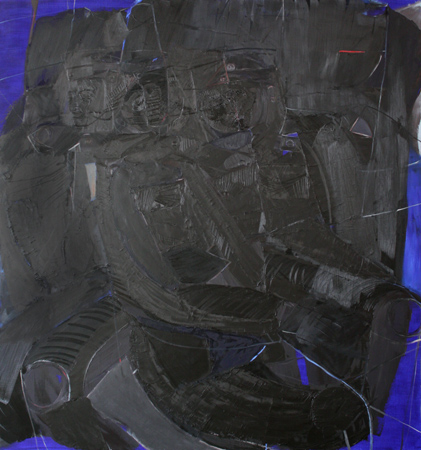
Liat Yossifor
The Monument, 2010 Oil on linen, 180 x 160 cm |
|||
|
||||
|
||||
|
"falling into ends" Liat Yossifor Opening: Thursday, June 10th, at 7 pm Duration: June 10th through August 28th, 2010 Yossifor�s new series of paintings, falling into ends, closes the distance between the past and the present thoughts on past ideas. The new paintings ignore linearity; instead they awaken events, gestures, and conflicts that shaped the present, asking to reopen the story-telling part of history and the generalization of non-identical things. In her paintings, symbols, images, and stories associated with the construction of history are up for debate. By using an old medium to paint archaic ideas (such as national monuments and soldiers), a conversation about painting and construction of history is echoed back and forth between the paint and what it depicts. If what is painted can be argued to be abstract and openended because of the nature of painting (even if figurative and referential information in painting ultimately breaks into abstract shapes and forms), then what happens to historical information inside of the language of painting? What happens to symbols inside the language of painting? These works build on an argument about the medium of painting, which is that painting opens and expands socio-political subject matter. It abstracts the subject�s meaning by the fact that what is painted is already transformed into an open shape. The references for falling into ends are archetypes. For this project, Yossifor collected images of statue-like national monuments (including soldiers from various wars) and of paintings of soldiers (specifically post war German painting). She treats the images as equal documents, derived from documentary, nationalistic, and artistic perspectives. The national monuments as symbols hover above all the other symbols that are dealt within this work. Monumental forms are, at times, ironic and strangely effective. In these paintings, monumental forms are formed as a series of failed accounts and ambiguous narratives, and they become about feelings associated with stories already told. Painting attaches itself to these forms, nostalgic and broken as well. The soldiers as archetypes are painted freely, in the sense that their medallions, uniforms, hats, and flags are a mixture of various styles and origins. They are, on the one hand, in a confused state due to them being composed from multiple references; and, on the other hand, they are a universal and clear symbol of a nation. These characters are also painted as pathetic and absurd forms. They make up a mass of bodies, they share a language, and they melt into each other. They melt together for the sake of the overall shape of the painting, forcing their shapes into a more overwhelming graphic shape that is the structure of the painting. They seem to be celebrating an end of a war, or its beginning; moreover, they seem to be gathering but it is not clear for what. Their state of becoming �one� is heroic and pathetic at once. Yossifor grew up in Israel, and while her work is not only tied to this one aspect of her identity, it is filled with questions about nation, violence, history, and political positions for which the triggers are personal and autobiographical. Yossifor has shown her work in solo exhibitions at various venues, such as: �The Tender Among Us� at the Pomona College Museum of Art, Claremont, CA; �The Dawning of an Aspect� at Susanne Vielmetter Gallery, LA, CA; �The Black Paintings� at Noga Gallery of Contemporary Art, Tel Aviv, Israel; and �New Paintings� at Anna Helwing Galley, LA, CA. She has been included in group exhibitions at the Lyman Allyn Museum, New London, CT; Museum of Modern Fine Arts, Minsk, Belarus; The Torrance Art Museum, Torrance, CA; and the New Wight Gallery at UCLA, LA. Currently, she is attending the Frankfurter Kunstverein residency program, and will be showing solo in 2010 at Anita Beckers Gallery, Frankfurt, Germany, and at Angles Gallery, Los Angeles, US. Martina Wolf Sturm auf Berlin June 10th through August 28th 2010 The Museum of the Great Patriotic War, Poklonnaya Gora, in Moscow is devoted to the memory of the victory of the Red Army over fascism in World War II. The gigantic building complex in the west of the Russian capital was inaugurated in 1995 during the Yeltsin era. The decision for the establishment of such a memorial was however, taken already by the Central Committee back in 1957. Even in Russia 2.0., this symbolic place represents the heart of post-communist official state policy, as the celebration of the 65th anniversary of the victory over Nazi Germany has shown. The photographer and video artist Martina Wolf has been working for some time with the Russian present. Among others and with a grant from the Hessen Cultural Foundation she lived in Moscow and visited several other cities. Her current video work, /Sturm auf Berlin/ is based on one of the six battle dioramas, exhibited in the basement of the intensively visited Poklonnaya Gora. Combining paintings and real objects, the museum shows a fight scene with bombed-out houses and the burning Reichstag of the Soviet Army in Berlin. The historical reference is the final battle in Berlin, from April 16th to May 2^nd 1945, of the occupation of the Reichstag building on April 30th by the Red Army, and the final surrender of the German forces on may 2^nd , 1945 which ended the II World War. Wolf's interest lies primarily on the level of observing and artistic structures. The video installation /Sturm auf Berlin/ consists of two separate works: Firstly the artist photographed the Moscow Berlin-diorama fully in several hundred shots, and mounted them in a digital large-format, ultimately being scanned like a cut-out which is showed in a painfully slow motion digital video. The second work was shot in November 2009 in the exhibition space: Martina Wolf 's still camera films the viewers in real time. This film is partly backed by sound, one listens to the speech of the woman who leads a group of young people through the exhibition. Both films are similarly long, during which one sees oneself in the process of reflection, remembering and seeing. (Text by Karin G�rner) |
||||
re-title.com
International contemporary art
SIGN UP FOR NEWSLETTERS

 SIGN UP for ARTIST MEMBERSHIP
SIGN UP for GALLERY MEMBERSHIP
SIGN UP for ARTIST MEMBERSHIP
SIGN UP for GALLERY MEMBERSHIP
Click on the map to search the directory