|
Galerie Anita Beckers: Vee Speers - The Birthday Party | Aurelia Mihai - Transhumanţa - 16 Feb 2008 to 5 Apr 2008 Current Exhibition |
||||
|
Vee Speers
|
|||
|
||||
|
||||
|
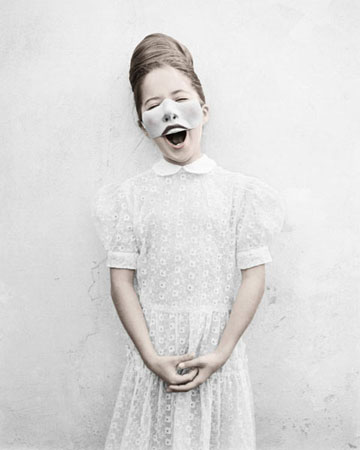
Vee Speers - The Birthday Party Aurelia Mihai - Transhuman�a Opening reception: Friday, February 15th from 7.30 pm Duration of the exhibition: February 16th - April 5th, 2008 Works by Aurelia Mihai will also be shown at our project space SATELLIT [during the opening night the SATELLIT will be opened from 7 - 10 pm] new opening hours of SATELLIT: Wed + Thurs 4 - 9 pm Fri 2 - 7 pm Sat 12 noon - 4 pm and on request The list of photo artists who have taken the theme of childhood for themselves is long. That�s understandable, for it is a rewarding photographic subject. What�s fascinating is the position of in-between, the ambiguity of being a child: The child�s ego is fragile, there are plenty of options. Is this only at the beginning: in a paradisiacal state, as has often been written? When Vee Speers places children in front of the same white wall to photograph them in their costumes for the �Birthday Party� series, one might at first wonder about this visual concept. We tend to associate childhood with spontaneous movement rather than immobility. This is different with Vee Speers: Her models act within a strictly laid-out frame. Lisette Model was one of the first female photo artists to take pictures of young people not only in their freedom of movement but also in regard to their future roles. Childhood is a period of time in which one practices taking on roles � something which Vee Speers� �Birthday Party� series also explores. It�s not that their role corsets are already threatening to overpower them, since the children depicted here are anything but free and innocent. They stand in their fantastic costumes, but don�t look very cheerful. �Aren�t you happy at all?�, you want to ask them. And although some of them are even smiling or singing, they don�t appear to be truly happy. They open themselves to the camera with gazes that say to us grown-ups: Look at us. We know much more than you think. Are they representatives of the much-cited �lost childhood� that photographers such as Achim Lippoth have portrayed in such a captivating way? The Cologne artist photographed children with expressions full of hate, children much too grown-up for their age, for example, such as the Chinese gymnasts he portrayed in his series titled �L�homme Machine� � machine people. They are mutants of the adult world, premature ones, but still in the bodies of children. The guests of the imaginary birthday party have not yet entirely detached themselves from their childhood. It is not childlike happiness that is revealed in their regard, but pressing openness. Carefree childhood, purity, naturalness�it�s all a clich� � that�s what these image impart. Irritation is programmatic here; Vee Speers� art is meant to confuse: Be it the small child soldier � does he have a real machine gun? � or the girl opening her palms as if to say: All I have in this world is myself. As openly as they look at the camera, the children reveal very little of themselves. Standing in front of a white background, they are symbols of�they won�t say of what. And this is precisely what makes these portraits so magnetic: The children do not divulge their secret, the reason for their forlornness. �I�m interested in the psychology of human nature � what we really are beneath the surface,� Speers once said. Yet she creates her art in the certainty of never being able to expose what lies beneath. �I wanted to capture the last moments of childhood by means of an imaginary party,� says Speers. What she has cast in strange, pale colour photos is an ambivalent state between freedom and role play, between spontaneity and premonition (later on I will be a sad old witch!), between the world of children and the world of adults. The childlike game of dressing up, of putting on costumes, reinforces the surreal tone of the series. Boxing gloves alone don�t make a boxer, a helmet doesn�t make a Roman legionnaire. That�s what Vee Speers tells us. But we should indeed think more frequently about the dreams we have. Marc Peschke (Art historian and culture journalist, Wiesbaden & Hamburg. www.marcpeschke.de) ----------------------- In her video and photo works, Aurelia Mihai (*1968 Bucharest) examines the disappearing boundaries between documentation and fiction in the area of media images. Historical references merge with legends and personal memories, forming suggestive images in which the reflection on the conditions of media perception always resonates. In the two-channel video piece �Transhuman�a�, which we will presented for the first time in the gallery, the borders between reality and fiction, tradition and modernity are fluid. Transhuman�a is the name of the traditional migration of flocks of sheep as it was customary in many European countries including Romania, where the film was shot. But when the new EU directives came into force, this kind of livestock husbandry was forbidden. In Aurelia Mihai�s works, the sheep now roam through the countryside for the last time; but they have left the green meadows behind and arrive in the inhospitable Romanian cityscapes. The distanced, documentary view of the camera stands in a tensional contrast to the old romantic image of sheep and shepherd. In our SATELLIT project room, we will additionally show, along with a selection of further works by the artist, the work �Von Herzen (From the Heart)�: �A pretty, young woman in a well-kept Mediterranean garden: With concise words, she gives an account of the all but unbelievable events of her young life, from cancer as a child to her heart transplant at the age of 19. (...) In Aurelia Mihai�s video film, which in just five minutes creates a suspense curve that surpasses many a feature film, the most various levels of representation overlap. By aesthetically shaping the authentic and real, the limits of representational conventions (from embarrassment to candour) are touched. The narrator, actress and subject of the story are all same � equally authentic and seemingly composed � person. Word and image, on the other hand, diverge. The rationality of her manner of speaking, the soberness of the text and the use of medical terms such as �immune suppressors� or �high urgency list� strongly contrast her colourful costume and the idyllic location. Yet the picture is deceptive: It is not a fairy tale that is being told here but a chain of tragic misfortunes: Cancer and chemotherapy during childhood are followed in her teenage years by heart disorders, diabetes, asthma, a stroke, and finally the life-saving heart transplant. As opposed to the drama of the narrated events, the account itself is pointedly calm and soft. The camera doesn�t move either, it is fixed to one angle.� (Doris Krystof) -- Messen / fairs: Pulse New York, 27.03. - 30.03.2008 Art Chicago, 25.04. - 28.04.2008 -- Galerie | Anita Beckers | Frankfurt Bj�rn Melhus "Deadly Storms" at 23th Manifestation Internationale Art Vid�o et Nouveaux M�dias We kindly would like to inform about the presentation of the new work "Deadly Storms" by Bj�rn Melhus at the 23th Manifestation Internationale Art Vid�o et Nouveaux M�dias in Clermont-Ferrand / France. "Deadly Storms", 2008 3 channel video installation, 7'00 min DEADLY STORMS is based on appropriated audio footage from the US American news network FOX NEWS. Three identical talking heads separated on three vertical screens are repeating phrases and statements of alert and threat as well as happy journalism. The repetitive elements and the structures are set to rhythm and exercise a hypnotic power on the viewer that, together with the utterances and the emotionally charged language, serve the traditional rhetorical strategy of enchantment and persuasion. The gaze directed out of the picture is suggestive of a direct appeal and refers to composited framed talking heads in news broadcast, who are always addressing the viewer while having a conversation. The psychagogic effect of the image is intensified in Melhus� work by the rhythmic, in parts melodic articulation of the text, the words of which are spoken synchronically with varied vocal emphasis. DEADLY STORMS tries to focus on the overall tone, the manipulative carrier of the content rather than on the grotesque political content itself. During the last 10 years Rupert Murdoch's FOX NEWS became one of the most powerful and influential news networks in the United States. Claiming to be fair and balanced, the over designed propaganda machine creates an atmosphere of permanent alert and fear. Exhibition: 12. - 30.3.2008 Festival: 11. - 15.3.2008 23th Manifestation Internationale Art Vid�o et Nouveaux M�dias La T�lerie 10 rue de Bien-Assis 63000 Clermont-Ferrand, France Opening times Mon - Sun: 3pm - 7 pm www.nat.fr/videoformes/FESTIVAL/2008/expo/tolerie.html |
||||
re-title.com
International contemporary art
SIGN UP FOR NEWSLETTERS

 SIGN UP for ARTIST MEMBERSHIP
SIGN UP for GALLERY MEMBERSHIP
SIGN UP for ARTIST MEMBERSHIP
SIGN UP for GALLERY MEMBERSHIP
Click on the map to search the directory