|
Galeria Fucares Almagro: �TIEMPOS DE ALEGR�A� - 20 Oct 2012 to 29 Dec 2012 Current Exhibition |
||||
|
Carlos Correia. �ST (LBD#006)�, 2012. Acr�lico sobre tela. 50 x 61 cm
|
|||
|
||||
|
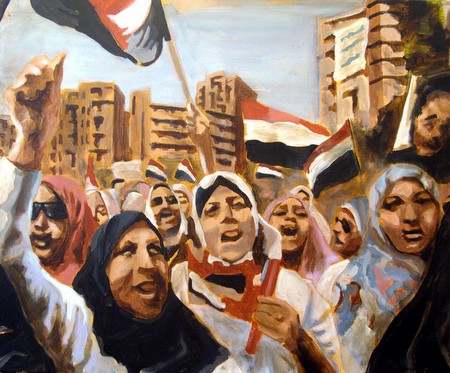
“TIEMPOS DE ALEGRÍA” Comisariada por / Curated bySimeón Saiz Ruiz & Monika Anselment Del 20 de octubre al 29 de diciembre de 2012 From October 20th 2012 to December 29th 2012 Inauguración: sábado 20 de octubre de 2012 / 20:00 h Opening: Saturday 20th October 2012 / 8 pm Fúcares Gallery presents at Almagro, “Tiempos de Alegría”, a project curate by Simeón Saiz Ruiz and Monika Anselment. Tiempos de Alegría (Moments of Joy), is a project by ten artists who have been discussing and working on the subject of the representation of happiness of the Other in a specific political context as in the case of the events of the so called Arab Spring. In the gallery is presented the result of a year’s work (since July 2011). In a context of deep economical and political crisis in all Europe, but especially in some countries of the South, like Spain, we thought it was necessary to look at positive moments, not to ignore the crudity of reality, but to find ways of resistance. The project intends to escape the traps easily found in the representation of violence in locations that are far away from where one lives and works by focusing in other aspects. Is there in those countries something else beyond corpses? There must be moments of happiness in the people’s daily life. Trying to think about somebody happy lately, perhaps one only remembers the happy faces of people in Tunisia and in Egypt when the non-violent demonstrations were able to bring down their corrupt governments. Those events produced images of euphoria that arrived in our homes through the TV and the press. Here we had happiness of a social nature, of political weight. That is the reason why the changes in the Arab world were chosen as subject. It is obvious that the situation has developed towards dramatic situations. We are not ignoring it. A glimpse of it appears in some of the works and is mention in the texts of the catalogue. The exhibition concentrates in a very specific moment. Nobody can accuse us of ignoring what is happening. Instead, it is one reason the more to show the promises that were contained in those first moments. The images are easily found in internet, and a collection of them was the first working material, but the work of all of the artists soon took very different approaches that cover a very wide set of views upon the theme. The following description of the work of the artists is made using their own words: Claire Angelini (Paris) is a filmmaker dealing with the political issues of the History, proposes an installation in which the viewer, settled between 2 film screenings, is asked to view 2 fragments of the History in their both historical overlapping and differences, Algeria and Tunisia. The first film, Brise la mer!, asks itself for the reasons of the war in Algeria on occasion of the commemoration of the country’s independence (1962). The other, Jeune, révolution!, confronts t unhappiness of the young people in Tunisia after the developments following the revolution. The political situation in the present and the reflection on history are put on relation into a work that has been conceived for this special exhibition. Monika Anselment's (Berlin) work focuses on the question of how we visualize places where we are not and the role do the mass media play in this. Her work has explored these problems in many projects. For the exposition we are confronted with them through different kind of discourses. We have the discourse of the media images against the discourse of the personal images. We have the discourse of the images against the discourse of the word (in the text Notizen, written for the catalogue, and in the Arab jokes). We have the discourse of the representation against the discourse of the real objects. Hommarus W. Brusche (Amsterdam) tries to magnify what is barely seen. In his words, it is art what has the extraordinary capacity to make loss and desire visible. His works are drawings where people move and are moved by loss and desire into configurations similar to the movements of people through the squares of Tunisia and El Cairo, in patterns that suggest infinite change, infinite possibilities of resolution. Wojciech Ciesnieski (Warszawa) shows a group of paintings, in which the events of the present and the cultural interpretations over man’s actions of the past are related in order to illuminate each other. Some paintings refer to the drama/dilemma of Judith and Holofernes. Judith's action, on one side is seen as heroic, patriotic, that is, an action that deserves society's pride, joy, fame and gratefulness, but on the other side it has a dark side: in the hero's psyche a trace is left, the result of the traumatic events that go together with each of the fights. The non-violent efforts to gain personal or social change have a price: to reach the aim is a task that requires labor and sacrifice. People's smiling faces, besides the joy, sometimes the euphoria, of reached dreams, express so much the insec urity for the future as show the traces of the actions that made the event. The moral judgment of the victory, as much personal as social, has a double meaning. The events in the Arab countries awake the interest of millions of persons; for some they deserve imitation, for others they are just politics and business. Carlos Correia (Lisboa) makes drawings from images of the various protests that have occurred in recent times and in different cities. They are drawn on post-it paper, and these drawings are then placed in a corkboard, as is done routinely in offices and sometimes in people’s houses. In both places they are a memory support, and Correia’s imitation of them emphasizes the need not to forget those moments of popular togetherness. It is also a symbolic way of perpetuating the slogans that those people shouted in the events. Peter Hauenschild (Linz) presents drawings on a squared format of faces taken out of pictures of people from internet. The drawings themselves are made out of squares, since the pixel is a square. Hanged all together they make a bigger square. And beyond that, a square is a place where the people meet. All the elements in this simple structure make reference at the events under scrutiny. Today’s electronic cameras make pictures out of pixels. Some of the pictures chosen could have been made with mobile phone cameras and uploaded into internet, a very important platform for communication. Then downloaded and transferred into drawings, a simple and old technique. Sofia Jack (Madrid) offers us a diagram in which we could find reflected ways to connect emotionally with the events that have taken place in the Arab Spring. The images and videos that have arrived to us through the mass media have allowed us to take part in the Arab Spring, and that process can not be completed if we do not make an emotional connection with whatever the images are showing us. The work can be understood then as a brief guide that could push us in a trip to those emotions. Marek Szymanski (Kraków) looks for images that can make us to understand what we are seeing. In many occasions it is the feeling of being confronted to something utterly unfamiliar what triggers mechanisms of understanding. The images of people in the Arab countries using their shoes waved with their hands as a sign can be one of those images. Can we understand that use through the shoes of Van Gogh? The challenge, as he says, is: how to describe the joy, happiness of the people I do not know and not to fall down into a trap of illustration! Simeón Saiz Ruiz (Madrid) makes paintings of people smiling from faces taken out of the images found in internet of the celebrations for the downfall of Mubarak in Egypt. We are seeing those people and not matter how distant or how close with them we feel, we can connect directly with their joy. If they are able to be happy as we are, they must be as we are. Wolfgang Wirth (Wien), concerns himself also with those moments of collective joy when Mubarak´s resignation was announced on TV by vice-president Suleiman. But he gets more interested in the conditions under which that collective outburst of happiness took place and not so much on representing the emotions that could be seen in peoples´ faces. We get instead all sort of indirect references. Aspects such as weather, temperature or light can get our attention, as also elements in the background of photos, such as street lamps, fences, traffic lights. It is not la question of looking for a unify position, on the contrary, it is more a question of finding visible as many layers of meaning as possible that could be superimposed over whatever information we had been getting through the media. Simeón Saiz Ruiz & Monika Anselment. Artists Claire Angelini (Paris), Monika Anselment (Berlin), Hommarus W. Brusche (Amsterdam), Wojciech Ciesnieski (Warszawa), Carlos Correia (Lisboa), Peter Hauenschild (Linz), Sofia Jack (Madrid), Marek Szymanski (Kraków), Simeón Saiz Ruiz (Madrid) & Wolfgang Wirth (Wien) |
||||
|
||||
re-title.com
International contemporary art
SIGN UP FOR NEWSLETTERS

 SIGN UP for ARTIST MEMBERSHIP
SIGN UP for GALLERY MEMBERSHIP
SIGN UP for ARTIST MEMBERSHIP
SIGN UP for GALLERY MEMBERSHIP
Click on the map to search the directory