|
Galeria Fucares Almagro: DAVID ESCALONA - Bajo la Cama - 23 June 2012 to 11 Oct 2012 Current Exhibition |
||||
|
DAVID ESCALONA
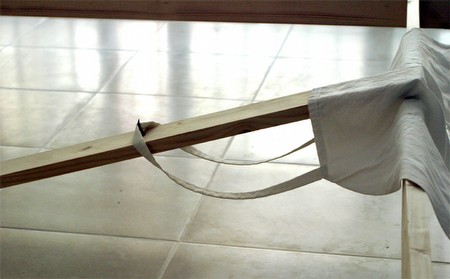
�S/T (Cama)�, 2011 T�cnica mixta. Medidas seg�n instalaci�n. |
|||
|
||||
|
DAVID ESCALONA Bajo la Cama Del 23 de junio al 11 de octubre de 2012 From June 23th to October 11th 2012 Inauguración: sábado 23 de junio de 2012 / 20:30h Opening: Saturday 23th June 2012 / 8:30 p.m. AGOSTO CERRADO Horario: de Martes a Sábado: de 18:30 h a 21:30 h Opening Hours: Tuesday to Saturday: 6:30 – 9:30 pm "Bajo la Cama" Bajo la cama hay un niño, un perro con una cicatriz, un caja de gusanos de seda, una botita de cuero, añicos de cal … Esta exposición del malagueño David Escalona no muestra una intimidad arrancada del cuerpo, sino el modo en que la memoria sigue dejándolo abierto como una herida, pero también como la infinidad de posibilidades que a cada instante se abre al vivir. Y si esta vida es un hospital –como Baudelaire nos tiene bien dicho– donde cada enfermo está poseído por el deseo de cambiar de cama, bajo la cama de un hospital aprendió David, cuando apenas era un crío, que el juego conjura el dolor y sólo el miedo nos expone al peligro. Éste es el misterio que yo no pienso desentrañar. En el obrador de pan de sus padres una máquina casi se le lleva la mano; al sacarla estaba envuelta en masa de pan, triturada y sin forma, como antes la masa madre que en sus manos había cobrado todas las formas, figurita desfigurada para un niño que jugaba a ser escultor. Pero sabemos de sobra que los niños no pueden estarse quietos, que el dolor no les duele hasta que alguien les dice cuánto duele el dolor. David escondía bajo la cama una caja de gusanos de seda, y se divertía observando a esos tejedores infatigables que se envuelven a soñar mientras trabajan, pues toda la labor de estos animalitos consiste en hacer un diminuto obrador donde dejarse el cuerpo para hacerse otro cuerpo: ¿qué pasará dentro de un capullo de seda; estará la crisálida muerta o estará viva?, &iques t;y qué pasará con la mano bajo la venda? Bajo la cama hay también clavo y limón, el quicio de una puerta, una mano que es una aldaba, un mandil de panadero, la funda de una almohada, las muñequeras de David, huevos de polilla. Convendría distinguir en este punto lo que es una vivencia de lo que se llama experiencia, puesto que el arte obra en el umbral que hay entre ambas. De una vivencia podemos obtener información suficiente: qué pasó, cuándo, cómo y dónde; sin embargo, la experiencia es ese conocimiento que se va acumulando en la medida en que hacemos uso de él. Aquélla se cierra en lo que ha pasado, se recuerda tal cual, pero la experiencia siempre vuelve a ponerse en práctica, su lugar es el de una memoria que siempre vuelve a actuar. Se puede, por ejemplo, describir una vivencia; la experiencia, sin embargo, es lo que nos permite coger un lápiz como sólo la mano sabe, experiencia es, en definitiva, lo que en la mano juega, lo que en la mano piensa. David Escalona expone aquí no sólo una vivencia, sino la experiencia que se abre en los Duermevelas o en el Aguijón, en todas las obras que aquí podréis ver. Así vuelve a ver él lo que tenía bajo la cama, para enseñarnos, a fin de cuentas, que el juego nos puede salvar, como un cante andaluz salva la pena por alegrías: Nadie arrimarse a mi cama Que estoy ético de pena El que de mi mal se muere Hasta la ropa le quema Daniel Lesmes "Under the Bed" Under the bed is a boy, a scarred dog, a box filled with silkworms, a little leather boot, bits of lime… This exhibition of work by David Escalona, from Malaga, does not display the body’s intimacy torn apart, but the way memory keeps it like an open wound – and like the constantly endless possibilities opened up by living. And if life is a hospital – as Baudelaire famously put it – where each sick person is possessed by the desire to lie in another bed, it was under a hospital bed that David learnt, when he was just a boy, that playing conjures pain and only fear exposes us to danger. This is the mystery that I don’t plan to unravel. In his parents’ bakery, he almost had his hand cut off by a machine – he took his hand out and it was wrapped in dough, crushed and shapeless like the starter dough that had become all kinds of shapes in his hands, a disfigured little figure for a boy who’d play at being a sculptor. But we know perfectly well that children can’t stay still and that pain does not affect them until someone tells them how much pain hurts. David used to hide a box of silkworms under his bed and enjoyed watching those tireless weavers that wrapped themselves in their dreams while labouring – for all the work these small creatures have to do is to create a tiny oven to leave their body in to form a new one: What happens inside a silk cocoon? Is the chrysalis dead, or is it alive? What about the hand under the bandage? Under the bed is also clove and a lemon, a piece of door frame, a door knocker shaped like a hand, a baker’s apron, a pillowcase, David’s wristbands, some moth’s eggs. At this point, it would be wise to distinguish between an event in one’s life and an experience, since art lives on the threshold between them both. An event provides us with the information: what happened, when, how and where. An experience, on the other hand, is the knowledge accumulated as we make use of it. The former embraces whatever actually happened and is remembered just as it is, whereas an experience is always put into practice again – its place is that of a memory that continually re-enacts itself. Thus, an event can be described; however, experience is what allows us to pick up a pencil as only our hand knows how. Experience is, in short, what plays in our hand, what thinks in our hand. David Escalona exhibits not just events here, but also the experience revealed in Duermevelas [Light sleep] or Aguijón [Sting], as in all the works on show. Thus, he sees once again what he had under his bed in order to reveal that playing can ultimately save us, just like flamenco can save grief with its “alegrías” songs: Don’t come near the bed I’m lying in That I’m ethic with so much grief He who dies of my sickness, His very clothes burn his skin Daniel Lesmes |
||||
|
||||
re-title.com
International contemporary art
SIGN UP FOR NEWSLETTERS

 SIGN UP for ARTIST MEMBERSHIP
SIGN UP for GALLERY MEMBERSHIP
SIGN UP for ARTIST MEMBERSHIP
SIGN UP for GALLERY MEMBERSHIP
Click on the map to search the directory