|
Galeria Fucares Almagro: PEDRO MORALES ELIPE �LA PIEL� - 12 Mar 2011 to 21 May 2011 Current Exhibition |
||||
|
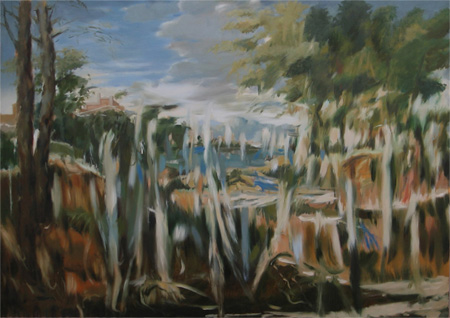
PEDRO MORALES ELIPE, PAISAJE MITOL�GICO, 2011
�leo sobre lienzo 114 x 162 cm |
|||
|
||||
|
||||
|
PEDRO MORALES ELIPE �LA PIEL� Del 12 de marzo al 21 de mayo de 2011 From March 12th 2011 to May 21st 2011 Inauguraci�n: s�bado 12 de marzo de 2010 / 19:30 h Opening: Saturday 12th March 2011 / 7:30 pm La piel, las piedras, el agua Es quiz�s el tema mitol�gico un lugar donde la pintura se ha reinventado a s� misma. Un espacio de extrema libertad, donde todo parece sometido a la ceremonia de la confusi�n de los opuestos. Donde son posibles todos los encuentros. Cuerpos luchando en la naturaleza: David y Goliath, Apolo y Marsias, Acte�n y los perros, Narciso persiguiendo su sombra� Un acontecimiento en un paisaje donde los dioses, los hombres y la naturaleza se entretejen y se confunden y donde el tiempo queda suspendido, detenido, abolido, y el aire agita las cosas en todas las direcciones posibles. Explican los expertos en las t�cnicas pict�ricas que usaba Poussin, que las capas de pintura que aplicaba eran tan delgadas, que los personajes, con el tiempo, parecen estar en trance de desaparecer, o de confundirse y mezclarse con el paisaje, lo que viene a ser lo mismo. Parece, desde luego que, de esta manera, (la piel de la pintura devorada por el tiempo), el mito encuentra su verdadero sentido y el fragor de la disputa alcanza su descanso en la transparencia absoluta, fusion�ndose con el paisaje, haci�ndose carne con �l. Cuerpos de cristal, pieles fin�simas, colgadas de los �rboles, perdidas en la espesura del boscaje, disueltas en el agua. Jirones al viento. Huesos abrasados por el sol. El paisaje en el que suceden los ires y venires de los dioses y los hombres es, por otra parte una invenci�n pura, un lecho para los acontecimientos y, como tal, se conforma a la medida de estos, como una construcci�n ilusoria que da eco a los cuerpos, que prolonga o da escala a sus anatom�as, que amplifica o calma sus desvelos, sus afanados trabajos, sus deseos. El paisaje por tanto no existe como tal, porque no describe un lugar sino que lo funda, sustenta el sentido y conforma la trama. El paisaje se torna tambi�n transparente, transparente de pura visibilidad. La superficie delgada y mentirosa de la pintura es el espacio ilusorio en el que se libra esta batalla. Las cosas haci�ndose la guerra en la pintura, en espera de su reconciliaci�n. Piel fina de la pintura en la que lo visible se conforma desde su afuera, desde su l�mite, desde su exterioridad. Superficie de rozamiento con el mundo. Sabemos que Rothko, en el viaje que realiz� por Italia, durante el verano de 1959, (N�poles, Pompeya, Herculano, Paestum�), fue donde verdaderamente encontr� y vio con sus propios ojos, aquello que andaba buscando desde hace a�os, el espacio de la dramaturgia que quer�a para sus cuadros. Fue la superficie vibrante de los frescos de la Villa de los Misterios, la que le reafirm� en la elocuencia del camino elegido. �He estado pintando templos griegos toda mi vida sin saberlo�, confesaba a sus compa�eros de viaje. Rothko, preocupado como hab�a estado siempre por el mundo m�tico, ese espacio paralelo del sentido donde las cosas se hacen la guerra, se reencuentran y descubren el descanso bajo una parra, por caminos subterr�neos, encontr� una profunda afinidad entre el rojo laca de los frescos y las amplias extensiones de color sombr�o que llenaban sus cuadros. Pudo ver que ese espacio sin tiempo, ten�a, en efecto, huesos, ten�a carne y ten�a piel. Su viaje a las piedras antiguas era en realidad un viaje que le devolv�a otra vez a las paredes de su estudio de New York, despu�s de descansar, como le vemos en una fotograf�a, almorzando pan, queso y vino con sus amigos, a la sombra de las columnas, bajo la b�veda del templo de Hera, en Paestum. Rothko hace en una entrevista estos comentarios sobre su cuadro del a�o 35 Grupo de gente en una estaci�n de metro: �Figuras muy delgadas y altas como barras verticales. Recuerda a Giacometti� Sombreros, ojos, monederos de mujer, etc,�son simples puntos de pintura. Las figuras tienen una existencia fantasmag�rica, l�nguida, ef�mera�� Tambi�n otro pintor norteamericano algo m�s joven, Cy Twombly, acaba encontrando agua bajo el adoquinado romano, como un zahor�, y despu�s de su viaje a Italia, en agosto del 52, (en compa��a de su amigo Robert Rauschenberg) termina qued�ndose y fija su estudio en Roma. La piel es un argumento y es tambi�n una evidencia, en los cuadros que conforman esta exposici�n. Cuerpo y paisaje son los dos elementos que articulan el recorrido en el que la referencias al mundo mitol�gico no est�n presentes de una manera expl�cita, narrada, sino m�s bien como un aire de familia que salta de unos cuadros a otros, como superficies que fueran intercambiables, que mudan su apariencia y buscan espacios de contig�idad m�s all� de sus l�mites. Los cuadros se buscan unos a otros para ampliar su conversaci�n. Una conversaci�n ya iniciada. La piel, que es superficie y es envoltura, como la pintura, aguarda en silencio la mirada que la anime y le devuelva el sentido. En un cuadro, que Poussin, pinta, en agosto de 1648, titulado Paisaje con un hombre muerto por una serpiente, tambi�n llamado Los efectos del terror. Vemos en el extremo izquierdo y en primer t�rmino a una mujer o un hombre tendido en tierra, enlazado por una enorme serpiente que lo devora y lo arrastra hacia el fondo del agua, sobre la que ya cuelgan sus brazos, su cabeza y sus cabellos. Poussin, fascinado por las serpientes, har�a alusi�n a �las que nacen por generaci�n espont�nea de la espina dorsal de un hombre muerto� y podr�a haberse inspirado en un texto de las Metamorfosis de Ovidio que relata la historia de una serpiente monstruosa (un drag�n posiblemente) que asfixia a uno de los compa�eros de Cadmo. Todo se confunde entre las sombras de las rocas y la vegetaci�n: la t�nica agitada, el reptil entre los brazos, el tronco y las piernas. Todo se precipita hacia el agua, y el agua sombr�a es tambi�n devorada y bebida por la tierra. Al fondo, un grupo de viajeros descansa apaciblemente al borde de un lago, junto a unas barcas de pescadores, cerca de la arboleda que cubre en parte la lejan�a. Todo se vuelve transparente. Todo fluye. PME. Febrero, 2011 The skin, the stones, the water The mythological subject is, perhaps, a place in which painting has reinvented itself. A space of extreme freedom, where everything seems subjugated to a ceremony of confusion of opposites. Where all encounters are possible. Bodies fighting in Nature: David and Goliath, Apollo and Marsyas, Actaeon and the dogs, Narcissus pursuing his own shadow� An event in a landscape in which gods, men and Nature are woven together and get mixed up, and in which time is suspended, arrested, abolished, and the air whips things up in all possible directions. Experts in Poussin�s painting techniques explain that the layers of paint that he applied were so thin that his figures, with time, seem to be on the verge of disappearing, or getting mixed up and merging with the landscape � which is more or less the same. It indeed seems that, in this way (the skin of painting devoured by time), myth finds its real meaning and the heat of the quarrel reaches a break in absolute transparency, fusing together with the landscape, becoming flesh with it. Crystal bodies, very thin skins hang from the trees, lost in dense thicket, dissolved in water. Shreds in the wind. Bones scorched by the sun. The landscape in which the comings and goings of gods and men is, on the other hand, pure invention, a bedstead for events and, as such, it is shaped to fit them, as an illusory construction that echoes the bodies, that prolongs or provides their anatomies with a scale, that intensifies or lessens their efforts, their busy toils, their desires. Landscape, therefore, does not exist as such, since it does not depict a place, but founds it, sustains its meaning and constitutes its plot. The landscape turns also transparent, transparent with sheer visibility. The thin and deceiving surface of painting is the illusory space in which this battle is fought. Things waging war in painting, waiting for conciliation. Thin skin of painting, in which the visible is shaped from its outside, from its limit, from its outer-ness. Surface of friction with the world. We know that where Rothko truly found what he had sought for years, the dramatic space that he wanted for his paintings, was in the trip he made through Italy during the summer of 1959 (Naples, Pompeii, Ercolano, Paestum�). It was the vibrant surface of the fresco paintings in the Villa of the Mysteries that confirmed him in the eloquence of the path chosen. �I�ve been painting Greek temples all my life, without knowing it,� he admitted to his travel companions. Worried as he had always been for the mythic world, that parallel space of meaning in which things wage war, find each other again and discover a break under a grapevine, through underground paths, Rothko found a deep affinity between the lacquered red of the fresco paintings and the wide extensions of sombre colour that filled his paintings. He could see that, in effect, such timeless space had bones, had flesh and had skin. His trip to the stones was in fact a trip that took him back to the walls of his New York workshop, after resting, as we see him in a photograph, having a lunch of bread, cheese and wine with his friends in the shade of the columns, under the vault of the Temple of Hera, in Paestum. In an interview, Rothko makes these comments on his painting from 1935 Group of People at a Subway Station: �Very thin and tall figures, like vertical bars. It reminds us of Giacometti� Hats, eyes, women�s purses, etc. are simple dots of paint. The figures have a ghostly, languid, ephemeral existence�� Another, some younger, North American painter, Cy Twombly, finally finds water under the Roman paving, too, like a dowser, and after his trip to Italy, in August 1952 (in company of his friend Robert Rauschenberg), he finally stays and settles his workshop in Rome. The Skin is a storyline and is also an obviousness, in the paintings making up this exhibition. Body and landscape are the two elements that chart the tour in which the references to the mythological world are not there in any explicit, recounted way, but rather like a family air that jumps from some paintings to others, like surfaces that were interchangeable, that changed their appearances and sought spaces of nearness beyond their limits. The paintings seek one another in order to broaden their conversation. A conversation already started. The Skin, which is both surface and casing, like painting, silently awaits that look that will bring it to life and bring meaning back. In a painting created by Poussin in August 1648 and entitled Landscape with a Man Killed by a Snake, also called The Effects of Terror,we first of all see on the far left a woman or a man lying on the ground, hugged by an enormous snake that devours him and drags him towards the bottom of the water, over which his arms, his head and his hair are already hanging. Poussin, fascinated by snakes, would allude to �those who are born by spontaneous generation from the dorsal spine of a dead man� and might have drawn inspiration from a text from Ovid�s Metamorphoses that tells the story of a monstrous snake (possibly a dragon) that asphyxiates one of Cadmo�s mates. Everything gets mixed up among the shadows of the rocks and vegetation: the quivering tunic, the reptile in the arms, the trunk and the legs. Everything precipitates towards the water, and the gloomy water is also devoured and drank by the earth. In the background, a group of travellers rest peacefully by the banks of a lake, beside some fishing boats, near the grove that partly covers the distance. Everything turns transparent. Everything flows. PME. February 2011 |
||||
re-title.com
International contemporary art
SIGN UP FOR NEWSLETTERS

 SIGN UP for ARTIST MEMBERSHIP
SIGN UP for GALLERY MEMBERSHIP
SIGN UP for ARTIST MEMBERSHIP
SIGN UP for GALLERY MEMBERSHIP
Click on the map to search the directory