|
g39: Infernal Machine Stuart Croft, Martijn Hendriks and Dave Griffiths - 9 Oct 2009 to 14 Nov 2009 Current Exhibition |
||||
|
Dave Griffiths, Seer`s Catalogue (from Cue Dots series)
|
|||
|
||||
|
||||
|
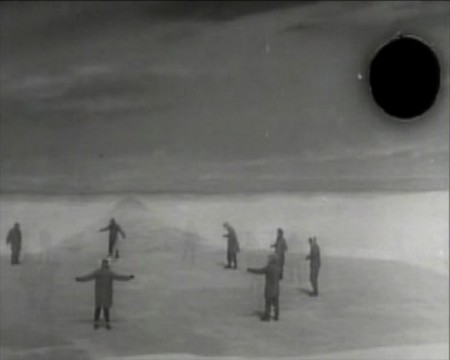
Infernal Machine Dave Griffiths, Martijn Hendriks and Stuart Croft Opens Friday 9 October 2009 g39 presents a new group exhibition, bringing together new work from three significant artists working with film as a gallery based medium. Infernal Machine takes its name from the writer Christopher Isherwood�s description of film as a medium in his novel Prater Violet (1945): �The whole beauty of the Film,� I announced to my mother and Richard next morning at breakfast, �is that it has a certain fixed speed. The way you see it is mechanically conditioned. I mean, take a painting - you can just glance at it, or you can stare at the left hand top corner for half an hour. Same thing with a book. The author can�t stop you from skimming it, or staring at the last chapter and reading backwards� You see, the film is really like a sort of Infernal Machine�� Stuart Croft explores the relationship between art and cinema. Often involving a film crew, Croft normally writes, produces and directs his short film works. The films are typically dialogue-based and character-driven, apparently following a contemporary TV drama genre. Scenes and characters are established rapidly and only partially, and the audience is quickly drawn into the story. Before long, we are faced with an unmistakable d�j� vu sensation, as Croft employs a circular narrative technique and the storyline loops on itself. Within Dave Griffiths� practice is a somewhat fanatical appreciation of the cinematic medium. Often working with existing footage, he celebrates the subtlest of filmic nuances. An ongoing motif in his work is the cue dot: the cinematographer�s discrete marker on screen to indicate an imminent reel change. Griffiths has amassed an impressive archive of cue dots, linking diverse film clips and stills with one consistent but rarely noticed mechanical device. When exhibited his growing archive has taken various forms, from edited film sequences to a colour microfiche sheet. His work for Infernal Machine may be the final showing of the cue dot series, marking the closure of this archive. Like Griffiths, Martijn Hendriks pursues a particular idea using found materials such as objects, text, images and videos. His work is said to address how �unproductive� gestures might become productive. For Infernal Machine Hendriks will be showing an ongoing work which is a version of Hitchcock�s �The Birds� in which he has digitally removed all incidences of the menacing creatures, leaving the characters wildly fleeing from an imagined presence. Rather than being a simply mischievous act, Hendriks� gesture seems to deliberately miss the point, or perhaps more precisely, makes it missing. For more information about the exhibition, or to organise a group visit please contact Sam Perry t: +44 (0)29 2025 5541 e: [email protected] or for press quality images visit our website www.g39.org Drawn In, Drawn Out, Drawn Round Sharon Crew, Jessica Hunziker and Alistair Owen Previews Friday 9 October 2009 G39 continues its curatorial residency at National Theatre Wales with a group exhibition of new work by three promising young artists. Drawing and its myriad forms are imbedded in our ability to learn about what we can do. An abstract page completely covered by a child in colouring crayon is made to understand direction and fullness, trajectory and containment. The works in this exhibition, by some of Wales� most promising recent graduates, explore space through something that is perhaps like drawing. Sharon Crew�s video work observes an interplay and blurring between the fictional and the constructed. The works often contain and element of poetry bound up within the constructions of low-fi documentary filmmaking. Circular Thoughts Also is meandering thought. It�s passing the time. As in a child-like wonderment at the world and the repetition one encounters within it, Crew�s fingers trace out her thoughts of a circle, another circle and yet more circles. Rhythms and tempos build as the world is mapped out and understood through the hand eye/lens relationship. Alistair Owen�s Half a Box is another enactment of space. A loosely sketched drawing in ink of half a cardboard box is mapped onto the artist�s hand. The hand serving as a stand in for a missing sheet of paper for an idea that has suddenly sprung to life and been impatiently jotted down. Through traditional sculpture Jessica Hunziker defines an area of space, inside and out, that would be occupied by the artist�s activity of day-to-day life; Containment and expulsion are both at play simultaneously in Bubblegum Bubble. Perched at mouth height, this captured moment of blowing a gum bubble is rendered in bronze, fixed forever as an expulsion of the artist�s air, rendered inadequate and impotent of the normally inevitable pop. Through a variety of drawing the artists here are ultimately dealing with the performative action in the realisation of the work. A drawn line on a page always delineates space, this side or that side. The drawn lines in each of these artists� works draws out more than a side, they draw what is within, what is out, and of course like all good drawing everything that is (a)round. |
||||
re-title.com
International contemporary art
SIGN UP FOR NEWSLETTERS

 SIGN UP for ARTIST MEMBERSHIP
SIGN UP for GALLERY MEMBERSHIP
SIGN UP for ARTIST MEMBERSHIP
SIGN UP for GALLERY MEMBERSHIP
Click on the map to search the directory