|
frank elbaz: Jesus Alberto Benitez - Le centre n'est pas un point - 14 Jan 2012 to 3 Mar 2012 Current Exhibition |
||||
|
Jesus Alberto Benitez
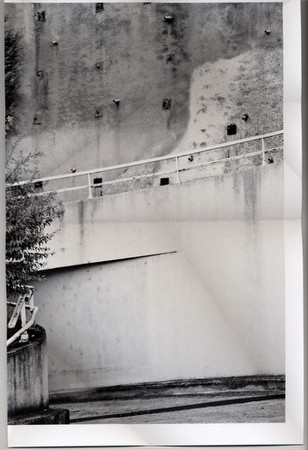
Untitled, 2010, Folded photograph, scanned, inkjet printing, 110 x 165 cm / 43,4 x 65 inc. Courtesy galerie frank elbaz Paris |
|||
|
||||
|
Jesus Alberto Benitez Le centre n'est pas un point VERNISSAGE le samedi 14 janvier OPENING on Saturday, January 14th EXPOSITION jusqu'au 3 mars 2012, du mardi au samedi de 11h à 19h EXHIBITION runs through March 3rd, 2011, Tuesday-Saturday, 11am-7pm The first time I saw Jesus Alberto Benítez’s work was on a studio visit during his production residency in 2010, at the CPIF (Pontault-Combault). He had laid out drawings and photographs on several tables, and you could look at them from all sides. There was no causal link between such and such a photograph and such and such a drawing. When questioned, the artist remained guarded, refusing any overly direct connections. So that disconcerting proximity between two distinct praxes was developed like a complex and enigmatic tissue of liaisons—with which painting is now associated. Oblique forms, diagonals, and triangular shadowy zones all surged up here and there. In the photographs, the lines of the architecture duplicated by lines of shadow increased the number of planes. The drawing was outlined in the image, while abstract forms coming from the photographs made their appearance in the drawings. It had to be noted, however, that the two media differed in both content and treatment. On the one hand, the images included various cut-outs and folds, framed by unequal margins. On the other, the drawings were more instinctive and direct, a few irregular lines made with a perceptible stroke. But obtained using what rule, what procedure? Randomness alone did not seem to be the answer, so right did the placing seem. In fact the reduction of colour and line to the essence denotes a choice about the placing, like, for example, the 2011 drawing Sans titre / Untitled , with a single vertical green line, but with one end separated, suggested a slight assumed accident. We should not overlook another sort of line obtained by folding, a line obtained without any tool, responsible for the input of a third dimension to the sheet of paper, which is nothing other than a very flat object. The formal requirement is all the more disturbing: one easily imagines the precision necessary to inflict a fold on a sheet of paper where the line has already been decided, or vice versa. Lastly, the choice of different sorts of paper, here rough, there smoother, with different shades of colour, suggested that the material was significant. It is in fact this contained drawing, with its rare and precise gestures, which lends an element of disjunction to all Jesus Alberto Benítez’s propositions. It upsets the overspill of the photographs. Even if these latter inspire a sensation of void, probably through the absence of bodies and through truncated views of work spaces. The cut-out and the unequal placing on the paper throw the whole thing off-balance. It would not be out of place to talk about image gravity. Sans titre / Untitled (2010, a scanned folded photograph printed on poster paper, is how the work’s notice describes it1 ), is an exterior image with a staircase, folded several times over, suggesting different types of gravity. One being retinal, a matter of balance, then that of the paper itself, raised, separated from the wall or table where it is installed. So it is hard to precisely define the object of these images, even if they conjure up studio work (they come from different environments, from the porcelain factory to the musical rehearsal studio) and urban nooks. A tea-towel, cut-out planks, a slope between two buildings, all first and foremost denote the content of an eye coming to rest on the side of the central nucleus of human activity and the walls with which it is surrounded. Whence the can and the aerosol in Queens (2007-2010), put there by a hand too busy to then get rid of them. The image treatment, for its part, evokes the document by way of a rhetoric involving margin and printing, which is tantamount to questioning the manner of materializing the image. Like the drawings, the images are the object of a quest for purification which lends visibility to the choice of elements bringing into existence a moment in time, to which are given a space and a matter. It remains to be said that the actual driving force of the drawings and photographs is the right placing of the things, from the line to the fold, like when you put something on a table or against a wall. Without any aesthetic quest, these residual gestures are the outcome of circumstances and conditionings which have given rise to such tiny and banal micro-situations that we scarcely notice them. But this is where a French expression springs to mind: when it is a question of underscoring the importance of a fact or action which might otherwise go unnoticed, we often resort to the euphemism “ ce n’est pas rien” , (loosely translated as “it’s no small thing” or “it’s no mean feat”). It cannot really be translated, as such. In Benítez’s language, Spanish, and in mine, Portuguese, this would literally be like saying “it’s nothing”. It is the breakdown of the negative adverb into two words, “ne” and “pas”, which probably permits the euphemism and underpins a line of thought, by the same token, involving the “next to nothing”. This cut-out of the next-to-nothing which Jesus Alberto Benítez makes is in reality a rigorous research into elements which make something exist. He is fascinated by theories of origins, like that of the proto-planet Theia which allegedly made the earth explode and thus gave birth to the moon. He functions from chance to chance to form a cosmogony. But why, then, look for the ways things exist in their poorest and most neglected crannies? An ethic takes shape here, one involving siding with everything that is no small thing, like a way of questioning man’s place in the totality of the world. One does not practice purification for nothing. The fact remains that the artist’s ambitions are not those of the scientist who reproduces gigantic phenomena on a small scale. Photography may be a way of making the phenomenon exist in the present, but it is also creation, a tension between present and future. The manipulations to which Jesus Alberto Benítez subjects it, along with their poor object, are mechanisms of an eye for detail, for what is overlooked, and omitted. They are the medium of an attention paid to forms in shadow, but engendering the multiplication of swathes of unsuspected realities, by artistic creation. Whence the recourse to the source, the studio, with its machines and its tools. These interplays between void and solid recur at the centre of his images and drawings, as well as his paintings. As nothing less than exercises in partial coverings, the paintings on plyboard display as many planes of painting as gestures of drawing or remains of paint or adhesive tapes. Like the flipside of the decor, they can be looked at in profile, displaying very controlled runs. The plyboard is “poor”, to be sure, but it is new and clean. The gestures seem random, but situate objects (withdrawn after the fact) placed haphazardly. A game, reduced to its elements, the line, the spray mark and the framing, refers to another much more metaphysical game, that of chance and creation. Like a piece of music focusing essentially on noise, silence and atonality, Jesus Alberto Benítez’s oeuvre is focused on line, void and de-hierarchization of the gaze. In a word, an oeuvre encompassing elements that are culturally excluded from creation (but precisely where one can better question it)—everything that is no small thing. Joana Neves (translated by Simon Pleasance) Born in 1978 in Valencia, Venezuela. Lives and works in Lyon, France. Exhibitions: 2012 : Le bleu du ciel, Lyon, France (solo); 2011 : Jeune Création, le Centquatre, Paris, France (group); Codex , LiveInYourHead - Institut curatorial de la Head, Geneva, Switzerland, curated by Pierre Leguillon (group); Des années de poudre recouvrant des années de jaune, galerie frank elbaz, Paris, France, curated by Gyan Panchal (group); 2000- 2010 , Atelier Grognard, Reuil-Malmaison, France (group); 2010: Sommerrundgang, Kunstakademie Düsseldorf, Germany (group); 2009 : L’évocation documentaire , Mois européen de la photographie, Bratislava, Slovakia (group); 2008 : Exposition de noël, CNAC-Magasin, Grenoble, France (group); Panorama de la jeune création, Bourges, France (group); 2007 : Papier sur le bureau , Le bleu du ciel, Lyon, France (solo); Biennale de Prague, Czech Republic (group); Anonyme zeichner, selection , 4 Berliner kunstsalon, Berlin, Germany (group); Poésie, l’image et le son - La poésie nuit , Chantier Public, Lyon, France (group); 2006 : Grammaire de la ville, Goethe Institut, Lyon, France (group); I° Bienal internacional de fotografia , Museo Alejandro Otero, Caracas, Venezuela (group); 2005 : P.I.O.U., Château de la Petite Malmaison, Rueil-Malmaison, France (group); Bredi-breda - Diplômés de l’Ecole d’Arts de Rueil-Malmaison , Le Plateau, Paris, France (group) For more informations, please contact Daphné : +33 (0)1 48 87 50 04 / [email protected] - La première fois que j'ai vu le travail de Jesus Alberto Benitez fut lors d'une visite d'atelier pendant sa résidence de production, en 2010, au CPIF (Pontault-Combault). Il avait disposé dessins et photographies sur plusieurs tables, qui pouvaient être observées de tous les côtés. Or, il n'y avait pas de relation causale entre telle photographie et tel dessin. Questionné, l'artiste restait sur ses gardes, refusant des rapprochements trop directs. Ainsi, cette proximité déroutante entre deux pratiques distinctes se déploya comme un tissu complexe et énigmatique de correspondances - auquel s'associe à présent la peinture. Des formes obliques, des diagonales, des zones d'ombre triangulaires ressurgissaient ici et là. Dans les photographies, les lignes de l'architecture doublées par des lignes d'ombre multipliaient les plans. Le dessin se profilait dans l'image, tandis que des formes abstraites issues des photographies faisaient leur apparition dans les dessins. Force était de constater, cependant, que les deux supports différaient en contenu et en traitement. D'un côté les images portaient des découpes et des plis variés, cadrées par des marges inégales. De l'autre les dessins étaient plus instinctifs et directs, quelques lignes irrégulières d'un trait sensible. Mais obtenus par quelle règle, quel protocole? L'aléatoire seul ne semblait pas être de mise, tant le placement paraissait juste. En effet, la réduction de la couleur et du trait à l'essentiel dénote un choix quant au placement comme, par exemple, le dessin Sans titre de 2011, avec un seul trait vert vertical, mais dont un bout se détache, suggérant un brin d'accident assumé. Il ne faut pas négliger une autre sorte de trait obtenu par le pliage, trait obtenu sans outil, responsable de l'apport d'une troisième dimension à la feuille, qui n'est autre chose qu'un objet très plat. L'exigence formelle est d'autant plus troublante : on imagine aisément la précision nécessaire pour infliger un pli à une feuille où le trait est déjà décidé, ou vice-versa. Finalement, le choix de différents papiers, ici rugueux, là plus lisses, avec des tons différents, suggérait une importance du matériau. C'est en effet ce dessin contenu, aux gestes rares et précis, qui apporte un élément de disjonction à l'ensemble des propositions de Jesus Alberto Benitez. Il vient troubler le trop-plein des photographies. Même si celles-ci inspirent une sensation de vide, sans doute par l'absence de corps et par des vues tronquées d'espaces de travail. La découpe et le placement inégal sur la feuille déséquilibrent l'ensemble. Il ne serait pas malvenu de parler de pesanteur de l'image. Sans titre (2010, photographie scannée pliée imprimée sur papier affiche, précise la notice de l'oeuvre ), est une image d'extérieur avec une rampe, pliée plusieurs fois, suggérant différents types de pesanteur. L'une étant d'ordre rétinien, affaire d'équilibre, puis celle du papier lui-même, relevé, séparé du mur ou de la table où il est installé. Il est donc difficile de définir précisément l'objet de ces images, même si elles évoquent le travail d'atelier (elles sont issues de milieux divers, de l'usine de porcelaine au studio de répétitions de musique) ou des recoins urbains. Un torchon, des planches découpées, une pente entre deux immeubles, dénotent d'abord la teneur d'un regard qui se pose sur l'à-côté du noyau central de l'activité humaine et sur les formes peu remarquées des murs dont elle s'entoure. D'où la canette et l'aérosol de Queens (2007-2010), posées là par une main trop occupée pour s'en débarrasser de suite. Le traitement, quant à lui, évoque le document par une rhétorique de la marge et de l'impression, ce qui revient à s'interroger sur la façon de matérialiser l'image. Comme les dessins, les images sont l'objet d'une recherche d'épuration qui rend visible le choix des éléments faisant exister un moment dans le temps, auquel sont donnés un espace et une matière. Reste à remarquer que le moteur même des dessins et des photographies est le placement juste des choses, du trait ou du pli, comme lorsqu'on pose quelque chose sur une table ou contre un mur. Sans recherche esthétique, ces gestes résiduels sont le résultat de circonstances et de conditionnements qui ont suscité des micro-situations tellement infimes et banales que nous les remarquons à peine. Mais voilà qu'une expression française vient à l'esprit : lorsq |
||||
|
||||
re-title.com
International contemporary art
SIGN UP FOR NEWSLETTERS

 SIGN UP for ARTIST MEMBERSHIP
SIGN UP for GALLERY MEMBERSHIP
SIGN UP for ARTIST MEMBERSHIP
SIGN UP for GALLERY MEMBERSHIP
Click on the map to search the directory