|
frank elbaz: Gorgona (... Knifer, Mangelos, Vanista...) - 9 June 2011 to 30 July 2011 Current Exhibition |
||||
|
|
|||
|
||||
|
||||
|
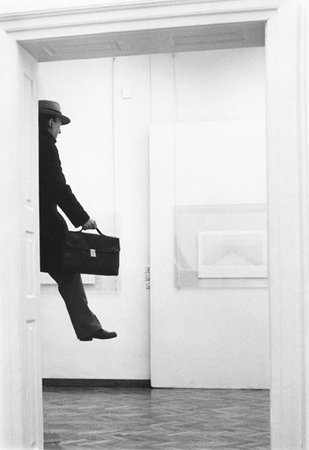
Gorgona (... Knifer, Mangelos, Vanista...) VERNISSAGE le jeudi 9 juin OPENING on Thursday, June 9thEXPOSITION jusqu'au 30 juillet 2011, du mardi au samedi de 11h à 19h EXHIBITION runs through July 30th, 2011, Tuesday-Saturday, 11am-7pm Communiqué de presse: Pour cette exposition, la Galerie Frank Elbaz choisit de montrer une sélection d'oeuvres mettant en lumière une approche artistique à part dans le contexte croate et européen de la deuxième moitié du XXème siècle. Gorgona n'a rien à voir avec un groupe d'artistes dans le sens conventionnel du terme. A la fin des années 50, à Zagreb, les peintres Julije Knifer, Marijan Jevsovar, Duro Seder, Josip Vanista, le sculpteur Ivan Kozaric, l'architecte Miljenko Horvat et les historiens d'art Dimitrije Basicevic Mangelos, Matko Mestrovic et Radoslav Putar avaient l'habitude de se réunir. Ils organisaient des expositions dans la boutique d'un encadreur, Studio G, et publiaient une anti-revue entre 1961 et 1966. Chacune des onze publications était une oeuvre d'art en soi, conçue par un des artistes. Ils n'avaient rédigé aucun manifeste, ce qui les unissait c'était le même état d'esprit. Chaque membre poursuivait sa propre activité artistique ou théorique dans un espace de liberté totale, tout en participant aux actions du groupe. Bien entendu, leur troc intellectuel a créé des transferts qui ont fortement influencés leur propre travail. L'oeuvre des trois plus fortes personnalités, Vanista, Knifer et Mangelos est marquée par cet échange permanent en la faisant apparaître sous un angle différent. L'art de Gorgona est tout d'abord une opération mentale qui peut exister sans sa réalisation matérielle. La pratique pré-conceptuelle de Gorgona place l'activité artistique dans le domaine de la pensée, du nihilisme, du philosophique...Elle passe du positionnement existentiel à l'approche comportementale, son domaine d'action se place dans la sphère de la dématérialisation de l'art, une pratique d'art au quotidien, des promenades, des rassemblements, réunions. Des parallèles s'imposent avec les artistes dont la démarche est une expression d'une attitude ou d'un processus, comme celle d'Yves Klein, de Piero Manzoni, du groupe Zéro, ou bien de Fluxus. Ce n'est pas par hasard s'ils ont tissé les liens avec Dieter Roth, Piero Manzoni, Robert Rauschenberg, Harold Pinter, François Morellet, Vasarely et Yves Klein. D'ailleurs l'exposition s'articule non seulement autour des oeuvres personnelles des trois artistes mais aussi autour des activités réelles dans une interaction internationale, documents d'archives et photographiques à l'appui, telle la lettre adressée à une poétesse dans laquelle Josip Vanista parle du conservateur du Guggenheim, M. Fry soumettant la proposition de Marcel Duchamp désireux d'élaborer un projet pour le groupe. Citons aussi les numéros de l'anti-magazine Gorgona réalisés par Roth, Pinter et Vasarely ainsi que la toute première exposition de François Morellet à l'espace Studio G. L'exposition met en lumière un groupe d'artistes dont l'attitude prime sur la forme, démontrant encore aujourd'hui la vitalité d'une activité qui n'a jamais cessé d'exister. Tel est le meilleur hommage à un mouvement en marge du système institutionnel de l'art contemporain, jamais essoufflé dans sa recherche de liberté spirituelle et intellectuelle. Danka Sosic Press Release: The works making up this exhibition at Galerie Frank Elbaz spotlight a distinctive avant-garde within the Croatian and European context during the second half of the 20th century. Gorgona was no conventional group of artists. In Zagreb in the late 1950s the painters Julije Knifer, Marijan Jevsovar, Duro Seder and Josip Vanista used to get together regularly with sculptor Ivan Kozaric, architect Miljenko Horvat and art historians Dimitrije Basicevic Mangelos, Matko Mestrovic and Radoslav Putar. They organised exhibitions in the Studio G framing shop and published the anti-magazine Gorgona between 1961 and 1966: each of these eleven publications was designed by an artist as a work in its own right. The group never issued a manifesto: its unity hinged on a shared state of mind that allowed each member full freedom to pursue his own artistic and/or theoretical activities while still contributing to the group's activities. Naturally enough, the ongoing intellectual interplay had a marked influence, and in their work the three strongest personalities, Vanista, Knifer and Mangelos, bear witness to this, each in his own way. The Gorgona group's art was first and foremost a mental affair that did not necessarily require material expression: this was a preconceptual practice that situated the making of art in the domain of the intellectual, the nihilistic and the philosophical. Moving from an initially existentialist stance to a behaviourist one, it took the dematerialisation of art as its sphere of action: art as an everyday matter of outings, assemblies and meetings. The obvious parallel here is with artists whose agenda embodied an attitude or a process, like Yves Klein, Piero Manzoni, the Zero group and Fluxus. It is hardly surprising, then, that there were connections with Dieter Roth, Piero Manzoni, Robert Rauschenberg, Harold Pinter, François Morellet, Vasarely and Yves Klein. Accordingly, the exhibition centres not only on the work of its three artists, but also on archival documents and photographs relating to international ventures: one example is a letter to a woman poet in which Josip Vanista mentions Guggenheim curator Edward F. Fry's advocacy of Marcel Duchamp's proposition for a project for the group. There are also the issues of Gorgona prepared by Roth, Pinter and Vasarely, and material relating to François Morellet's very first Studio G exhibition. Focusing on a group of artists for whom standpoint outweighed form, this exhibition demonstrates the enduring vitality of a specific kind of artistic activity. There could be no better tribute to a movement working on the fringe of the institutionalised Contemporary Art system, one that never faltered in its quest for spiritual and intellectual freedom. -- Danka Sosic (Translation: John Tittensor) galerie frank elbaz 7 rue saint claude 75003 Paris France T + 33 1 48 87 50 04 F + 33 1 48 87 52 93 www.galeriefrankelbaz.com [email protected] |
||||
re-title.com
International contemporary art
SIGN UP FOR NEWSLETTERS

 SIGN UP for ARTIST MEMBERSHIP
SIGN UP for GALLERY MEMBERSHIP
SIGN UP for ARTIST MEMBERSHIP
SIGN UP for GALLERY MEMBERSHIP
Click on the map to search the directory