|
frank elbaz: Bernard Piffaretti - bande-annonce - 7 May 2011 to 4 June 2011 Current Exhibition |
||||
|
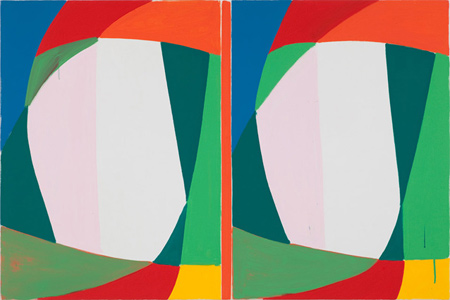
Piffaretti, Sans titre, 2007, Acrylique sur toile / Acrylic on canvas, 100 x 150 cm
� Bertrand Huet |
|||
|
||||
|
||||
|
Bernard Piffaretti bande-annonce VERNISSAGE le samedi 7 mai EXPOSITION jusqu'au 4 juin 2011, du mardi au samedi de 11h � 19h La galerie frank elbaz a le plaisir d'annoncer la premi�re exposition personnelle de Bernard Piffaretti � la galerie. Entrer dans une exposition de tableaux de Bernard Piffaretti, c'est d'abord appr�hender une s�rie de � situations picturales �, comme le peintre les appelle, que l'observateur reconna�tra sans mal comme celles de l'abstraction moderniste, dont les codes et les composantes se sont progressivement d�finies au long d'une histoire d�sormais s�culaire. Soit un ensemble de motifs et de structures, grilles, trames, damiers, patterns r�p�titifs et all-over, de semis de t�ches ou de menus �l�ments, qui d�clarent la plan�it� et l'isomorphisme intrins�ques du support de la peinture, auxquels s'accordent la pratique pr�dominante de l'aplat color�. Expliquer ce qu'est un tableau de Bernard Piffaretti passe n�cessairement par l'expos� d'une m�thode, celle consistant � partager d'un trait de s�paration vertical le champ de la toile vierge en deux parties �gales, avant de marquer l'une des moiti�s par un ensemble de signes, de gestes et de traces qui seront ensuite dupliqu�s sur l'autre moiti�. Par quoi la duplication piffarettienne s'inscrit dans une longue histoire de � l'image d�doubl�e � et du tableau dans le tableau dont tous les exemples parlent de la peinture comme outil r�flexif � faire voir le travail de la peinture. Tout tableau de Piffaretti est donc un m�ta-tableau, puisqu'il est ce dispositif en miroir dans lequel une partie refl�te le sc�nario de la production de l'image pr�sente dans l'autre partie, sa reprise cons�cutive et adjacente. L'ensemble d'oeuvres de 2011 que pr�sente la Galerie Frank Elbaz ne d�roge ni � ces caract�ristiques visuelles ni � la m�thode. Mais le titre sous lequel le peintre a voulu les rassembler, � bande-annonce �, invite � en saisir le projet selon un r�cit diff�remment circonstanci� -- c'est souvent le r�le du langage chez Piffaretti. Au moment d'entamer une nouvelle collaboration avec le partenaire artistique et commercial qu'est son galeriste pour le peintre, ce dernier annonce la couleur et, � la mani�re de ces films brefs dont l'industrie cin�matographique se sert pour la promotion de ses produits -- pot-pourri des sc�nes les plus all�chantes et des dialogues les plus saillants --, fait d�filer un �chantillonnage de toutes ses inventions. Avec, par ordre d'apparition dans la chronologie piffarettienne : le tableau sous sa forme la plus fr�quente, organis� en deux moiti�s identiques, que l'on vient de d�crire ; le tableau inachev�, dont l'une des moiti�s est laiss�e vierge ; le tableau uniquement structur� par l'architecture de la lettre ou du mot ; le � dessin apr�s tableau �, r�alis� a posteriori, d'apr�s un tableau ex�cut� ; le � poncif �, impression en noir et blanc de d�tails de tableaux grossis jusqu'au pixel ; et le tableau dit � en n�gatif �, derni�re des d�clinaisons de la m�thode Piffaretti, toile de format tondo qui se pr�sente comme le d�tail d'un tableau qui n'existe pas. La bande-annonce, dans le registre m�tapictural de Piffaretti, c'est aussi et bien s�r le marquage central et principiel de la toile, la bande qui pr�lude au tableau et annonce la peinture � venir. Dans le cas du tableau laiss� volontairement inachev�, par impossibilit� reconnue de retrouver l'ordre des gestes originels sous les strates successives de la peinture, c'est au spectateur de projeter sur l'�cran de la toile vierge le film des �v�nements qui auraient abouti � la compl�tude. De m�me, dans le cas des tableaux en n�gatif, le spectateur aura tendance � combler le manque en compl�tant virtuellement les motifs et les structures, et � rechercher l'axe de sym�trie capable de r�organiser la compr�hension du tableau. Dans les deux cas, la strat�gie retenue est un moyen de rendre visible en creux le processus de cr�ation, et de d�voiler l'op�ration fondamentale dont d�pend chez Piffaretti l'instauration du tableau en deux moiti�s �quivalentes : � mi/mi �, dit quant � lui le tableau de lettres, en un �nonc� bi-partite et sym�trique on ne peut plus clair, qui enrichit un petit groupe d'oeuvres o� c'est le langage qui est charg� de th�matiser la proc�dure du redoublement. Filer un peu plus la m�taphore cin�matographique pourrait avoir comme cons�quence fortuite de faire appara�tre le tableau piffarettien non plus seulement comme le r�sultat d'une duplication, mais aussi comme celui d'un montage -- un montage qui n'avance pas, cela dit, et qui n'est l'instrument d'aucune progression temporelle. A l'instar de ce qui se passe -- ou ne se passe pas -- dans l'oeuvre de Piffaretti depuis que la r�p�tition de sa m�thode lui tient lieu de toute �volution et que le peintre s'est ainsi soustrait � l'emprise de la chronologie : Piffaretti a peut-�tre d�j� peint ses derniers tableaux alors que les premiers ne le sont peut-�tre pas encore... Mais que l'oeuvre soit sans chronologie n'implique pas qu'elle soit sans histoire ni que l'historicit� soit sans prise sur elle. Il faut au contraire le rappeler : au beau milieu des ann�es 1980, lorsque se fixe le protocole de la duplication, Piffaretti met au point l'une des mani�res les plus d�cisives de tenir � distance le geste et l'expression -- de celles qui octroient � leur inventeur une place essentielle dans l'histoire. Arnauld Pierre Bernard Piffaretti bande-annonce OPENING on Saturday, May 7th EXHIBITION runs through June 4th, 2011, Tuesday-Saturday, 11am-7pm Galerie frank elbaz is pleased to announce Bernard Piffaretti's first personal exhibition at the gallery. Going to a Bernard Piffaretti exhibition first of all involves addressing a series of what the artist calls "painterly situations". These, as the viewer will have no trouble in recognising, represent the modernist abstraction whose codes and components have been gradually defined in the course of the last century : a set of motifs and structures - grids, interweavings, checkerboards, repetitive patterns, all-overs, scatterings of marks or little bits and pieces - which assert the intrinsic flatness and isomorphism of the picture supports, qualities matched by the prevailing use of areas of flat colour. Any explanation of a Piffaretti painting necessarily involves outlining a method, one that consists in dividing the blank canvas in two with a vertical line and marking one half with a set of signs, signals and traces which are then duplicated on the other half: a process that makes Piffaretti part of the long history of those "split images" and pictures within a picture which all speak of painting as a reflexive tool for making the work of painting visible. So every Piffaretti picture is a meta-picture, a mirror-device in which one part, as a consecutive, adjacent recreation, reflects the production scenario of the image to be found in the other part. The group of paintings from 2011 being shown at the Galerie Frank Elbaz departs from neither these visual characteristics nor the method. But the title the painter has chosen for them, bande-annonce ("Trailer"), invites us to consider the project in the light of a different kind of narrative - which is often what Piffaretti's use of language is all about. At the beginning of this joint venture with his artistic/commercial partner - the gallerist - the artist stated his position and - as in those brief promotional opuses the movie industry puts out for each new production, farragoes of the most eye-catching scenes and snappiest dialogues - ran through a sample of his inventions. Sticking to the Piffaretti timeline, things run as follows: the picture in its most frequent form, the layout in two identical halves just described; the unfinished picture, with one half left blank; the picture structured solely by the architecture of a letter or a word; the "drawing after a picture", executed a posteriori from an already finished work; the "stencil", a black and white print of pixellated details of pictures; and the most recent of the Piffaretti variations, the "negative" picture, a tondo-shaped canvas presented as a detail from a picture which in fact does not exist. In the artist's metapictorial register the "trailer" is also - of course - that central, generative marking of the canvas, the preludial strip heralding the painting to come. In the case of the picture deliberately left unfinished because of the impossibility of any ordered reprise of the originative gestures beneath the successive strata of paint, it is up to the viewer to project onto the screen - the blank canvas, that is - the film of the events that would have led to completion. Similarly, in the case of the negative pictures, the viewer will tend to fill the gap via virtual closure of the motifs and structures and by hunting for the axis of symmetry capable of reorganising an understanding of the work. In both instances the strategy chosen is a way of rendering the creative process implicitly visible and revealing the fundamental operation required by the Piffaretti system for the establishing of the picture as two equivalent halves: "half/half" the letter picture says, in a bipartite, symmetrically pristine statement that enriches a small group of works in which language is given the job of thematising the reduplication procedure. Taking the cinema metaphor a little further could have the unintended consequence of making the Piffaretti picture look like the result not only of a replication, but also of a montage - but a montage that goes nowhere and is the instrument of no temporal advance. Just like what happens - or doesn't happen - in the Piffaretti oeuvre since methodological repetition supplanted evolution and the painter broke the hold of chronology: maybe Piffaretti has already painted his last pictures, while the first ones are still pending. But being asynchronous does not mean the oeuvre has no history or that historicity has no dominion. On the contrary, let us not forget that in the mid-1980s, with his adoption of the duplication procedure, Piffaretti perfected one of the most decisive methods of keeping gesture and expression at bay - one of those methods that grant their inventor a crucial place in history. Arnauld Pierre Translated by John Tittensor A l'occasion du vernissage, pr�sentation du catalogue Avant/Post et signature de la 2�me s�rie des tir�s � part : 15 ouvrages illustr�s par un dessin original aux crayons de couleur. The vernissage will also feature presentation of the artist's Avant/Post catalogue and dedications of the second series of special printings: 15 copies including an original colour-pencil drawing. AVANT/POST Bernard Piffaretti / tableaux d�riv�s & produits d�riv�s Edition Epileptic - 2011, r�alis� avec le soutien du Centre national des arts plastiques (aide � l'�dition imprim�e), minist�re de la Culture et de la Communication, du FRAC Haute-Normandie et de Fedrigoni France galerie frank elbaz 7 rue saint claude 75003 Paris France T + 33 1 48 87 50 04 F + 33 1 48 87 52 93 www.galeriefrankelbaz.com [email protected] |
||||
re-title.com
International contemporary art
SIGN UP FOR NEWSLETTERS

 SIGN UP for ARTIST MEMBERSHIP
SIGN UP for GALLERY MEMBERSHIP
SIGN UP for ARTIST MEMBERSHIP
SIGN UP for GALLERY MEMBERSHIP
Click on the map to search the directory