|
David Risley Gallery: Roderick Harris - Fugue - 7 Mar 2008 to 6 Apr 2008 Current Exhibition |
||||
|
Roderick Harris
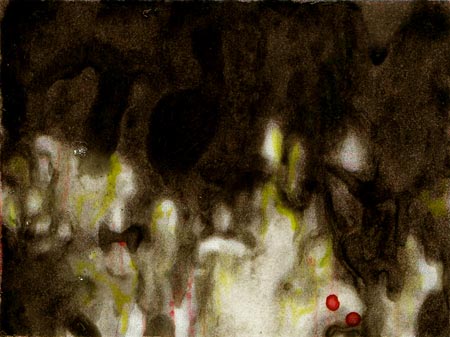
Fugue. Audience 1 (close up) 6 x 4.5cm Inkjet, Watercolour and Glitter on paper 2008 |
|||
|
||||
|
||||
|
Roderick Harris | Fugue 7 March - 6 April | Preview 6 March David Risley Gallery is proud to present a new body of work by Roderick Harris. David Risley�s first independently organised exhibition at Zwemmer Gallery, London �Showdown� was a solo show of work made by Harris following his graduation from the Royal College of Art in 2000. Fugue will be Harris� first solo show for 4 years. Over the past year Harris has been photographing and re-working footage of Michael Jackson performing �Smooth Criminal� from his �Dangerous� World Tour of 1993. Shooting directly from the screens surface, anomalous digital effects are created and a foggy, electronic texture resembling vintage or �psychic� photography emerges as a digital ghost of a ghost - further liquefied through painterly interpretation. The collective title for this body of work �Fugue� derives from the Latin fuga � related to fugere (to flee). In music it denotes a type of contrapuntal composition most highly developed during the Baroque. In psychology it denotes a dreamlike altered state of consciousness that is dissociative � characterised by flight from personal identity as a response to trauma or stress. Harris identified this performance as an effective lens through which an ongoing fascination with a network of psychological, esoteric, existential, pictorial and painterly connections converging around the notion of fugue could be explored. The stage performance is read as a highly orchestrated ritualisation of a surrogate persona analogous to the logic of personal fugue - as the notion of fugue itself is read as analogous to a wider, collective situation. Experience of fugue state typically expressed as that of the �puppet zombie� holds an uncanny relevance in light of the logic of Jackson�s earlier �Thriller�. Pyrotechnics, spotlights, dry-ice and shadows, feature as centrally as performers but distanced from their original identity and context invite readings less than theatrical or banal. A hallucinatory transmutation bordering on the hyper-religious emerges, its participants caught up in a performance of uncertain currency. The star of this spectacle fails to appear as icon to be worshipped or object of lampoon, but as an obscured and elusive fragment, a microcosmic creature (and audience) in dissociative flight playing out a game of losing itself on stage as within the materiality of a dissolved miniature painterly adventure. |
||||
re-title.com
International contemporary art
SIGN UP FOR NEWSLETTERS

 SIGN UP for ARTIST MEMBERSHIP
SIGN UP for GALLERY MEMBERSHIP
SIGN UP for ARTIST MEMBERSHIP
SIGN UP for GALLERY MEMBERSHIP
Click on the map to search the directory