|
christine koenig galerie: curated by_vienna 09 : Beginnings, Middles, And Ends - 9 May 2009 to 13 June 2009 Current Exhibition |
||||
|
curated by_vienna 09 : Beginnings, Middles, And Ends
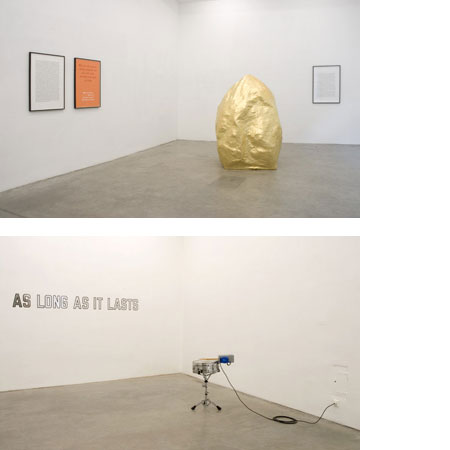
Installation Views christine koenig galerie, 2009 |
|||
|
||||
|
||||
|
CHRISTINE K�NIG GALERIE, ENGHOLM ENGELHORN GALERIE, GEORG KARGL FINE ARTS and GABRIELE SENN GALERIE cordially invite you to the opening of the exhibition curated by_vienna 09 Beginnings, Middles, And Ends Curator: Gianni Jetzer, New York Opening: Friday, May 8, 2009, 6 - 12 pm Duration of the exhibition: May 9 - June 13, 2009 Lecture Matthew Higgs and Gianni Jetzer Tuesday, May 5, 2009, 5 p.m. Depot, Breitegasse 3, 1070 Vienna Panel Fractured Narrative Thursday, May 7, 2009, 2 p.m departure lounge, VIENNAFAIR 09, hall A Diana Baldon (moderation) D�ra Hegyi J�rg Huber Gianni Jetzer Roberto Ohrt Beginnings, Middles, And Ends Luke Butler, Annelise Coste, Ceal Floyer, Douglas Gordon, Amy Granat, Matthew Higgs, Gabriel Kuri, J�rg Lehni, Louise Lawler, J�n Man�u�ka, Kris Martin, Olivier Mosset, Marlo Pascual, Mai-Thu Perret, Alex Rich, Valentin Ruhry, Gedi Sibony, William Stone, Lawrence Weiner, Andro Wekua, Guido van der Werve Once there was a little boy and everything turned out alright. THE END Louise Lawler Narration has long since been the common denominator of art and writing. But artists do not always make a point of telling the whole story. Art aims at the untellable, the untold; it dwells in the absence of action, exposing such quintessence as is lost in the transit from first word to last. Beginnings, Middles, And Ends brings together works for which the narrative fragment is the primary unit of measure. The exhibition presents image sequences, abstract forms, film sequences, single words or - as an exception - sentences in their entirety; story is reduced to its simplest component parts, without, however, referring to an overarching whole. Under the sign of the fragment, the work of art comes to resemble certain classical sculptures of the human torso, which, lacking organs of mobility and sight, confront us with the paradox of a unity or wholeness premised upon partiality and absence. Louise Lawler's work Once there was a little boy plays on the promise of totality implied by traditional narration. A two-sentence story with definite start- and endpoints, Once there was a little boy summarizes a life in the most lapidary way possible. Lacking a definite middle, Lawler's fictional frame rejects the specificity of traditional storytelling; the boy in question disappears as soon as he is introduced. Indeed, the ending seems quite solemn, following from no definite storyline, no dramatic chain of events. In the exhibition, Lawler's use of monochrome wall paint and her ostentatious application of letters accentuate the story's perplexing brevity. The terrain charted in Beginnings, Middles, And Ends is not to be reached by straightforward means. Here, narrative finds itself fragmented, and fragments about each other in turn, objects, sentences, and ideas in unruly order - a syntax of discontinuity and false starts. The exhibition extends over four gallery rooms and is based entirely on such fragments. Intentionally, there is no defined sequence. The untold is, in this sense, a quantity as well as a quality: for every path towards narrative, there is also a path in the reverse direction, along which lies the image of what goes unsaid. |
||||
re-title.com
International contemporary art
SIGN UP FOR NEWSLETTERS

 SIGN UP for ARTIST MEMBERSHIP
SIGN UP for GALLERY MEMBERSHIP
SIGN UP for ARTIST MEMBERSHIP
SIGN UP for GALLERY MEMBERSHIP
Click on the map to search the directory