|
Caroline Pag�s Gallery: JESUS ALBERTO BENITEZ - Pulsar - 18 Apr 2013 to 15 June 2013 Current Exhibition |
||||
|
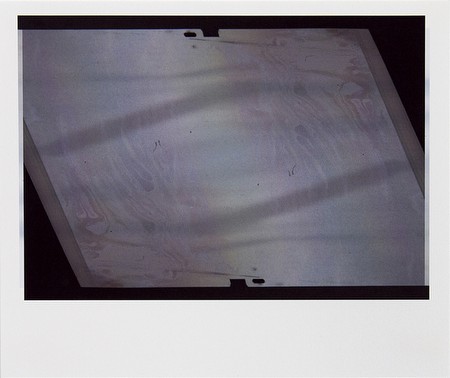
Jesus Alberto Benitez, Untitled, 2011
Double inkjet print 17 x 21 cm |
|||
|
||||
|
JESUS ALBERTO BENITEZ Pulsar Opening Thursday, April 18 at 10 pm April 18 - June 15 Pulsar Shapes that are both delicate and coarse, made up of silence and eloquence, are what generally constitute the graphic and photographic work of Jesus Alberto Benitez. These shapes can be extremely soft or sometimes display barely contained brutality. An example is this wooden plaque, partially covered with grey paint (visibly painted by the fingers in a movement that one imagines to have been as decisive as it was swift), through which a persistent shape, a square, is visible 1 . This shape seems to appear in a “deliberately fortuitous” manner, an expression for which we can attempt an explanation: Jesus Alberto Benitez leaves nothing to chance, but owes much to it. He is precise, even meticulous. He is as demanding as he is of our attention. His precision is confronted with change, breaks, obstacles and, in one word, accidents. The studio is the ideal place to provoke these. And at that point, it becomes clear that the square, unexpectedly highlighted by a solid area of glue, is far from insignificant. It is the mark of something that has disappeared, that of an adhesive whose memory it retains. Just like this square, the work of Jesus Alberto Benitez is testimony to that which is transient, and to infinite variations - it is able to delineate the contours of that which is yet to come. Le bureau2 (“The Office”) also shows proof of this. This inkjet print imperceptibly shows a surface that has been involuntarily dusted off, a track that seems to pave the way for the arrival of the rest of the image. This, then, is how we must use the approach to which we are committed here: concentrating our eyes on the details while at the same time striving to detach from them, or, to put it succinctly, to look beyond what we see. This transgression of the visible translates as a pronounced taste for the audible. In fact, Jesus Alberto Benitez takes an interest in music and even more in sound material. Like in Queens 3 , some works are discreetly permeated by it. Seemingly anecdotal, this studio photograph is very grainy, revealing what is commonly referred to in photography as “noise”. The sound analogy may once again be a useful one in describing the way in which Jesus Alberto Benitez uses lines. The line is an essential element found in many drawings, paintings or photographs. In rare instances, it appears alone or sometimes accompanied by very little, as for example in this ink on paper work 4 whose torn edge links it to four round perforations. The lines provide the tonality, classically referred to as “l’ostinato”, or perhaps more pleasingly to musicians, “the riff”. Angular choruses structure Table à dessin 5 (“Drawing Board”); more curved ones irradiate the image of an evanescent photograph6 . Jesus Alberto Benitez is a strange iconoclast who, while refusing to set limits, conjures up imagery. His works share the power attributed to Pulsars, the electromagnetic impulses radiating from vanishing stars that produce a signal as brief as it is stable, visual and aural. - Martial Deflacieux, April 2013 Jesus Alberto Benitez (VE, b. 1978) has a Bachelor of Arts from the École Supérieure d’Arts de Rueil-Malmaison (2005) and in 2007 he concluded with honours his Master of Fine Arts at the École Nationale Supérieure des Beaux-Arts de Lyon. In 2010 he was a resident artist at the postproduction studio of the Centre Photographique d’Ile-de-France, Pontault-Combault, France. His solo exhibitions include Time is the tiger (2013) at the Centre d'Arts Plastiques, Saint-Fons, France; The center is not a point (2012) at Frank Elbaz Gallery, Paris; and Paper on the desk (2007) at Le Bleu du Ciel - Le Bureau, Lyon, France. Collectively, he participated in Most of the time (2013), curated by Martial Deflacieux, La Tôlerie, Clermont-Ferrand, France ; The Prairies (2012), Les Ateliers de Rennes/Contemporary Art Biennale, curated by Anne Bonnin, Rennes, France; Codex (2011), curated by Pierre Leguillon, LiveInYourHead, Geneva; Jeune Création (2011), Le 104, Paris; Sommerrundgang (2010), Kunstakademie, Düsseldorf; Identities - Lyon Photography September (2008), Maison de la Danse, Lyon, France; the International Photography Biennale (2006) at Alejandro Otero Museum, Caracas, Venezuela; and Bredi-Breda (2005), Le Plateau, Paris. Pulsar is his first solo show at the Caroline Pagès Gallery and in Portugal. For more information and visuals please contact Caroline Pagès Gallery at [+315] 21 387 33 76 or [+351] 91 679 56 97 or email us at [email protected] . 1] Untitled, 2012, acrylic and glue on wood, 30 x 40 cm 2] Le bureau/the office , 2006-2007, inkjet print, 56 x 86 cm 3] Queens , 2007-2010, inkjet print, 64 x 95 cm 4] Untitled, 2010, ink on paper, 43 x 30 cm 5] Table à dessin/drawing table , 2009, inkjet print, 78 x 52 cm 6] Untitled, 2011, double inkjet print, 17 x 21 cm Caroline Pagès Gallery Rua Tenente Ferreira Durão, 12 – 1º Dto. [Campo de Ourique] 1350-315 Lisboa Tel. 21 387 33 76 Tm. 91 679 56 97 [email protected] www.carolinepages.com Opening hours: From 3 - 8 pm every day except Sundays, and by appointment. |
||||
|
||||
re-title.com
International contemporary art
SIGN UP FOR NEWSLETTERS

 SIGN UP for ARTIST MEMBERSHIP
SIGN UP for GALLERY MEMBERSHIP
SIGN UP for ARTIST MEMBERSHIP
SIGN UP for GALLERY MEMBERSHIP
Click on the map to search the directory