|
aeroplastics contemporary: GEORGE MEURANT : NO NEED OF LIGHT - 13 June 2008 to 5 Sept 2008 Current Exhibition |
||||
|
GEORGE MEURANT
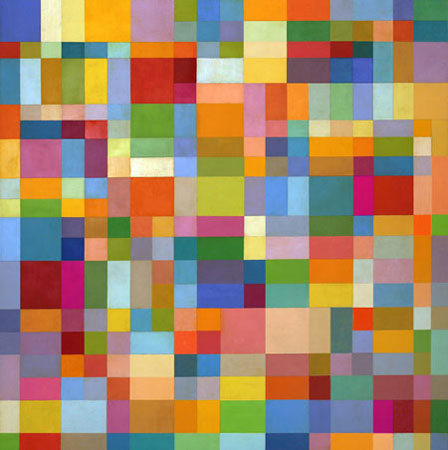
2008, unique, huile sur bois oil on wood, 200 x 200 cm, 78.7 x 78.7 inches |
|||
|
||||
|
||||
|
GEORGE MEURANT : NO NEED OF LIGHT 13/06 > 29/07 2008 GEORGE MEURANT : NO NEED OF LIGHTGeorges Meurant's work requires no special lighting. The blues are vivid early in the morning, and late in the evening it's the turn of the reds. At dawn, the three colors on which the works are based settle down. The structures underlying each painting are best showcased at dusk. These works also function under constant lighting: the color rectangles suddenly begin forming temporary groups which we perceive as standing out from the rest, each group soon superseded by the emergence of another, and then another, each of them different. Moreover, some groupings of such rectangles momentarily stand back, forming a ground in respect of which the others come forward; moments later, new groupings assume ground status, and then others. For as long as we look at the paintings, the permutations continue. THE HOW AND THE WHYTo experience these paintings we need no explanations. But we can endeavour to understand the process, and appreciate that the singular spatial tension involved has never been put to such use before. Esthetical theorist Jean Guiraud has suggested metaphorically that the evanescent space engendered by the work, constantly emerging in discontinuous and unpredictable packets, has the features of a quantum structure1 . Meurant's rectangles, placed as by algorithm, illustrate (as do those of Mondrian and Malevich) the search for innovation in artificial intelligence, a field in which engineer Jacques Lef�vre is working2. The poet Bernard No�l has wondered How we name the quality of standing on silence to speak ?3. According to Guiraud, Meurant is at the core of the mechanism that may dictate both the (spatial) coming together of the forms and the (sequential) connections of language, and this may well prove to be the most mysterious � and most important � of his contributions to art.4 A.M Jean GUIRAUD, The Figure Field, looking at Georges Meurant's paintings. Translation from the French by Michael Novy. Brussels : Didier Devillez �diteur, 1994, p 43-49. Jacques LEF�VRE, L'algorithmique �volutive, in: Bernard Yannou and Philippe Deshayes, Intelligence et Innovation en conception de produits et services (part 2), Paris : L'Harmattan, 2006, p 141-186. Bernard NO�L, in a letter to Georges Meurant (7/30/1998). Jean GUIRAUD, [Untitled], Grand Rechain : Keuninckx, 2004. PAS BESOIN DE LUMIERE L'�uvre de Georges Meurant n'exige pas d'�clairage particulier. T�t le matin ses bleus sont exalt�s, tard le soir ce sont les rouges. La trichromie qui la fonde s'�quilibre vers midi. La p�nombre met en valeur les structures qui l'organisent. Cette peinture mute aussi sous �clairage constant : ses couleurs s'associent inopin�ment en configurations qui se d�font bient�t par l'�mergence d'autres groupements, ensuite d'autres. Certains ensembles de formes/couleurs sont per�us comme un fond dont se d�gageraient tous les autres, puis ce sont de nouveaux agr�gats qui assument un moment le statut de fond, puis d'autres encore. Cette combinatoire demeure active tant que dure l'attention. COMMENT ET POURQUOI ? �prouver une telle peinture ne n�cessite aucune explication. On peut cependant comprendre son activit�, d�couvrir que sa tension spatiale singuli�re n'avait jamais �t� accomplie. L'esth�ticien Jean Guiraud sugg�re m�taphoriquement que cet espace �vanescent, qui appara�t constamment par paquets discontinus et impr�visibles, pr�sente les caract�ristiques d'une structure quantique1. Les rectangles plac�s par Meurant de mani�re algorithmique, illustrent (avec ceux de Mondrian et de Malevitch) la recherche d'innovation dans le domaine de l'intelligence artificielle, � laquelle travaille l'ing�nieur Jacques Lef�vre2. Le po�te Bernard No�l s'interroge : Comment nommer la qualit� de ce qui s'appuie sur le silence pour parler ?3. Selon Guiraud, Meurant exploite le c�ur du m�canisme qui pourrait commander et l'agr�gation [spatiale] des formes et les encha�nements [s�quentiels] du langage, ce qui pourrait bien �tre son apport � la fois le plus myst�rieux et le plus important4. A.M Jean GUIRAUD, The Figure Field, looking at Georges Meurant's paintings. Translation from the French by Michael Novy. Brussels : Didier Devillez �diteur, 1994, p 43-49. Jacques LEF�VRE, L'algorithmique �volutive, in: Bernard Yannou and Philippe Deshayes, Intelligence et Innovation en conception de produits et services (part 2), Paris : L'Harmattan, 2006, p 141-186. Bernard NO�L, in a letter to Georges Meurant (7/30/1998). Jean GUIRAUD, [Untitled], Grand Rechain : Keuninckx, 2004. GEEN LICHT NODIG Het werk van Georges Meurant heeft geen speciale belichting nodig. De blauwe kleuren zijn 's ochtends levendig en 's avonds is het de beurt aan de rode kleuren. Bij dageraad, komen de drie kleuren waarop de werken gebaseerd zijn tot rust. De structuren die aan de basis liggen van elk schilderij, komen best tot hun recht in de schemering. Deze werken functioneren echter ook onder constante belichting. De gekleurde rechthoeken beginnen plots tijdelijke groepen te vormen, waarvan we denken dat ze zich van de rest onderscheiden. Elke groep wordt echter al gauw verdrongen door een andere, en dan weer een andere, telkens verschillende. En sommige groepen van rechthoeken trekken zich soms tijdelijk terug, vormen een achtergrond waartegen de andere naar voor kunnen treden. Enkele ogenblikken later, zijn het weer andere groepen die naar de achtergrond treden en dan weer andere. Zolang we naar de schilderijen kijken, duren de permutaties voort. HET HOE EN HET WAAROM Om deze schilderijen te ervaren, hebben we geen uitleg nodig. Maar we kunnen wel proberen om het proces te begrijpen en proberen in te zien dat de specifieke hier opgewekte ruimtelijke spanning nog nooit eerder op een dergelijke manier werd gebruikt. De estheticus Jean Guiraud stelde metaforisch dat de door het werk opgewekte vluchtige ruimte, die constant opduikt in onvoorspelbare pakjes, de kenmerken heeft van een quantumstructuur1. Meurants als in een algoritme geplaatste rechthoeken, illustreren (net als die van Mondriaan en Malevitsj) de zoektocht naar innovatie in artifici�le intelligentie, het domein waarin de ingenieur Jacques Lef�vre werkzaam is2. De dichter Bernard No�l vroeg zich af Hoe noemen we de kwaliteit van het sprakeloos staan om te spreken3. Volgens Guiraud bevindt het werk van Meurant zich in het centrum van het mechanisme dat aan de basis ligt van zowel de (ruimtelijke) ontmoeting van de vormen als de (samenhangende) verbindingen in de taal, en dit zou de meest mysterieuze en �belangrijkste� bijdrage aan de kunst kunnen blijken te zijn.4 A.M Jean GUIRAUD, The Figure Field, looking at Georges Meurant's paintings. Translation from the French by Michael Novy. Brussels : Didier Devillez �diteur, 1994, p 43-49. Jacques LEF�VRE, L'algorithmique �volutive, in: Bernard Yannou and Philippe Deshayes, Intelligence et Innovation en conception de produits et services (part 2), Paris : L'Harmattan, 2006, p 141-186. Bernard NO�L, in a letter to Georges Meurant (7/30/1998). Jean GUIRAUD, [Untitled], Grand Rechain : Keuninckx, 2004. ALSO PRESENTING Diffracted Solstice GROUP EXHIBITION including GASTON BERTIN JAMES LEE BYARS KOEN DELAERE KATHARINE DOWSON JOY EPISALLA TXIKI MARGALEF ANDRE MARLY GEORGES MEURANT FRANCOISE MORELLET MARTIN RICHMAN KURT TREEBY CARRIE YAMAOKA |
||||
re-title.com
International contemporary art
SIGN UP FOR NEWSLETTERS

 SIGN UP for ARTIST MEMBERSHIP
SIGN UP for GALLERY MEMBERSHIP
SIGN UP for ARTIST MEMBERSHIP
SIGN UP for GALLERY MEMBERSHIP
Click on the map to search the directory