In 2005 Jan Vercruysse initiated a new group of works, amed Places. The artist situated the Places works vis-�-vis the previous Tombeaux works, based on the idea and practice of memory. Where the Tombeaux are places for memory�empty, by definition full of the faculty of memory�, the Places are places of memory�more conclusive, concentrating �meanings�, things that happened, parts of lives. They allow and support a �fulness�. A first group of works, Places (I)�the image of which refers to ex votos�is composed of the hands of the five cards of the poker card game. Configurations are installed using the four suits�spades, hearts, diamonds and clubs�, made of rusted or coloured thin steel sheets.
A second group, Places (II), is based on the image of commemorative plaques, often embedded in the floor of churches or found in archeological sites and where the traditional inscriptions are replaced with the shapes of the four suits of the playing cards, cut out in heavy rusted corten steel sheets. These works focuse on how to define a space / a place through purely visual elements and (rhetorical) strategies.
The works from Places (III) have text. The characters of the Roman alphabet are transcribed into a new alphabet, based on a permutation system using the four shapes (suits) of the playing cards. In a first series of these works, the texts have a rather poetic or philosophic content (the way an artist would formulate it)�without any reference to an existing �place�. In a second series, Places (III.8)�in which the shapes which form the text, are cut out in marble slabs�the names of �real� places appear, each of them preceded by the sentence �mist obscured �� (e.g. �mist obscured � Palermo�). Through this reflective manoeuvre, the initial attention to the memory of a real, existing place, can be guided towards an understanding of the �existence� of the Places works: they are their own place.
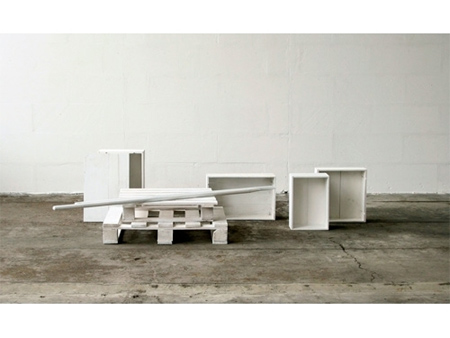
The works which Jan Vercruysse now exhibits, are part of a new series: Places [Lost]. How to initiate a first introduction, a narrative on these new works? A limited set of selected objects constitutes the base for the compositions of these works: a few wooden wine crates�of different shapes and dimensions, two wooden pallets and a pair of billiard cues. These objects are artefacts and they served a specific purpose; they have a �human� history. While a single wine crate, a single pallet or a single pair of billiard cues would be just that, it is in their combination�their compositions�that these objects transcend their primary physical characteristics: they become the remains of a journey, the silent keepers of �parts of lives�. In order to enhance the distance with these primary characteristics, the original artefacts are cast in bronze; these bronzes are thereafter painted with a chalklike white colour or sometimes patinated in the classic way. While the Places [Lost] acquire a sculptural quality�in fact, they even are sculptures�they are their own place.
JAN VERCRUYSSE Places [Lost]
5 juin � 17 juillet 2010
En 2005, Jan Vercruysse initiait un nouveau groupe d�oeuvres, nomm� Places (Lieux). L�artiste situait les oeuvres Places vis-�-vis les oeuvres pr�c�dentes, Tombeaux, en se basant sur l�id�e et la pratique de m�moire. Alors que les Tombeaux sont des lieux pour la m�moire�vides, par d�finition pleins de la facult� de m�moire, les Places sont des lieux de m�moire�plus concluantes, concentrant des �significations�, des choses �qui se sont pass�es�, des tranches de vies. Elles permettent et soutiennent une �pl�nitude�. Un premier groupe d�oeuvres, Places (I)�dont l�image r�f�re aux ex�voto�est constitu� des mains des cinq cartes du jeu de poker. Les configurations sont install�es en usant les quatre �couleurs� du jeu de cartes�pique, coeur, carreau et tr�fle�et faites de fines t�les d�acier rouill� ou peint.
Un deuxi�me groupe d�oeuvres, Places (II), est bas� sur l�image de plaques comm�moratives, souvent incrust�es dans le sol des �glises ou trouv�es sur des sites arch�ologiques, et dans lesquelles les inscriptions traditionelles ont �t� remplac�es par les formes des quatre couleurs du jeu de cartes, d�coup�es dans des �paisses t�les d�acier cor�ten rouill�es. Ces oeuvres se focalisent sur la fa�on de d�finir un espace / lieu par le biais d��l�ments purement visuels et de strat�gies (rh�toriques).
Les Places (III) contiennent du texte. Les caract�res de l�alphabet romain sont transcrits dans un nouvel alphabet, en usant un syst�me de permutation avec les quatre formes (couleurs) du jeu de cartes. Dans une premi�re s�rie d�oeuvres, les textes d�notent un contenu plut�t po�tique ou philosophique (comme le formulerait un artiste)�sans aucune r�f�rence � un �lieu� existant.
Dans une deuxi�me s�rie, Places (III.8)�dont les formes qui constituent le texte, sont d�coup�es dans des plaques en marbre�appara�ssent des noms de lieux �r�els�, chacun de ces noms �tant � chaque fois pr�c�d� par la phrase �le brouillard obscurcissait �� (par exemple, �le brouillard obscurcissait � Palermo�). A travers cette manoeuvre r�flective, l�attention initiale pour la m�moire d�un lieu r�ellement existant, peut �tre guid�e vers une compr�hension de �l�existence� des oeuvres Places: elles sont leur propre lieu.
Les oeuvres que Jan Vercruysse expose maintenant, font partie d�une nouvelle s�rie: Places [Lost]. Comment entamer une premi�re introduction, une narration sur ces nouvelles oeuvres? Un ensemble limit� d�objets s�lectionn�s constitue la base des compositions des oeuvres: quelques caisses � vin en bois�de diff�rentes formes et dimensions, deux palettes en bois et une paire de queues de billard. Ces objets sont des art�facts, des objets fa�onn�s, et ont servi un but pr�cis; ils ont une histoire �humaine�. Alors qu�une seule caisse � vin, une seule palette, une seule paire de queues de billard ne seraient que �a, c�est dans leur combinaison�leurs compositions�que ces objets �transcendent� leurs caract�res physiques primaires: ils deviennent les traces, les restes d�un voyage, les gardiens silencieux de �tranches de vie�. Afin de renforcer la distance avec ces caract�res primaires, les art�facts originaux sont coul�s en bronze; ces bronzes sont ensuite peints d�une couleur blanche pl�treuse, ou parfois patin�s � la mani�re classique. Tandis que les Places [Lost] acqui�rent une qualit� sculpturale�en fait, ce sont m�me des sculptures�elles sont leur propre lieu.