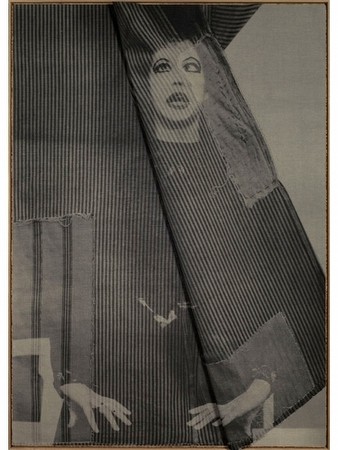
David Noonan’s tableaux employ a curious cast. Documentation of Japanese textiles and theatrical performances are combined and reassigned – printed onto a coarse weave.
In the past Noonan has used burlap, the same cloth as that worn in the eighteenth century by German mercenaries in the employ of Britain’s colonial armies in southern Ireland and North America. A headless ghost of one such ‘Hessian’ was to haunt Washington Irving’s short story from 1820, ’The Legend of Sleepy Hollow: ‘a drowsy, dreamy influence seems to hang over the land, and to pervade the very atmosphere… the place still continues under the sway of some witching power, that holds a spell over the minds of the good people, causing them to walk in a continual reverie. They are given to all kinds of marvellous beliefs, are subject to trances and visions, and frequently see strange sights, and hear music and voices in the air. The whole neighbourhood abounds with local tales, haunted spots, and twilight superstitions; stars shoot and meteors glare oftener across the valley than in any other part of the country, and the nightmare, with her whole ninefold, seems to make it the favourite scene of her gambols. The dominant spirit… that haunts this enchanted region, and seems to be commander-in-chief of all the powers of the air, is the apparition of a figure on horseback, without a head. It is said by some to be the ghost of a Hessian trooper.’ 1
Such poor material may find a significantly more tangible art-historical heritage in the works of mid-twentieth century painter Alberto Burri (and his Arte Povera disciples in the 1960s and 70s) but coincidentally something of Irving’s marvellous beliefs, trances and visions permeate Noonan’s work.
The link between theatre and prehistoric ritual has been widely proposed. Sir James Fraser’s pseudo-scientific treatise ‘The Golden Bough: A Study in Magic and Religion’ (1890) proposed with numerous examples that illiterate cultures enacted dramas believing that these would maintain seasonal cycles and bring new life, be it vegetable or animal: ‘food and children, were what men chiefly sought to procure by the performance of magical rites for the regulation of the seasons.’ Such profound ceremonies were tragically, over millennia, to devolve into, for example, the passive bourgeois melodramas of Fraser’s Victorian and Edwardian England.
Martin Esslin’s ideas of ‘The Theatre of the Absurd’ (his critical grouping of avant-garde playwrights made in 1960) 2 recall the ritual basis of stage performance. Such theatrical pioneers as Arthur Adamov, Samuel Beckett, Jean Genet, Eugene Ionesco and Harold Pinter (amongst others) – loosely referenced rather than appropriated by Noonan – can ‘be seen as part of an old tradition that may at times have been submerged but that can be traced back into antiquity.’ He quotes Ionesco’s ‘La démystification par l’humour noir’: ‘The true nature of things, truth itself, can be revealed to us only by fantasy, which is more realistic than all the realisms’. Writing at the same time, theatre director Peter Brook, like Esslin inspired by the work of Antonin Artaud, asserted that ‘theatre had in its origins in rituals that made the invisible incarnate.’ 3
Such expressions of the certainty of fantasy and attempts to give form to ideas are Noonan’s materials. Time, however is folded and the characters in the images exist not in Modernist theatre but in their own indistinct space. They are simultaneously shadows from the past and projections of the future – seeking perhaps some timeless truth (and something more optimistic than that sought by nihilst playwrights who had been so damaged by the Second World War). Already contorted and variously veiled, they are recast – torn, collaged and realigned into new forms with new functions.
Pictorially woven within them is a further layer – imagery taken from the patched and darned textiles of nineteenth and early twentieth century Japanese agricultural workers.
From the fifteenth century Japan began to import cotton from China and India for the manufacture of cloth for peasant clothing. The raw material was then spun domestically creating a widespread, successful cottage industry. Japan began to cultivate its own cotton in the seventeenth century in the warmer western areas of the archipelago. Produced largely in peasant homes for domestic use, this labour intensive process meant that it remained expensive. The high cost was exacerbated by Japan’s self-imposed isolationism and its failure to establish the industrial, powered cotton mills prevalent in western Europe (which did not appear in Japan until the late nineteenth century after America had forced it to open for foreign trade and resultant competition). In the north of Japan where it was too cold for cotton to grow there was a demand for second-hand, recycled cotton and accordingly a trade developed up the coast supplying worn indigo fabric that was repaired and reused as noragi (work wear) and futongawa (bed covers). Accordingly such ‘Boro’ developed as a folk craft.
Japan is now the third largest economy in the world, best known for its technological exports. The clothing and bedding of nineteenth century subsidence workers is recycled once again and provides a ground for Noonan’s explorations of the human condition. Images of Kogin Sashiko – the traditional white, Japanese running stitch – bisect and compose his works and provide imaginary hems for his folds. Elsewhere this utilitarian embroidery (which in print appears as an inversion of French ticking) provides a frame to his depictions of ritualistic practise. Layers of tradition advance and recede with the layers of digitally and manually produced collage in, respectively, the ink of the screen-printed imagery and the cut and torn panels of course cloth. Stitched spirals appliqued onto the original source are re-imagined again and again and tears reproduced in print are then repeated in the cloth in a series of trompe-l’oeil subplots.
The patched grounds bring to mind the clothes of the fictional Russian clown, disciple of the crazed Kurtz, lost in Joseph Conrad’s novel ‘Heart of Darkness’ (1903): ‘His clothes had been made of some stuff that was brown hollard probably, but it was covered with patches all over… patches on the back, patches on the front, patches on elbows, on knees; coloured binding round his jacket, scarlet edging at the bottom of his trousers… A beardless, boyish face, very fair, no features to speak of, nose peeling, little blue eyes, smiles and frowns chasing each other over that open countenance like sunshine and shadow on a windswept plain.’
At the same time however they might suggest a calmer ascetic tradition coming, for example, from Sufist belief. Al-Hujwiri’s ‘Kashf al-Muhjub’ written in about 1074 describes the rags worn by holy men: ‘I saw in Transoxania an old man who belonged to the sect of Malamatis… His food consisted of things thrown away by men, such as putrefied vegetables, sour gourds, rotten carrots, and the like. His clothes were made of rags with which he had made a muraqqa’a. And I have heard that among the mystics of recent times there was an old man of flourishing condition and of excellent character, living at Marv al-Rud, who had sewn so many patches, without taking pains, on his prayer-rug and cap, that scorpions brought forth their young in them. And my Shaykh… wore for fifty one years a single cloak, on which he used to sew pieces of cloth without taking any pains.’
Noonan’s choice of boro and his casting of actors determine one another. Different cultures from different decades define and compose one another. The edge of a stage or the profile of a face or a body and a rough tear in a piece of cloth loose their scale and work together to deliniate the ‘Divine Proportions’ of the pictorial surface. Elsewhere the hands of performers appear to be in the process of constructing their own image as they seem to pull threads together and fold in a further layer fabric. A couple shelter under a tree appearing to be both under canvas and imprinted onto it. And a pair of performers press one another and their surface firmly into place.
The taught muscles and poised digits of Noonan’s protagonists, frozen in their ritualistic tableaux are at once composed by their ground and hold it together in fine balance. They are like the ‘Origami’ of the exhibition title with this craft skills somewhat grandiosely titled valley, mountain, reverse and squash folds and sinks all realised from modest paper squares. Produced to celebrate weddings and to burn at funerals they are at once precious and disposable, and as the Absurdists would probably have it, like us, everything and nothing.
Rob Tufnell, 2012
Notes: 1. 'The Legend of Sleepy Hollow' by Washington Irving from 'The Sketch Book of Geoffrey Crayon, Gent.' (1820). 2. Martin Esslin, 'Theatre of the Absurd’ (1968) 3. Peter Brook, ‘The Empty Space’, (1968)