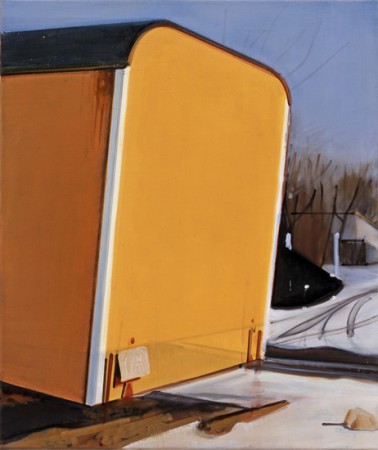
The paintings of Thoralf Knobloch are a double-edged sword. Working from his own analogue photographs, he scans and prints the images. Some get cropped others remain in tact before the process of painting begins. During this tactile, hands-on stage the artist accentuates certain aspects of the original photo, or chooses to remove others.
The resultant paintings are both true renderings of a place and location in time or an extemporaneous removal of the initial visual information.
In Knobloch�s new series of ambivalent realism, the exterior landscape and objects set in them are malleable forms that retain identifiable traits. His sense of colour precisely calibrates mood and feeling.
A rust coloured tarpaulin draped over some wires (Gelbes Tuch) leaves few clues about how it got there. In another picture, a mysterious wooden post takes on the appearance of a crucifix (Birkenkreuz).
Perspectival nuances subtly induce the eye to gravitate towards specific points in the mediated area. The plank seat in a rowboat and the black hole in its hull invite the viewer into the panoramic space. Telephone poles or structural support beams (Stromleitungen) use their verticality to balance out carefully delineated line and form.
With the exception of a couple of canvases there are no people, but when depicted a figure is either apparition-like or detached from their immediate surroundings.
An image scavenger, Thoralf Knobloch quietly conveys our post modern isolation and detachment with probity. They are an altered reality of quasi-archives from the real world. Although deceptively simple formal constructs, his interpretation of the recorded image is less about the documentary than it is the enigma of it.