|
DIEHL Berlin: SERGEY BRATKOV - CHAPITEAU MOSCOW - 8 June 2013 to 27 July 2013 Current Exhibition |
||||
|
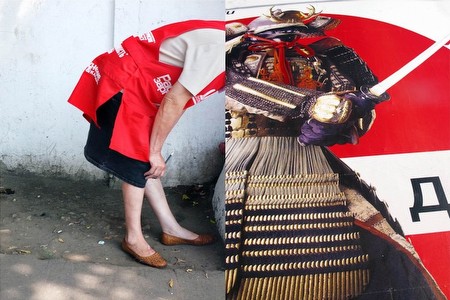
#15 from the series Chapiteau Moscow, 2012
colour photo, 200 x 300 cm, 78 3/4 x 118 1/8in edition of 3 plus 1 artist's proof |
|||
|
||||
|
SERGEY BRATKOV CHAPITEAU MOSCOW Opening: Friday, June 7 - 7 to 9pm On view: June 8 - July 27, 2013 ‘SERGEY BRATKOV’ Life is seen as a vital energy or force as far as Sergey Bratkov is concerned. It drives forward the artist’s passion and feelings that life for him must always be an interactive (if not necessarily dialectical in the ideological sense) form of social engagement. There is nothing that could be called contemplative about Bratkov’s pictorial view of the world. His current series of photographs called Modern Gaiety. Chapiteau Moscow , are a clear case in point, they were first shown in hall of the former Red October factory in Moscow. The series suggest that polarity is a natural dichotomy, since they juxtapose image contents in the form of a visual montage (simple binary pictorial confrontations), where different component elements of Moscow’s social, economic, and cultural life, are chosen to reflect the city’s vibrant conditions of continuous social and cultural experiment. The scientific is juxtaposed to the social, the experiment next to the random commonplace, public protest next to ciphers of authoritarian repression. The bringing together in binary montages of different temporalities and places, both recognisable and intentionally anonymous, framed under the auspices of Moscow as the central character, has the effect, as Viktor Misiano claims, of creating a feeling of ‘urban phantamagoria’. In a city that was shaped in part by Stalin’s stylistic uniformity, bracketed between the revolutionary architecture of the 1920s, and the new modernist post Stalinist architectural experimentation of the 1960s, Bratkov has been able to reveal a unique heterogeneity that elides and undermines statist authoritarianism on the one hand, and the theoretical ideologies of deterministic modernism on the other. The photographs reveal social icons as well as contemporary cultural pretensions, but do in a humane manner whereby the city’s people sustain (rather than the authorities) an individual paradoxical sense of social cohesion. Bratkov intentionally suggests that Moscow is to be seen as a twentieth century city, a place that—after it became again the capital—was a platform of continuous social experimentation and investigation. This said there is nothing morose or introspective about these montages, and the tone is celebratory in very many respects. These are not images for the archive, dry documentary records for future remembrance, rather they are images of life, or, as he calls them of ‘modern gaiety’. The title Chapiteau Moscow uses the French word for ‘tent’, suggesting that Moscow has become a latter day ‘Big Top’, a living circus of difference and plenitude. One is reminded of Walter Benjamin who after Berlin, chose Paris, and then Moscow (he visited in 1926) as his cities of the nineteenth and twentieth centuries respectively. Speaking of Moscow “…each thought, each day, each life lies here as on a laboratory table. And as if it were metal from which an unknown substance is by every means to be extracted, it must endure experimentation to the point of exhaustion. ©Mark Gisbourne, 6 June 2013 DIEHL Niebuhrstrasse 2 - 10629 Berlin T +49 30 22 48 79 22 F +49 30 22 48 79 29 [email protected] |
||||
|
||||
re-title.com
International contemporary art
SIGN UP FOR NEWSLETTERS

 SIGN UP for ARTIST MEMBERSHIP
SIGN UP for GALLERY MEMBERSHIP
SIGN UP for ARTIST MEMBERSHIP
SIGN UP for GALLERY MEMBERSHIP
Click on the map to search the directory