|
Galerie Urs Meile, Beijing-Lucerne: Bai Yiluo - Fate No. 4 - 25 Aug 2007 to 20 Oct 2007 Current Exhibition |
||||
|
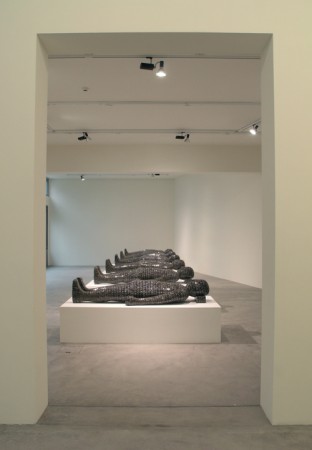
Bai Yiluo, Fate No. 4" 2007
installation at Galerie Urs Meile, Lucerne mixed media, fiberglass, copper wire, giclee prints, resin, 215 x 83 x 33 cm |
|||
|
||||
|
||||
|
Garments for the Beyond, or The Memory of Art Bai Yiluo's Sculpture Series "Fate No. 4" Beijing artist Bai Yiluo (b. 1968 in Luoyang, Henan province) with his recent series of sculptures Fate No. 4 takes the viewer on a time travel that simultaneously sharpens their gaze on the present. Weaving thousands of little black-and-white photo portraits to a memento carpet, he transforms the jade burial suit made for Chinese dignitaries more than 2000 years ago into a 'photographic sculpture'. The emperors and kings of the Han dynasty asserted their singular claim to power not only on Earth. They also postulated it by palace-like burial sites and funerary rituals such as the jade death shroud, which was said to have the power of protecting against decay and to aid resurrection - even for the Beyond. Ceremonial garments made of nephrite jade (nephrite is one of two minerals called jade) used as burial suits for deceased emperors, princes or influential ministers were an invention of the Han era. In the Western Han dynasty (206-9 BC) not only the emperor but also princes could be buried in nephrite jade garments adorned with gold wire thread. Later, during the Eastern Han dynasty (25-220 AD), a hierarchical system was developed that clearly defined who deserved a burial suit of nephrite jade and what class of thread it was allowed to contain. According to these rules, only emperors were allowed to don garments of nephrite jade with threads made of gold (jinl� yuyi), while princes and princesses were accorded silver, the emperor's elder sisters were left with bronze wire. "When I looked at the historic gold-wired jade garment of prince Liu Sheng (deceased in 113 BC) at a Beijing exhibition, I was not so much interested in the person for whom this effort had been made. My perspective was rather the 'Here and Now': what will remain of us, of our lives, after we are dead?" Bai Yiluo flattens out such intricate human hierarchy without further ado. It is not one particular prominent person set apart from the masses that the sculptures of Fate No. 4 intend to commemorate; they instead honor the Chinese people as a whole: each person entered namelessly into the collective but was rescued from oblivion by preserving their faces. Paralleling the production process of traditional jade burial suits, thousands of black-and-white portraits of unknown Luoyang citizens are interconnected by means of cross-stitched wire. They form the surface of the sculptures. They form the surface of the sculptures. Fate No. 4 raises an unequivocal objection against human thinking in hierarchies. The people portrayed thus obtain a place in collective memory - each as an individual, and also together as a proxy for all mankind. Bai Yiluo does not want to commit himself to any definition of destiny although he does believe that our lives are predetermined to a certain extent. Earlier photographic works such as Fate No. 1 and Fate No. 2 through their clear death-related imagery, a skeleton and a skull, emphasize the physical finiteness of human existence. While the sculptures of Fate No. 4 formally refer to a period more than 2000 years in the past - thus presenting history as a continuum in which our own lifetime finds a place - on a the content level they express a most humanist vision: the privileges for life after death which in imperial China were reserved to monarchs alone are now transformed into a more democratic afterlife. Coincident with the Lucerne exhibition, the artist is also presented at the show Mahjong - Contemporary Chinese Art from the Sigg Collection at Museum der Moderne M�nchsberg, Salzburg, Austria (July 21 - November 11, 2007). Text: Ulrike M�nter Translation: Werner Richter |
||||
re-title.com
International contemporary art
SIGN UP FOR NEWSLETTERS

 SIGN UP for ARTIST MEMBERSHIP
SIGN UP for GALLERY MEMBERSHIP
SIGN UP for ARTIST MEMBERSHIP
SIGN UP for GALLERY MEMBERSHIP
Click on the map to search the directory