6 Feb 2009 to 7 Mar 2009
Opening reception:
Thursday, February the 5th, 2009, 6-9 p.m.
Galerie Loevenbruck
40 rue de Seine,
2 rue de l Echaud�
F - 75006
Paris
France
Europe
p: +33 (0) 1 53 10 85 68
m:
f: +33 (0) 1 53 10 85 68
w: www.loevenbruck.com
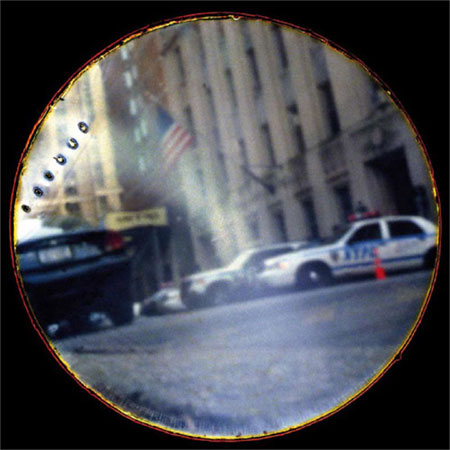
Alain Declercq, Hidden camera obscura Midtown North Precinct / Manhattan 54th street Color print after negative, camera obscura, 50 X 50 cm. Edition of 5
ALAIN DECLERCQ HIDDEN 6 FEVRIER � 7 MARS 2009 Vernissage le jeudi 5 f�vrier � partir de 18h
Pour l�exposition personnelle que lui consacre la galerie, Alain Declercq montre Hidden Camera obscura, une nouvelle s�rie de photographies prise � New York au cours de l�ann�e 2008. Ce quadrillage photographique de Manhattan recense environ 70 lieux que personne n�est autoris� � photographier. Consid�r�s comme � sensibles � depuis les attentats du 11 septembre, les prisons, les commissariats ou encore les tunnels et les ponts sont cens�s �chapper � toute reproduction. Pour r�aliser ces images interdites, Alain Declercq construit lui m�me son outil de prise de vue, une camera obscura constitu�e d�un simple bo�tier en plastique, dans lequel un minuscule trou perc� fait office de diaphragme. L�artiste d�coupe ensuite la pellicule qu�il dispose au fond du bo�tier. Cette chambre noire low tech est pos�e directement au sol, le temps qu�un n�gatif s�imprime. Les photographies ne cachent pas les imperfections du syst�me de prise de vue : images floues, cadres impr�cis, lumi�re manquante due � des temps de pause hasardeux, soulignent une technique hautement artisanale. Pourtant, avec des moyens d�une grande simplicit�, Alain Declercq produit une br�che dans la l�gislation, et vole m�thodiquement ce qui devrait �tre soustrait aux regards, au coeur m�me de l�espace public.
Appareils de contr�le et syst�mes de r�pression, manipulation, d�sinformation, tels sont les sujets qui guident le travail d�Alain Declercq, passionn� par tout ce qui touche de pr�s ou de loin aux logiques s�curitaires � tendance parano�aque, aux politiques de la peur version � hyst�rie collective � ou � toute forme de th�orie du complot. Il ne tente pas de savoir � qui profite le crime, mais il met � jour les m�thodes permettant de biaiser le r�el et de brouiller les ondes. Pour cela, il devient lui-m�me brouilleur, mais toujours l�air de rien, plus proche de l�anti-h�ros1 que du militant agitateur et charismatique. � Homme de l�ombre �, � acteur invisible � sont les termes qu�il utilise pour d�crire son double positif, Mike, personnage principal de la vid�o �ponyme, docu-fiction post-11 septembre retra�ant le parcours d�un suppos� agent secret entre Le Caire, Washington, Paris et Amsterdam. Sans �tre ouvertement d�nonciateur, Alain Declercq utilise les outils de ceux sur lesquels porte sa critique. Deux m�thodes s�imposent : l�infiltration ou la surexposition. Dans Welcome home Boss (2001), il �claire violemment � la nuit tomb�e les maisons des dignitaries de Montr�al. Ailleurs, il se poste devant un radar avec un panneau afin d�avertir du dispositif de contr�le.
Dans d�autres cas, il mime et infiltre : par exemple en proposant aux visiteurs du Centre d�art de Br�tignysur- Orge (2000) d�utiliser une voiture de police, en filmant � leur insu des militaires dans la vid�o �tat de si�ge (2001) ou en reproduisant un missile de croisi�re � l�effigie de la compagnie American Airlines. En se glissant dans la peau du journaliste d�investigation, du flic ou de l�agent secret, l�artiste d�joue de l�int�rieur les syst�mes de pouvoir et les discours dominants. Avec l�interview du commandant Pierre-Henri Bunel (2), il propose une analyse dissonante et minutieuse de l�attentat du Pentagone et �claire d�un jour nouveau un �v�nement devenu illisible � force de surexposition. Les cibles d�Alain Declercq sont autant les apparels r�pressifs et violents que les appareils id�ologiques, qu�il aborde avec les moyens de la fiction. La perquisition par la police judiciaire dans l�appartement de l�artiste � Bordeaux distillera de mani�re troublante, et en miroir, la fiction dans le r�el. Les fausses armes, les billets d�avion, les coupures de journaux sur les attentats du 11 septembre, rassembl�s pour le tournage de Mike (2005), conduisent la brigade anti-terroriste � interroger Alain Declercq sur l�existence de ce myst�rieux Personnage Face au conditionnement des corps et des esprits, l�artiste propose des outils pour se r�approprier un r�el dilat� et incompr�hensible : � Ce qui m�int�resse, c�est la possibilit� qu�une oeuvre puisse �tre activ�e par d�autres. En somme, de proposer des outils au spectateur qui devient un usager potentiel. Par exemple quand je r�ponds � des lettres manuscrites en imitant l��criture de mon interlocuteur gr�ce � un logiciel informatique (Faux en �criture, 1997-2004), l�oeuvre peut faire figure de mode d�emploi. � Ni agitation, ni propagande, le travail d�Alain Declercq choisit le mode du d�cryptage et de l�enqu�te, en reproduisant et en documentant des outils de pouvoir afin de nous redonner prise sur ceux-ci.
Marie Cozette 1. Une des premi�res photographies d�Alain Declercq, dat�e de 1998, s�intitule Anti-h�ros. L�autoportrait en pied montre l�artiste affubl� de deux bras gauches. 2. Ancien officier des services de renseignement fran�ais, il a �crit le chapitre IV (� L�effet d�une charge creuse �) du livre Le Pentagate de Thierry Meyssan, qui d�c�le des incoh�rences dans les versions diffus�es par les autorit�s am�ricaines sur l�attentat du 11 septembre ayant vis� le Pentagone.
ALAIN DECLERCQ HIDDEN FEBRUARY 6 - MARCH 7, 2009 Opening Reception Thursday, February the 5th, 2009, 6-9 p.m.
For his solo exhibition at the gallery, Alain Declercq is showing Hidden Camera Obscura, a new series of photographs taken in New York last year. He crisscrossed Manhattan getting these images of some 70 sites where photography, precisely, is prohibited. These prisons, police stations, tunnels and bridges have had their security status raised since 9/11, so in order to take his forbidden pictures, Declercq built his own lo-tech pinhole camera by making a tiny aperture in a plastic box. He would then cut a piece of film, place it in the box, place this on the ground facing the location, and let the light in to print the negative. The resulting photographs are often hazy, imprecisely framed, sometimes inadequately lit because of the fluctuating exposure times � everything draws attention to the crudeness of the homemade method. And yet with this very simple tool Declercq made a breach in the law, methodically stealing that which is supposed to be hidden from the public gaze, yet exists at the heart of public space.
Alain Declercq is fascinated by all things more or less directly related to paranoiac logics of security, to the political manipulation of fear and its use of collective hysteria, and to any kind of conspiracy theory. His subjects are control apparatus and systems of repression, manipulation and disinformation. He does not try to find out who is behind it all or what their motives are; rather, he reveals the methods that can be used to twist reality and scramble communications. To do this, he therefore becomes a bit of a scrambler himself, but seemingly without intent. He is more an antihero1 than an agitator or charismatic activist. He works in the background, an �invisible player,� as he himself describes his positive double, Mike, the eponymous hero of his post-9/11 docudrama which follows this purported secret agent between Cairo, Washington D.C., Paris and Amsterdam. Without explicit denunciation, Declercq uses the very tools wielded by those who are the object of his critique. The two chief methods seem to be infiltration and overexposure. In Welcome Home Boss (2001), he trained powerful spotlights on the homes of Montreal�s ruling classes at night. At the Centre d�Art in Br�tigny-sur-Orge (2000) he invited visitorsto use a police car, and in his video �tat de si�ge (2001) he secretly filmed soldiers, while in another piece he reproduced a cruise missile and plastered it with the insignia of American Airlines. In his interview with Pierre-Henri Bunel (2) he brought to light a highly detailed and iconoclastic analysis of the 9/11 attack on the Pentagon, an event that has become illegible because of over-exposure. Declercq�s targets are both the apparatus of violence and repression and ideological apparatus, and he approaches them by means of fiction. When the French criminal investigation department searched the artist�s own flat in Bordeaux, fiction and reality began to mirror each other to disturbing effect. On the strength of the fake weapons, plane tickets and press cuttings that he had gathered for the shoot of Mike (2005), Declercq found himself talking to the anti-terrorist brigade about this mysterious figure. In response to the condition of bodies and minds, the artist offers tools for expropriating a reality that has become dilated and incomprehensible. �What interests me is the possibility that a work of art can be activated by others. To sum up, I seek to offer the spectator tools that make them a potential user. For example, when I reply to letters using a computer programme to imitate the handwriting of the person who sent them (Faux en �criture, 1997- 2004), the work can be seen as a kind of manual.� Neither agitation nor propaganda, Declercq�s work chooses to proceed by deciphering and investigation. It reproduces and documents the tools of power in order to give us a grip on its workings.
Marie Cozette 1. One of Declercq�s earliest photographs, dating from 1998, is a full-length self-portrait entitled Anti-h�ros. It shows the artist sporting two left arms. 2. This former French intelligence officer wrote chapter IV of Le Pentagate, a book by Thierry Meyssan which details the inconsistencies of official accounts of the 9/11 attack on the Pentagon.