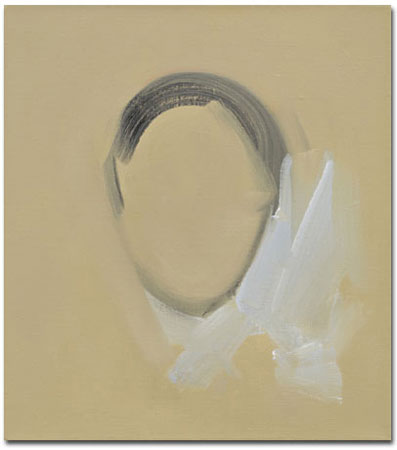
Michael van Ofen, 24.10.08-29.11.08 In the Space between Pictures
Here, a cool blue colour gradient that brings to mind a horizontal line as a minimum of landscape. There, no more than three spotty blobs on a black background that, readable as a head and hands, let the viewer see a standing figure. Michael van Ofen�s new pictures are even more reduced than what we have come to expect from his former works. They are further tapered to that turning point at which a picture becomes visible and achieves a specific presence between pure painting and imaginative space. Van Ofen has always worked on this fine line between artistic abstraction, collected objectivity and perceptive image. He exploits the area as a region of tension. In this region, it is about convincingly and clearly hitting the artistically important point where these aspects intertwine, almost become crystallised, and where a picture may even open up further into quiet irony and something silently cryptic. Van Ofen unfolds the simple into the complex, and the work is really about reinventing this again and again, staging it as if undecided between the art of painting�s objective reference and self-reference. By now, van Ofen manages to get to this point using the bare minimum.
To achieve this, he has developed characteristic subjects and a typical form language in ca. 25 years. He has managed something rare, i.e. conducting painting convincingly and simultaneously reflecting its means without didactically playing one off against the other. He conceptualised the artistic gesture while giving it back to the art of painting in equal measures. He says it is his �consistent topic to connect the creation of an illusional space behind the canvas (i.e. an imaginary space as only the art of figure painting possesses it) with the presentation of the method used to evoke this picture space.� (1) Presenting the means and using their full potential is a continuing fascination for Michael van Ofen. However, honouring this concept has to be done anew with every picture. On the one hand, van Ofen clearly practises painting as a reflective medium. On the other hand, honouring the concept defies prediction, and it is unavoidable that it can only be realised in the process of painting.
Thus, there are not only pure conceptual manoeuvres taking place here: a picture can also fail. The attempt to make something appear can be unsuccessful. One can get off course. This is important if you want to understand what �succeeding� is about. Van Ofen�s art of medial reflection deals with something genuinely artistic. It is about appearance, and also seriously considers the picture as an appearance. In his latest works, the reduction of the subject to its essence shows how strongly van Ofen focuses and concentrates on this feature in the individual picture at this time. But this comment is valid for his artistic approach in general. Often these works seem as if the picture in it shimmers through the painting diffusely or distantly. As if it only shows itself by drawing the viewer�s attention away from itself and onto the art of painting itself. Objectivity is present, but it is disguised by painting, withdrawn from view and compelled to the edge of dissolution. Through the mimetic minimum, van Ofen also formulates what painting by itself inserts into the visual concept of objectivity.
As a matter of fact, his mimesis hardly ever refers directly to the objective world, but instead again to painting. Van Ofen sometimes modestly talks of �copying� � �for a traditional painter, that is something quite normal, as with the Flemish artists, for example, who made pilgrimages to Italy and copied. I don�t see anything different in my works.� But his work is about more than that, as his paintings make references to picture clich�s and a visual grammar embedded in them. Characteristically, he locates his �source material� mainly in the 19th century�s picture production, and often it is the rather dubious works that he is attracted to: �Images I like to use best�, van Ofen says, �are often far back on the historical shelf.� In these paintings, van Ofen unveils condensed visual experiences, rules of perception, that reach far into today�s everyday experiences. �In it, you find the last 35,000 years of painting history�, thinks van Ofen, �a visual education from the phylogenetic development to the 19th century. This outlook has evoked genres that are still applicable to our perception today. The 19th century is the threshold in this respect. Its end coincides with the beginning of the Modern era, and does not outlive the Pop era and its instruments conveying pictures. But everything is contained in the classic genres like landscape, portrait, full and half figure portrait, bust, still life, interior etc. I move in this field.�
By abstractly referring to already shaped models, van Ofen reveals picture paradigms. He draws the view to perceptive constitutive patterns acting within them. He deconstructs picture compositions and colour grammars while transforming and outrunning them in his own art. He provides their appearances with new qualities by alienating them almost beyond recognition. Many of his earlier works in particular closely refer to models: Rue Neuve Notre Dame (1995), for example is based on Eduard Gaertner�s Rue Neuve Notre Dame in Paris (1826), and in Die drei J�ger (1993), Wilhelm von Kobell�s Drei J�ger zu Pferde, die Strecke besichtigend (1822) can be deciphered. This is also true for his more recent paintings, e.g. Junge Stuttgarterin (2004) paraphrases Franz Seraph Stirnbrand�s Junge Stuttgarterin im blauem Kleid (1838). But van Ofen more and more reaches visually coded archetypes with his paintings, and often, one picture of a genre is enough for this: Over the years, he has painted abstract still lifes like Blumen (1999) in remarkable variations and approaches. All of these go back to one template, which is Josef Lauer�s Blumen in einem blauen �berfangglas (1850). Van Ofen also looks at the portrait in this way: in untitled/Offizierstudie (2008), inspired by Anton von Werner�s historic sketches, he presents the individual as pragmatically constructed. Especially such reduced pictures as untitled/Stresemann (2008) prove how directly these dealings with traditional picture awareness actually work and how subtly van Ofen formulates the boundaries of abstraction. �There is really not much on it�, he says, �but nevertheless, you associate with it: head, two hands, person, a certain dignified demeanour � and probably also the genre of the representative politician�s portrait from around the turn of the century. This only works if it is artistically precise and the picture genre�s conditions are fulfilled efficiently. If I turn this around,� continues van Ofen, �then it is not an upside down picture, it is no longer anything.� Jens Asthoff
(1) All quotes: Michael van Ofen talking to the author in the D�sseldorf studio, 15/09/2008.
Michael van Ofen, 24.10.08-29.11.08 Im Zwischenraum der Bilder - Malerei von Michael van Ofen
Hier ein k�hlblauer Farbverlauf, der eine Horizontlinie als Minimum von Landschaft in die Vorstellung holt. Dort nicht mehr als drei punktuelle Taches auf schwarzem Grund, die, als Kopf und H�nde lesbar, dem Betrachter unmittelbar eine stehende Figur vor Augen f�hren: Michael van Ofens neue Bilder sind noch einmal st�rker reduziert als man es bisher bereits von seiner Arbeit kennt. Sie sind weiter zugespitzt auf jenen Umschlagpunkt hin, an dem ein Bild zwischen reiner Malerei und imaginiertem Raum zum Vorschein kommt und spezifische Pr�senz erreicht. Van Ofen arbeitet seit je an diesem feinen Grenzverlauf zwischen malerischer Abstraktion, gefasster Gegenst�ndlichkeit und Vorstellungsbild. Und erschlie�t das Areal als Spannungsfeld, in dem es gilt, den malerisch entscheidenden Punkt zu treffen, von dem aus diese Aspekte schl�ssig ineinandergreifen, quasi auskristallisieren und sich ein Bild wom�glich auch noch weiter zu stiller Ironie und etwas stumm Geheimnisvollem �ffnet. Van Ofen entfaltet Vielschichtiges aus Einfachem, und die Arbeit besteht eigentlich darin, dies immer wieder aufs Neue und anders zu erfinden und wie im Schwebezustand zwischen Gegenstands- und Selbstbezug der Malerei zu inszenieren. Mittlerweile bringt van Ofen das aus einem Minimum heraus zum Punkt.
Daf�r hat er innerhalb von etwa f�nfundzwanzig Jahren eine typische Formensprache und charakteristische Sujets entwickelt. Und es ist ihm etwas Seltenes gegl�ckt: N�mlich �berzeugend Malerei und zugleich die Reflexion ihrer Mittel zu betreiben, ohne didaktisch eins gegen das andere auszuspielen. Er hat die malerische Geste konzeptualisiert und sie in gleichem Ma�e ganz und gar an Malerei zur�ckgegeben. Er bezeichnet es als sein �durchg�ngiges Thema, die Erzeugung von Illusionsraum hinter der Leinwand � also imaginativen Raum, wie ihn nur die figurative Malerei hat � mit der Vorf�hrung der Mittel in Verbindung zu bringen, die zeigen, wie dieser Bildraum evoziert wird.�(1) Vorf�hrung der Mittel zugleich mit vollem Einsatz ihrer Wirksamkeit ist f�r Michael van Ofen eine anhaltende Faszination. Das Aufgehen dieses Konzepts bleibt jedoch mit jedem Bild aufs Neue einzul�sen, und so klar van Ofen einerseits die Malerei als Reflexionsmedium praktiziert, bleibt das andererseits stets unvorgreiflich und realisiert sich unweigerlich nur im Vollzug der Malerei.
Hier finden also nicht blo� konzeptuelle Man�ver statt: Ein Bild kann auch misslingen, der Versuch, etwas in die Erscheinung zu holen, kann scheitern, man kann vom Weg abkommen. Das ist durchaus wesentlich, wenn man verstehen will, worum es beim �Gelingen� eigentlich geht. Van Ofens Art der medialen Reflexion geht mit etwas genuin Malerischem um: Sie hat mit Erscheinung zu tun und nimmt das Bild auch als Erscheinung ernst. Die punktgenaue Reduktion der neuesten Arbeiten zeigt, wie stark van Ofen dieses Moment inzwischen am Einzelbild fokussiert und verdichtet. Doch es gilt f�r seinen malerischen Ansatz insgesamt. Oft wirken diese Werke, als w�rde das Bild darin diffus oder entfernt durch die Malerei hindurch schimmern. Als zeigte es sich erst, indem es den Blick von sich weg auf Malerei selbst lenkt. Gegenst�ndlichkeit ist zwar pr�sent, doch ist sie auch durch Malerei verstellt, dem Blick entzogen, an den Rand der Aufl�sung getrieben. Van Ofen formuliert �bers mimetische Minimum auch das mit, was Malerei von sich her ins visuelle Konzept von Gegenst�ndlichkeit einf�gt.
Tats�chlich bezieht sich Mimesis bei ihm kaum je unmittelbar auf die Objektwelt, sondern wiederum auf Malerei. Van Ofen spricht bisweilen bescheiden von �Kopieren� � �f�r einen traditionellen Maler ja etwas ganz normales, wie bei den fl�mischen K�nstlern zum Beispiel, die nach Italien gepilgert sind und kopiert haben. Nichts anderes sehe ich da bei mir.� Doch bei ihm geht es denn wohl doch um mehr, bezieht er sich mit den Bildern ja auf Bildklischees und eine darin eingelassene visuelle Grammatik. Charakteristischerweise verortet er sein �Ausgangsmaterial� ganz �berwiegend in der Bildproduktion des 19. Jahrhunderts, und oft reizen ihn sogar die eher zweifelhaften Werke: � Bilder, die ich am liebsten verwende�, sagt er, �stehen meist weit hinten im historischen Regal�. In dieser Malerei deckt van Ofen kondensierte Seherfahrung auf, Wahrnehmungsregeln, die bis in heutige Alltagserfahrung hineinreichen. �Darin stecken die letzten 35000 Jahre Malereigeschichte�, meint van Ofen, �eine Schulung des Sehens von der stammesgeschichtlichen Entwicklung bis ins 19. Jahrhundert. Dieses Sehen hat Gattungen evoziert, die bis heute Geltung f�r unser Wahrnehmen haben. Das 19. Jahrhundert ist da die Scharnierstelle. Mit Beginn der Moderne und sp�testens bei Pop und dessen apparatevermitteltem Bild hat das aufgeh�rt. Aber in den klassischen Gattungen wie Landschaft, Portr�t, Ganzfigur, Halbfigur, B�ste, Stillleben, Interieur usw. steckt das alles drin. In diesem Feld bewege ich mich.�
Indem sich van Ofen abstrahierend auf Vorformuliertes bezieht, legt er Bildparadigmen frei. Er lenkt den Blick auf darin agierende wahrnehmungskonstitutive Muster, dekonstruiert Bildaufbau und Farbgrammatik, w�hrend er sie in der eigenen Malerei transformierend einholt und ihnen, sie bis zur Kenntlichkeit verfremdend, zu neuer Erscheinungsqualit�t verhilft. Viele insbesondere fr�he Arbeiten sind eng auf Vorbilder bezogen: Rue Neuve Notre Dame (1995) etwa geht auf Eduard Gaertners Rue Neuve Notre Dame in Paris (1826) zur�ck, und aus Die drei J�ger (1993) l�sst sich Wilhelm von Kobells Drei J�ger zu Pferde, die Strecke besichtigend (1822) entziffern. Das gilt teils bis in j�ngere Zeit, etwa f�r Junge Stuttgarterin (2004), das Franz Seraph Stirnbrands Junge Stuttgarterin im blauem Kleid (1838) paraphrasiert. Doch van Ofen dringt mit seiner Malerei zunehmend zu visuell codierten Archetypen vor, und da ist mit einem Bild der Gattung oft schon alles gegeben: So hat er �ber Jahre in frappierenden Variationen und N�herungen abstrahierte Stillleben wie Blumen (1999) gemalt, die alle auf ein einziges Vorbild, n�mlich auf Josef Lauers Blumen in einem blauen �berfangglas (1850) zur�ckgehen. Auch das Portr�t hat van Ofen auf diese Art im Blick: In o.T./Offiziersstudie (2008), angeregt durch historisierende Skizzen Anton von Werners, f�hrt er das Individuelle als paradigmatisch Konstruiertes vor Augen. Gerade an so reduzierten Bildern wie o.T./Stresemann (2008) erweist sich, wie direkt dieser Umgang mit tradiertem Bildbewusstsein hier tats�chlich funktioniert und wie subtil van Ofen die Grenze zur Abstraktion formuliert. �Da ist nun wirklich sehr wenig drauf�, sagt er, �trotzdem assoziiert man: Kopf, zwei H�nde, Person, eine bestimmte w�rdevolle Haltung � und wom�glich auch die Gattung des repr�sentativen Politikerportr�ts um die Jahrhundertwende. Das funktioniert nur, wenn es malerisch pr�zise ist und die Bedingungen der Bildgattung hinreichend erf�llt sind. Wenn ich das hier umdrehe�, so van Ofen weiter, �dann ist das kein Bild auf dem Kopf, dann ist es gar nichts mehr.� Jens Asthoff
(1) Alle Zitate: Michael van Ofen im Gespr�ch mit dem Autor im D�sseldorfer Atelier, 15.9.08.