28 Oct 2011 to 25 Feb 2012
Di-Sa 11-18 Uhr, Tues - Sat 11-18
JOHNEN GALERIE BERLIN
Marienstrasse 10
10117
Berlin
Germany
Europe
T: +49 30 27 58 30 30
F: +49 30 27 58 30 50
M:
W: www.johnengalerie.de
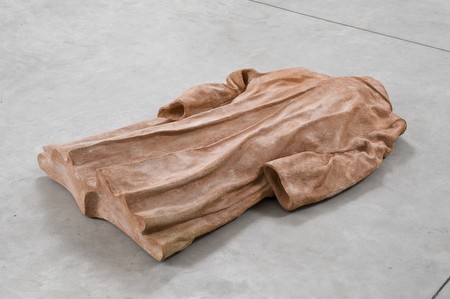
Francesco Gennari: "The Body Returns to Earth, and the Soul to Heaven (With a Stain of Amarena in the Heart)", 17 x 70 x 111 cm - 7 x 27.5 x 44 in. (dimensions vary depending on the sky), terracotta, gin, amarena syrup, starry sky
Francesco Gennari: A Stain of Amarena in the Heart 28 October 2011 – 25 febraury 2012 Opening: 28 October, 6 - 9 pm Gallery 1
One morning he felt the desire to look at his reflection in a liquid surface, wanting his beloved mint syrup to serve as the only albeit unstable carrier of his image, wishing for the continuous change in his appearance to coincide with the constant fluctuation of his feelings. While he was struggling to comprehend his emotions, his image continued to oscillate to the rhythm of the moving green fluid. At the same time he remembered what was to be his fate: the irreversible separation of body and soul. He knew that his body would return to earth where it would evaporate entropically, and his soul would go to heaven; he knew that only the shell would persist, only the apparition. And yet he decided to embark on that journey - but with a stain of amarena in his heart.Francesco Gennari, born 1973 in Fano, Italy, lives and works in Persaro and Mllan.
In his life, Florin Mitroi (1938-2002) had only one solo exhibition, in 1992 (Catacomba Gallery, Bucharest). And he retracted, spurned it. A lifelong Professor at the Bucharest Art Academy, known in person to most of the artists, art historians and art critics, Mitroi was, however, a secretive, quiet, self-effacing figure. His work evolved in the late 50s, during the hardest times of Proletkult-grounded Socialist Realism. Artists and students who declined propaganda art were excluded from schools, lost their ateliers, were marginalized or arrested. Mitroi’s work is a huge fresco of a passionate theatre of powerlessness: hatred, fear, doubt, hypocrisy, malice, abuse, deceit, perversity, the whole range of a mean mankind flourish in his gallery of dystopic, yet delicate characters of a voluptuous misanthropist play. When the human figure beomes a limit, allegorical objects substitute it: axes, sickle, knives turn apparently benign still-lives into a stage for anxiety, menace and violence, lived with a suicidal fervor. His painterly experiments resurrected ancient techniques. Like the psychotic one, his technical research was, however, politically-charged. He rebuffed oil painting, refusing its opportunity to repair, to embellish, to obtain effects through layering and shading. In contrast to it, the crisp, ancient tempera technique he employed is uncompromising: only one trait, only one colour, only one truth at a time is permitted, in a direct, immediate and un-alterable way. Each work is the accurate and indelible embodiment of a distinct fact and state of mind. Consequently, the works are named after the day they were made, as if to pin-point a transparent reality, verity or revelation, like a crude diary. Today, most analytical attention is paid to the two kinds of heroes of Communist times, either to the clamorous opposition (“the dissidents”), or to the vocal supporters (“the apparatchiks”). This because nowadays power still seduces even the critical eye. Yet, opposition and regime shared the language of the same power (frequently the dissidents were mere apparatchiks deprived of benefits, and then turned into detractors). But Mitroi enacts the language of powerlessness. His anti-heroic position is still challenging nowadays too, defying the public consciousness mesmerized by vacuous force. Mitroi’s barb-wired art is self-defense against the invasive, violent rhetoric of an ideological social body. Hence it’s cruelty. In his works, protest is disfigured by fear, humanity by survival, and charity by bestiality. His values are still difficult to stomach. Sincerity, immediacy, fervor, panic, weakness, desperation, and suicide as the only way out continue to challenge the beholder eager for visual comfort. Now is safer to accuse the political system (the Communist, but not only) and to turn individuals in mere victims. Mitroi simply couldn’t see the system: all what he saw were people mutilated by their own accepting of the given. Moral rather than conceptual, the work of Mitroi works like a lens for ecstatically monitoring the far-reaching evil inside, its self-destructing and de-legitimizing action. Based on his communist experience, his work addresses poignant questions to the contemporary consciousness too.