11 March - 16 April 2011 Tuesday - Saturday, 11 am - 6 pm
Jan Merta: Der Fr�hling ist gekommen
Jan Merta (b. 1952 in Sumperk, Czech Republic) ranks among the most important painters of his generation in his home country. His work is informed by the demise of the communist regime. Before the fall of Communism his practice was affected by conceptual strategies which has since changed into a more pictorial and colorful approach to painting. Jan Merta�s pictures attest to his great versatility and universalism. Any visual experience of Merta can become the starting point for a painting: photos, films, memories, everyday occurences and glimpses of nature. Through numerous reflections and pictorial decisions these impressions together form a socially relevant painting. Merta�s pictures are not easily accessible, yet at the same time they are simply beautiful paintings in a technical sense and have a great mystique in terms of their content. On the viewers� parts they certainly require an intellectual approach in order to reveal their meaning very slowly, layer by layer.
The painting Spring Has Come serves as the title of this exhibition, and relates to a childhood memory. It shows a child looking out through a window into a white, open space with a vague horizon looming in the distance. For Merta this motive is linked to a physical/mystical sense of well-being and the foreboding of enormous possibilities. By stylization and reduction, Merta converts the round art-d�co-glass elements into a �Mondrian�, the engraved Primavera figure morphs during the painting process into a child in a vehicle, holding a book in its hands. The painting shows the metamorphosis of an intense childhood experience into an image filled with allusions to hopes, visions and optimism.
The work Burnt-Out Abstraction stems from a visual adventure on the way to the studio. Merta saw a burnt-out apartment with its windows being merely black gaping holes, with dark traces scattered on the building walls. In playful mode, Merta�s painting sets the percipience of a burnt apartment in connection to abstract painting. Like in many other paintings by Merta one can find ironic undertones as a means of expression of ambivalent feelings and thoughts.
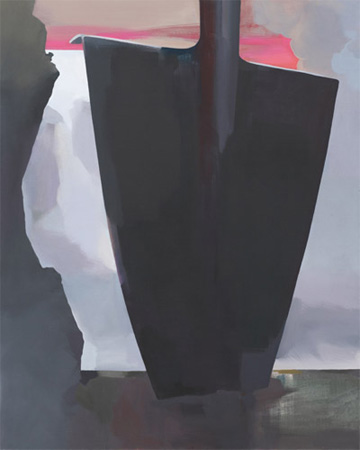
In Spring Work II Merta plays with a powerful symbol and stereotype for work, earth and agriculture. It accentuates the heroic, monumental aspect and thus delivers a tongue-in-cheek comment to the archetypal, patriarchic and romantic connotations of this motive. The spade was a popular symbol in both the art of Communism as well as Faschism. But Merta�s brushstroke gives the theme a tender, fragile chromaticity that seems closer to a vegetable garden than a deployment, even if it keeps a slightly eerie aura.
Jan Merta studied at the Academy of Fine Arts in Prague where he still lives today. He had numerous large exhibitions in the Czech Republic. Johnen Galerie is pleased to present its third solo show of Jan Merta�s work.
Robert Kusmirowski: Square2
Johnen Galerie is proud to present Robert Kusmirowski�s third solo show at the gallery. As common in his practice, Kusmirowski reconstructs historical artefacts and settings to examine and manipulate historical themes. By using old, archaic techniques and equipment, his exhibitions also have the materiality and appearance of a bygone time.
With the present exhibition Square2 Kusmirowski aims at explaining phenomena in art that are usually invisible and undiscovered as they are part of the creative process, barely tangible before the decisive idea for the artwork-to-be. Square2 shows a possbile re-production of those primary apparitions that happen before the genesis of an artwork. Thus the works on view can be seen as prototypes before they went into production.
The artist instances Andy Warhol�s famous Campbell�s soup cans as example to start a logical journey that �starting from the quadrangular label of the original painting of the soup can- leads the viewer to the fundamentally different positioned square of Kasimir Malevich. His Black Square was the initial work of Suprematism, characterized by its compositions consisting of geometric forms (e.g. squares, rectangles, circles, straight lines and cross shapes). The first and most prominent composition was the Black Square on white background that Malevich himself termed as �the atom of painting�, the very essence of form. True to this belief he completed his Suprematism with a white square on white ground. Suprematism as a style was resolved to completely separate art from reality, to pursue the most simple forms possible and finally break with all narrative and figurative aspects.
Kusmirowski about-faces this mechanism. The purity and essential reduction inherent to Malevich� works gets turned to the outside: Kusmirowski�s interpretation presents a black square as a physically manifest, haptic analogy to the delicate, elusive original. The show bears testimony to intense physical labor by visualizing the exhausting efforts, not unlike those undertaken by workers tarring the streets. The aspect of the artist�s pain that Malevich intentionally hid from the viewer is shown �squared�, raised to the second power. The work aims at stressing the physicality inherent to the concept of Kasimir Malevich whose painting of a black square turned out to be rather sophisticated and delicate. Kusmirowski�s presentation reverses the process of perception and translates Malevich� arduous intellectual process into the adequate weight/severity.
Along the journey between the two squares of Malevich and Warhol other great positions of Modern Art act a part in the exhibition: Jackson Pollock�s physically laborious action paintings, executed by dripping paint in rythmic motions around rectangular canvases lying on the floor complement Kusmirowski�s concept to finally conclude by referencing Roman Opalka famous rows upon rows of densely painted white numerals. Opalka began painting on black backgrounds, but changed over the years into grey to finally light up the backgrounds to an almost white tone today. While Opalka wants to show the passing of time, Kusmirowski�s version stresses the morphological affiliation to Malevich and Suprematism as a whole.
Robert Kusmirowski (b. 1973 in Lodz, Poland) studied sculpture at the Maria Curie-Sk�odowska University in Lublin and spent a year on a scholarship at the University of Rennes. His many exhibitions include solo shows at Center for Contemporary Art Warsaw, Kunstverein Hamburg, Stedelijk Van Abbe Museum Eindhoven, Migros Museum f�r Gegenwartskunst, Zurich; Bunkier Sztuki, Krakow, Barbican Art Gallery, London and Galleria Civica, Trento.