|
Hauser & Wirth Savile Row: Ida Applebroog | Dieter Roth - 17 Mar 2011 to 30 Apr 2011 Current Exhibition |
||||
|
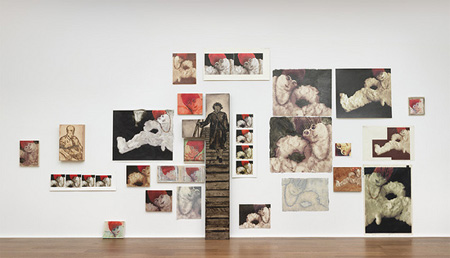
Ida Applebroog, Caleb, 2011
Mixed media on gampi, canvas and paper; 25 parts 320 x 670.6 cm / 126 x 264 in approx. |
|||
|
||||
|
||||
|
Ida Applebroog 17 March � 30 April 2011, Hauser & Wirth London, Savile Row, South Gallery Opening: Wednesday 16 March 6 � 8 pm Hauser & Wirth is proud to present an exhibition of major works by the American artist Ida Applebroog. Describing herself as a �generic artist�, Applebroog�s subject is a sustained enquiry into the polemics of human relations. She appropriates mainstream media in innovative ways and transforms her canvases into structural elements, effectively questioning the viewer�s active involvement in her works. Applebroog first came to attention in the 1970s with her �comic strip� works, which presented a succession of identical images in window-like cellular structures. In the mid-1980s, these paintings evolved into altarpiece constructions, joining several different sized canvases. In the early 1990s, Applebroog reached a turning point in her career with the �Marginalia� series. With �Marginalia�, Applebroog�s joining of images takes on a precarious spatial dynamic. Balanced on top of one another, leaning against walls or laid flat on the floor, the canvases are conceived as fragments of room-sized installations. The conventional clothing of Applebroog�s subjects marks them out as everymen or women, yet their multiple parts tell of psychoses: a man holding a baby has his arms strapped so that there is little else he can do; a woman clasps two guns, only to have a third held between her legs. �When I work with canvases,� Applebroog states, �I work with three-dimensional structures. It�s about structures, it�s about stagings�. The installed �Marginalia� works hold the viewer at their centre, their appearance dependent on where one stands. In �Monalisa�, the staging of images is taken further. Numerous drawings are latticed together on a wooden scaffold creating a house-like structure. The drawings are digitally reworked versions of Applebroog�s �Vagina Drawings� � a group of drawings originally made in 1969 when the artist spent hours in the �little sanctuary� of the bathroom. Inside the house is �Monalisa� � a painting of a giant doll-like figure, whose lumpy, blood red body courts the viewer with open legs and staring eyes. The construction recalls Duchamp�s infamous ��tant Donn�s�, which was first exhibited in 1969, the same year Applebroog began making her series of �Vagina Drawings�. �Caleb�, Applebroog�s most recent work, similarly confronts the viewer with multiple images of a single body. Its starting point, a tiny sculpted figurine, is photographed and digitally manipulated in a technique Applebroog names �Photogenetics�. In these physical permutations, Applebroog tests how little is needed to create a person, and what we, as observers, are prepared to recognise and accept. A symposium on Applebroog�s work, including discussions led by Jo Applin, art historian and lecturer at The University of York; Jon Bird, Professor of Art and Critical Theory at Middlesex University; Briony Fer, Professor in History of Art at University College London; Tamar Garb, Durning Lawrence Professor in the History of Art, University College London; and critic, curator and writer Elisabeth Lebovici, will take place on Saturday 19 March at University College London. Dieter Roth Reykjavik Slides (31,035) Every View of a City 17 March � 30 April 2011, Hauser & Wirth London, Savile Row, North Gallery Opening: Wednesday 16 March 6 � 8 pm Throughout his career, Dieter Roth worked with great breadth and diversity. He was a composer, musician, poet and writer as well as an artist, consciously obliterating categories and hierarchies and, through his collaborations with other artists, subverting the principle of authorship. Hauser & Wirth is delighted to present Roth�s monumental project �Reykjavik Slides�, on view at Hauser & Wirth London, Savile Row until 30 April 2011. Featuring 31,035 slides shown simultaneously on multiple projectors, �Reykjavik Slides� was inspired by the distinctive character of Icelandic architecture and documents every building in the capital. Made with the assistance of P�l Magn�sson and the artist�s two sons, Bj�rn and Karl, the work is a comprehensive survey, drawing one�s attention to the subject matter of the project, rather than the role of the artist. In his work from the 1960s and 1970s, Roth liberated himself from formal and linguistic conventions. He pursued the belief that life was art, achieving this through a decision to give all things, however insignificant or unappealing, equal importance. With projects such as �SNOW� (1963 � 69), a book project that involved the photographing and experimental printing of every object with which Roth came into contact; and �Flacher Abfall (Flat Waste)� (1975-76 / 1992), a collection of neatly and chronologically archived items less than a third of an inch thick, Roth�s strict avoidance of hierarchy developed a unique preservation of the ephemera of his life. These projects advanced a poetic of everyday meaningfulness: �every slip of paper is touching,� Roth said; �each day or thing sings its song�. With �Reykjavik Slides�, Roth used this same didactic approach to create an homage to Iceland. The work�s numerous images present an act of dedication to the singularity of Reykjavik, Roth�s home since 1957 and, in seeing every building as worthy of admiration, Roth allowed life itself to communicate as art. |
||||
re-title.com
International contemporary art
SIGN UP FOR NEWSLETTERS

 SIGN UP for ARTIST MEMBERSHIP
SIGN UP for GALLERY MEMBERSHIP
SIGN UP for ARTIST MEMBERSHIP
SIGN UP for GALLERY MEMBERSHIP
Click on the map to search the directory