|
Hauser & Wirth Zurich: Paul McCarthy Joan Mitchell - Sunflowers - 7 June 2009 to 25 July 2009 Current Exhibition |
||||
|
Paul McCarthy
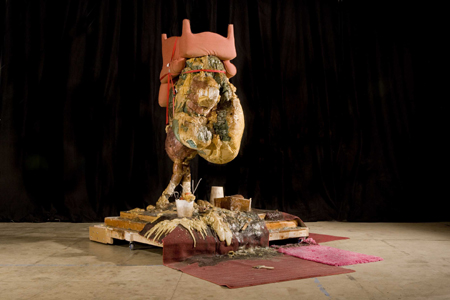
Captain Ballsack, 2009 |
|||
|
||||
|
||||
|
PAUL McCARTHY 7 June � 25 July 2009, Hauser & Wirth Z�rich Opening: Saturday 6 June 2009, 5 � 8 pm Captain Ballsack, Bush, pigs, piracy, Hummels and a plethoric variety of materials all feature in Paul McCarthy�s extraordinary new sculptures and drawings, on display in the downstairs galleries of Hauser & Wirth Z�rich. The works extend McCarthy�s fictive universe, advancing a raucous, exuberant mayhem that further admits the depravities of society into the realm of art making. Captain Ballsack (Original) (2009) is a splendidly heterogeneous three metre high sculpture that combines clay, carpet, foam and fibreglass with found objects. His giant cleft chin is in fact an enormous rancid-looking scrotum adorned with a red fedora formed out of an upturned armchair. Perched bashfully on a pair of knock-kneed legs, he stands on a redcarpeted platform that is foully bespattered with what looks to be semen; a kind of gross-out cartoon character and aficionado of the Readymade. The pirate has for a long time been a fecund figure in McCarthy�s work, spawning numerous sculptures such as Jack (2002), Shit Face (2002) and Captain Dick Hat (2003), and providing the psychological theme for a maledominated, hermetically closed world in which fantasies come to the surface and moral barriers are torn down. George Bush figures alongside pigs in two major new sculptural tableaux, Puppet (2008) and Bush Train #2/Board Room Table (2009), as well as in a drawing series from 2007. Both the sculptures and the drawings refer to and derive from Pig Island, a vast, sprawling, ongoing installation that McCarthy has been developing in his studio over the past 6 years. Reminiscent of the anarchic assemblages of Dieter Roth through its teeming conjunction of artwork and studio ingredients, Pig Island is the orgiastic breeding ground for unnatural hybrids. Whilst the drawings depict the former President in the throes of porcine sex, the sculptures witness Circe-esque transformations with Bush and various other politicians� giant foam heads grafted onto the bodies of pigs. Paula Jones Disney Pirate Table (Original) (2009) similarly implicates Clinton. In these sculptures, the political themes of overseas adventurism and sexual gluttony are embodied through McCarthy�s longstanding, larger-than-life iconography. Persona with mutilated limbs and caricature heads (often gouged or shafted by phallic objects), fluids and Disney-esque locations feature incessantly in his works: from his performances of the �70s to the installations that he has made in recent years with his son Damon (especially Caribbean Pirates (2005) and Piccadilly Circus (2003)), becoming ever more complex, potent and inter-connected. The 'Hummels', shown here as a group for the first time, are a new subject for McCarthy � commodifications of innocence ripe for defilement. These are kitsch German-made, porcelain figurines of children that in McCarthy�s hands become astonishingly grotesque and obscene. Their flesh is a queasy amalgam of clay, fibreglass, foam and resin that has dripped off them and lies disgustingly curdled at their feet, as though their bodies are decomposing in front of the viewer. In Adventure Bound Seven Swabians/Spear (2008), the Hummel rendering of a fable by the Brothers Grimm becomes a sadistic sex saga: eyes closed, rictus-grinned and one behind the other, the Swabians are throttled by their phallic spear. These Swabians, Kissing Cousins (2009), Happy Traveler (Kicker) (2008) and Mountaineer (2009) all travesty a central-European personification of purity, relating back to McCarthy�s earlier twisted parodies of Heidi and other clich�d Swiss characters. They are accompanied by large-scale Hummel Mountaineer drawings that submit inkjet prints of mountaineers to lewd embellishments in oil stick. Typically, the artist augments contemporary culture, taking what is already there and further exaggerating existing perversities. Paul McCarthy was born in Salt Lake City in 1945 and lives and works in California. Recent major exhibitions of his work include 'Central Symmetrical Rotation' Movement - Three Installations, Two Films', Whitney Museum of American Art, New York (2008); 'Paul McCarthy � Head Shop/Shop Head', Moderna Museet, Stockholm (2006), which toured to ARoS Aarhus Museum of Art, Aarhus, and S.M.A.K., Gent (both 2007); and 'Paul McCarthy: LaLa land parodie paradies', Haus der Kunst, Munich, which toured to Whitechapel Gallery, London (both 2005). Joan Mitchell. Sunflowers can be seen concurrently in Hauser & Wirth Z�rich�s upstairs gallery. Joan Mitchell Sunflowers 7 June � 25 July 2009, Hauser & Wirth Z�rich Joan Mitchell�s Sunflower paintings count amongst the most experimental and vibrant of all her works. In the upstairs gallery at Hauser & Wirth Z�rich, six canvases dating from the 1960s and the year before her death, etchings and drawings host an extraordinary diversity of marks with compositions whose ungovernable vitality refuse to comply to the rules of image making. Mitchell considered sunflowers to be �like people� � subjects to empathise with whose life cycles were played out with exuberance but brutal swiftness. �If I see a sunflower drooping, I can droop with it,� she explained, �and I draw it, and feel it until its death.� Like van Gogh whose precedent she was brave enough to summon, she embraced sunflowers for their hopefulness as much as for their assertive and undeniable splendour. Her images do not much resemble the plants themselves: they are blue and red as well as golden, erratically dancing sweeps of colour that communicate internal as much as external landscape. Mitchell began the Sunflower works after relocating from Paris to V�theil, a town 60 kilometres north of the capital. They grew out of a particularly difficult time in the artist�s life, following her mother�s death after a seven year struggle with cancer. The paintings from this earlier period are dark and foreboding, roiling tempests of paint. In Calvi (1964) named after a Corsican fishing port Mitchell visited on a sailing trip, a central area of densely worked impasto sits on top of a haze of translucent layers of pigment which conjures a landscape distance. The impression of solid weight achieved through the tactile physicality at the heart of this canvas recalls C�zanne, yet rather than suggest the volume of actual objects, Mitchell�s build-up of paint makes emotion palpable. Untitled, 1968-1969, and the drawing Untitled (1967) convey a different, brighter mood, whilst etchings the artist made in the early �70s establish a whiplash fluency of line. As the critic and poet John Yau has noted, the works of this period grant the viewer �an intimate encounter with a sumptuous but harsh lyricism that constantly courts but never succumbs to chaos.� In these pieces, Mitchell�s marks possess a fresh looseness, their brio asserted in opposing colours and unexpected positionings. Nature is conjured at its most unruly and oppositional: frenzy co-exists with calm, flux results in disruptiveness. In Untitled (1969) Mitchell pursues this diversity of painted gesture and unevenness of composition to magnificent extreme. Thick areas of red and yellow paint reveal a frenzy of working whilst elsewhere the canvas is marked only by faint washes of green. Drips slide down the picture and snarls of paint grow glistening and creamy where they collide with white. According to the writer Dave Hickey, Mitchell�s �manner is at once too varied and specified to ever be �a style�. She could make any mark but she never fell in love with one, just the speed of it.� Her works make lasting passion, movement and energy, describing not the appearance of the world nor transcendent revelation, but the nature of being in it, its transient, intense pleasures and pains. In the final years of her life Mitchell returned to the subject of sunflowers with renewed focus. These often multi-part canvases are assured, employing a carefully edited palette and calligraphic energy conveyed through lavish brushmarks. In these, a potential self-containment of individual rosettes is countered by the sideways spreading from one into several canvases allowing for a range of inter-related expressions that are vast and open-ended. �I want them to hold one image despite all the activity,� Mitchell has said of her works. �It�s kind of a plumb line that dancers have; they have to be perfectly balanced the more frenetic the activity is.� Joan Mitchell was born in Chicago in 1925 and died in Paris in 1992 at the age of 67. She came to attention in the early 1950s, exhibiting at the Stable Gallery in New York alongside Joseph Cornell and Robert Rauschenberg. In the summer of 1955 she travelled to France, settling there permanently in 1959. There have been numerous gallery and museum exhibitions of Mitchell�s work, including two major shows at the Whitney Museum of American Art in 1974 and 2002, which toured across the United States. Recent group exhibitions include �Action/Abstraction: Abstract Expressionism and Postwar America� (2008), The Jewish Museum, New York, which travelled to Saint Louis Art Museum, Saint Louis and Albright-Knox Art Gallery, Buffalo; Significant Form, The Persistence of Abstraction� (2008), Pushkin State Museum of Fine Arts, Moscow; and Action Painting (2008), Beyeler Museum, Basel. A touring solo exhibition, �Joan Mitchell: A Discovery of the New York School�, which opened at Kunsthalle Emden, Germany (2008 � 2009), can be seen at Palazzo Magnani, Reggio Emilia, Italy until June. Her paintings can be seen in museums and important private collections worldwide. �Joan Mitchell, Leaving America: New York to Paris 1958 � 1964�, a catalogue published by STEIDL Hauser & Wirth featuring 20 colour plates and an essay by Helen Molesworth, is available from the gallery. An exhibition of new works by Paul McCarthy can be seen concurrently in the downstairs gallery. GALLERY HOURS Tuesday to Friday 12 � 6 pm, Saturday 11 am � 5 pm OPENING HOURS DURING ART BASEL: Sunday 7 June, 11 am � 8 pm Monday � Friday, 10 am � 6 pm Saturday and Sunday, 11 am � 5 pm FORTHCOMING EXHIBITIONS Z�RICH: PIPILOTTI RIST, 29 August � 17 October 2009 FORTHCOMING EXHIBITIONS LONDON: MARTIN EDER Hauser & Wirth London, 15 Old Bond Street, 10 � 16 September 2009 SUBODH GUPTA Hauser & Wirth London, 196a Piccadilly and 15 Old Bond Street, 1 � 31 October 2009 For further information and artwork material, please contact: zurich @ hauserwirth.com, +41 (0) 44 446 80 50 or press @ hauserwirth.com, +44 (0)20 7399 9789 |
||||
re-title.com
International contemporary art
SIGN UP FOR NEWSLETTERS

 SIGN UP for ARTIST MEMBERSHIP
SIGN UP for GALLERY MEMBERSHIP
SIGN UP for ARTIST MEMBERSHIP
SIGN UP for GALLERY MEMBERSHIP
Click on the map to search the directory