LUIS GORDILLO Organic Logotypes 10.9. - 30.10.2010
Gordillo hat seiner Berliner Ausstellung den Titel Organic Logotypes gegeben. Das Wort Logotype stammt aus dem Druckbereich. Es bezeichnet die Zusammenstellung von Buchstabenkombinationen auf einer Type im Bleisatz, was Zeit beim Setzen ersparte. Inzwischen werden auch die Abk�rzungslogos von Firmennamen oder Warenzeichen so genannt. Logotype hat also etwas mit Beschleunigung zu tun und mit der Pr�gung von Einheiten, die selber keinen Sinn haben m�ssen, aber zu einem Gesamtsinn beitragen k�nnen. Das Logotype schwankt zwischen Sinn und Sinnlosigkeit. Es markiert den Ort f�r die �berproduktion von Sinn, von scheinbar hartgepr�gter Rationalit�t. ?Organic' steht f�r Wachstum und verweist im Zusammenhang mit ?Logotypes' auf nicht mehr kontrollierbares Wachstum und gleichzeitig auch wieder auf das Verschwinden von Sinnvorg�ngen in unserer heutigen Welt.
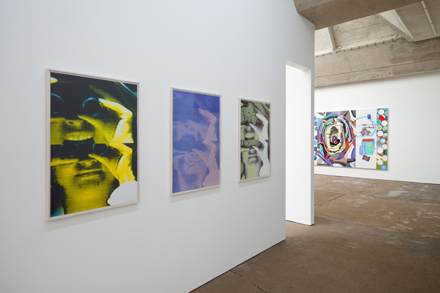
Gordillo hat f�r die drei Ausstellungsr�ume drei unterschiedliche Zyklen von Bildern geschaffen. Im ersten werden wir in bildliche Strudel oder sich drehende Geysire vor dem Ausbruch hinein gesogen. Organische Zellen, Augen, Landschaftsst�cke drehen sich in unaufl�sbaren Geweben. Der n�chste Zyklus hat mit Schl�nden, Verschlingungen oder Zerquetschungen zu tun, mit gro�en Bildm�ulern, die uns aufnehmen oder mit Mahlmaschinen und Vexierspiegeln, die von uns nur ein Flirren �briglassen. Im dritten Zyklus gibt es kleine lyrische Miniaturen, in denen Mikrowelten in ein nerv�ses Flackern geraten.
Wo ist der Platz des Menschen auf der Welt? Die Pop Art, die Gordillo in Spanien mitgepr�gt hat, beantwortet diese Frage nicht, stattdessen hat sie als Rezept den Glauben an die ikonenhafte Wirkung des Bildes herausgestellt. Gordillo ist in den folgenden Jahrzehnten einen Schritt weitergegangen: es gibt f�r den Menschen keinen nat�rlichen Ort mehr - auch nicht im Bild -, der Mensch muss sich damit begn�gen, in der auseinander treibenden Vielfalt mitzuschwimmen. Er erf�hrt dabei Beschleunigungen, die ihn auch in St�cke zerrei�en k�nnen, oder treibt immer st�rker auf Krisen zu, weil die Versatzst�cke, die er st�ndig produziert, sich nur eine Weile halten k�nnen. Gordillo macht diese Krisen sichtbar, indem er Strukturen immer mehr fragmentiert und neue Bilder aus Versatzst�cken eigener zerst�rter Bilder aufbaut. Wucherndes Wachstum und zerst�rendes Zerschneiden sowie die Selbstbeobachtung in diesem Treiben ist ein konstantes Merkmal seiner Bilder geworden. Mittels der Photographie h�lt er Zust�nde der Bilder fest, friert sie ein, legt sie collageartig neben- und �bereinander und reproduziert diese Zust�nde in anderen Ma�stabsdimensionen. So entsteht eine permanente Reproduktion und Selbstverschachtelung der Bilder. Die Versatzst�cke multiplizieren sich und treiben ihrer eigenen Sinnentleerung entgegen. So vollziehen Gordillos Bilder an sich eine st�ndige Re-Vision ihres Erscheinens. Einzig der Pinsel des Malers ist der Kleister, der die Versatzst�cke noch f�r einen Augenblick zusammen h�lt.
Wie schon in den sechziger Jahren vereinen Gordillos Bilder eine Wechselstimmung von Humor und gro�em Ernst . Comic-Elemente, �bertreibungen, schrille Farben und Formkonstellationen sind Bestandteile seiner Bilder. Andererseits atmen sie aber auch die Schwere und den Ernst des Ringens mit sich, des Sich-Auslieferns an das Bild im Aufbau starker Spannungen und innerbildlicher Kontraste. Standen urspr�nglich noch das menschliche Gesicht oder der menschlicher K�rper visuell im Vordergrund, sind es heute nur einzelne Versatzst�cke, Augen, Grimassen, Sch�del- oder Rumpfformen, die sich in seinen Bildern in komplizierter Weise verschachteln. Man kann nicht entscheiden, ist es das eigene Subjekt des K�nstlers, welches sich zersetzt und zerf�llt oder artikulieren seine Bilder unser aller sich aufl�sende Identit�t in der Hyperkomplexit�t unserer heutigen Welt. In dieser Ambivalenz von Selbstfreilegung und Artikulation der Ungef�gigkeit und Unverf�gbarkeit der Welt steht er dem Werk Kippenbergers nahe.
Rolf Hengesbach
LUIS GORDILLO Organic Logotypes 10.9. - 30.10.2010
The Hengesbach Gallery presents recent works of drawing, painting and monotype by Luis Gordillo, from 10 September until 30 October 2010. The 76-year-old Spanish artist lives and works in Madrid. In 2007, he was the Velazquez award-winner. In the same year, his retrospective in the Reina Sofia was voted best exhibition of the year in Spain.
Gordillo�s pictures are fresh, provocative and dynamic. This is the reason why his recent work is very close to positions of the young international art scene.
Gordillo has created three different picture cycles for the three exhibition rooms. In the first room, the viewer gets pulled into pictorial swirls or spinning geysers before their eruption. Organic cells, eyes and bits of landscape spin in inextricable textures. The next cycle is concerned with gorges, intertwinings or crushing, with large picture mouths that absorb us, or with grinding machines and vexing mirrors that leave behind only a shimmer. In the third cycle, there are small-sized lyrical miniatures � micro worlds, that get caught in a nervous jitter.
Luis Gordillo has given his exhibition in Berlin the title 'Organic Logotypes'. The word 'Logotype' originates from the field of print. It signifies the setting of letters onto a slug in the hot type that saved time while typesetting. Meanwhile, logos of companies and goods are referred to likewise. Logotype has to do with the coinage of units that do not have to make sense on their own, but may contribute to an overall sense. It fluctuates between sense and senselessness. In contrast, 'Organic' stands for biological becoming and decay, for an effectiveness that has a sensation of its own self. Gordillo's works oscillate between these two poles.
In Gordillo's view there are no natural places for human beings any more � not in a picture, either. Man has to be content with floating along in the plurality which is drifting apart. He thereby experiences accelerations that could tear him apart, or he drifts towards crises because the set pieces he constantly produces are only of a limited durability. Gordillo visualises these crises by fragmenting structures and constructing new pictures from his own destroyed set pieces. Rampant growth and destructive cutting to pieces have become a constant property of his pictures. By using photography, he captures the conditions of the pictures, freezes and arranges them like a collage side by side and on top of each other. He reproduces these conditions in other dimensions of scale. Thus, a permanent reproduction and interlocking of the pictures occur. The set pieces multiply themselves and drive towards their own depletion of sense. In this way, Gordillo's pictures as such perform a permanent re-vision of their appearance. Only the brush of the painter is the paste that holds the pieces together for another moment.
Like in the 1960s already, Gordillo's pictures communicate a changing atmosphere of humour and great seriousness. Elements from comics, exaggerations, flashy colours and constellations of shapes are constituents of his pictures. On the other hand, they also include the heaviness and seriousness of struggling with oneself, to surrender oneself to the picture in the build-up of strong tensions and inner pictorial contrasts. Whereas originally the human face or the human body were visually in the foreground, today there are only eyes, grimaces, skull and torso shapes that interweave in his pictures in a difficult manner. Within this consideration, one cannot decide whether it is the subject of the artist himself that is decomposing and decaying, or if Gordillo's pictures formulate the dissolving identity of every individual in the hyper-complexity of today's world.
In this ambivalence of self-exposure and the articulation of non-amenability and unavailability of the world, the artist stands close to the work of Martin Kippenberger. While Kippenberger expressed his cynical distant view of the world, the works by Luis Gordillo at all times reveal - beside his scepticism �curiosity as well towards the multilayer facets of a world that multiplies itself.