Wenn die diesjährige Documenta-Chefin Carolyn Christov-Bakargiev das anthropozentrische Weltbild näher in Augenschein nimmt, so schlägt sie damit ein Thema an, mit dem sich auch der Schweizer Künstler Alex Hanimann (*1955) seit Längerem beschäftigt. Die Hengesbach Gallery eröffnet am 31.08.12 eine Einzelausstellung und zeigt bis zum 20. Oktober 2012 die Videoarbeit „Shifting“ (2004) neben neu entstandenen, großformatigen Zeichnungen. Im Video „Shifting“ folgen wir einem an der Leine geführten Pitbull durch eine nächtliche Pariser Straße. Der Kampfhund, mit einem Maulkorb ausgestattet, ist zunächst von seinem nächtlichen Verfolger, einer Kamera, provoziert. Das Tier fühlt sich bedroht und reagiert gereizt. Die gespenstisch leuchtenden Augen des Hundes kommen bedrohlich nahe. Da aber das Zähnefletschen, Knurren und Bellen keine Wirkung zeigen, schlägt die Aggression des Hundes zunehmend in Irritation um. Die immer näher heranrückende Kamera lähmt das Tier, schüchtert es ein. Nur noch zaghaft bewegt sich der Hund vorwärts. Der Mann muss ihn immer wieder an der Leine weiterziehen. Schließlich nimmt er den Hund auf die Arme und trägt ihn wie ein schutzbedürftiges Kind über die Straße nach Hause. Das Video zeigt beispielhaft, wie zwischen Mensch und Tier bzw. zwischen Kameraauge und Hund langsam eine Art Kommunikation aufgebaut wird und dabei Stimmungen kippen, Gefühle sich wandeln, Handlungsmuster beeinflusst werden.
Alex Hanimann baut Versuchsanordnungen im Sinne eines Forschers auf: "Die Basis meiner Arbeit kann durchaus dokumentarisch verstanden werden. Aber eigentlich interessiert mich das Stereotype.“ Hanimann untersucht mit semiotischen Mitteln Versatzstücke der Realität. Bestimmte Erscheinungsformen, Zustände und Handlungen werden mit unterschiedlichen medialen Mitteln fokussiert und durch Manipulation, Isolation und Transformation deren zu Grunde liegende Mechanismen und prototypische Formen herausgearbeitet. Sein Werk fragt nach dem Zustande¬kommen von Erkenntnis, die notwendiger Weise an festgelegte Begriffe geknüpft ist. Und es stellt sich natürlich die Frage, in wieweit wir überhaupt in der Lage sind, bestimmte Meinungen zu korrigieren, Vorurteile zu revidieren. Setzen wir nicht so Vieles als gegeben voraus? Bedingen nicht Wörter und Begriffe, die wir einmal definiert haben, massiv unser Denken und die Wahrnehmung der Dinge, betrachten wir sie nicht als etwas Statisches und Verlässliches?
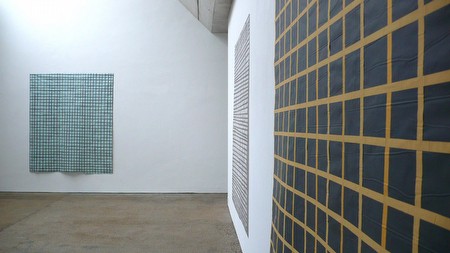
Diese Ambivalenz zwischen der Sicherheit, die vorgefasste Muster bieten und der Einengung und Determinierung, die sie auf der anderen Seite bedeuten, lotet Hanimann aus. Die Rasterstrukturen, die in Hanimanns Werk immer wieder auftauchen, werden zur sinnbildlichen Visualisierung dieser strukturellen Verstrickungen. Maschinell erzeugte Raster stehen in Hanimanns Werk händischen Rasterzeichnungen gegenüber, deren Linien voneinander abweichen, sich annähern und abstoßen und ihre eigenen Gesetzmäßigkeiten offenbaren: Damit führt Hanimann eine Mustervorgabe ad absurdum, indem er vorführt, wie subjektiv gebunden Systeme sein können – Wahrheit ist eine Frage der Perspektive und der Relation.
When this year’s Documenta director, Carolyn Christov-Bakargiev, takes a closer look at the anthropocentric world view, she shall be addressing a topic which has been preoccupying the Swiss artist, Alex Hanimann (*1955), for quite some time. Hengesbach Gallery is opening a solo exhibition on 31.08.12, showing „Shifting“, a video work (2004), as well as recently created, large-size drawings. (The exhibition ends on 20 October 2012).>In the „Shifting“ video, we are following a pitbull being lead on a leash through a Paris street at night. At first, the fighting dog, equipped with a muzzle, feels provoked by this night-time persecutor, a camera. The animal feels threatened and shows that he’s irritated. The ghastly, glowing eyes of the dog come threateningly close.But since its snarling, growling and barking show no effect, the dog’s aggression reverts more and more to a state of irritation. As the camera keeps moving closer and closer, it paralyses the animal and intimidates it. It now only moves forward tentatively. The man has to keep pulling him along by the leash.In the end, he picks the dog up and carries it home across the street in his arms, like a child in need of protection. The video is exemplary of how a kind of communication is slowly built up between the person and the animal, or between the eye of the camera and the dog, and of how moods are reversed, feelings are transformed and behaviour patterns are influenced.
Alex Hanimann sets up experimental arrangements in the same way as a scientist involved in research: “One can perceive the basis of my work as a type of documentary, no doubt about it. But what really interests me is the stereotype”.Hanimann examines fragments of reality by means of semiotics. Certain forms of appearance, conditions and actions are focused on through different means of media, and carved out through the manipulation, isolation and transformation of their underlying mechanisms and prototypical forms. His work asks how insight arises, which, of necessity, is connected to established definitions. Naturally, the question is also asked: to what extent are we actually capable of correcting certain opinions or revising prejudices? Do we not take so many things to be a given? Once we have defined words and meanings, do they not condition our thinking and perception of things enormously – do we not perceive them as something static and dependable? Hanimann is trying to fathom this ambivalence between the security that preconceived patterns offer, and, on the other hand, the restriction and pre-determining that they mean. The grid structures which appear repeatedly in Hanimann’s work become the emblematic visualization of these structural entanglements. Automatically generated grids confront manual grid drawings in Hanimann’s work, whose lines deviate from each other, approach and push each other away, revealing their own principles:In so doing, Hanimann leads a model parameter ad absurdum, in that he demonstrates how subjective bound systems can be – truth is a question of perspective and relation.
MARKUS WILLEKE Down Down Down
September 1 - October 20, 2012
Markus Willeke schafft mit der ungestümen, physischen Direktheit seiner Malerei einen Gegenpol zur amerikanischen Pop-Art. Entgegen der Billboard-Ästhetik, die durch das graphische Raster geprägt ist, steht Willekes gestischer Pinselschwung der Impulsivität des Graffiti und der Streetart nahe. Durch eine schnelle und kraftvolle Malweise erhalten die Bilder eine einzigartige Gewalt und Präsenz. Bindeglied zur Pop-Art ist der Umstand, dass Willekes Bilder unmittelbar agieren – das Bildgeschehen ist wie auf einen Schlag da und nicht der Ausgangspunkt von Erzählung. Die Macht der Bilder erwächst aus der Brillanz der Farbkontraste und der Gischt der Farbmaterie, die, wie aus einer gewaltigen Woge strömend, das Bild bedeckt. Die Bilder vermitteln den Eindruck, als ob sich ihre Inhalte zwanglos aus der Malerei ergeben, spontan im Akt des Malens erfunden sind. Daraus ziehen sie ihre Authentizität. Die Direktheit des Farbauftrags, die Leuchtkraft der Farben, die Schnelligkeit und Sicherheit der Pinselführung gibt den Bildern einerseits eine Magie und Unverrückbarkeit, andererseits eine Flüchtigkeit und Ungreifbarkeit.
Frühere Arbeiten des Malers zeigen Ikonen amerikanischer Populärkultur, an denen sich europäische Jugendkultur der 90er Jahre entzündete: Filmmotive aus „Die Simpsons“ und „South Park”, Videospielhelden, McDonald’s-Filialen, Pizzakartons. Die Bilder entfalten sich zu einer Bestands¬aufnahme medial geprägten, jugendlichen Bewusstseins. In ihrer Fiktionalität sind sie einfach da, ohne dass eine distanzierte Reflexion möglich wäre. Sie zeigen ohne Umschweife die sub¬kulturellen Auswüchse medial erregter Phantasien und artikulieren brillant den Punkt, in dem die Surrogate der virtuellen Welt eine Beständigkeit haben können.
Die jüngsten Arbeiten Willekes markieren häufig eine Grenzsituation – eine Glasscheibe, eine Wasseroberfläche, ein Rollo oder das Dickicht eines Feldes. Eine undurchdringliche Barriere dominiert den Vordergrund, sodass der Betrachter zu keinem Dahinter vorstoßen kann; er bleibt an der Oberfläche haften. Die Bilder hinterlassen ein Unbehagen darüber, was wohl hinter dieser Oberfläche lauern mag. Insofern sind die Motive die Weiterentwicklung eines visualisierten Bewusstseins und zwar in seiner Bedeutung als unkontrollierbarer Übergang, als die Spitze eines Eisbergs, dessen Grund nur schwer fassbar ist. Markus Willeke macht somit die Funktionsweise des Bildes in einer medialen Welt selbst zum Thema; er zeigt auf, wie Bilder lautlos die Schwelle unseres Verstandes passieren und sich unbemerkt einnisten.
With the heady, physical immediacy of his painting, Markus Willeke creates a counterweight to American pop art. Willeke’s gestural sweep of the brush is echoed in the impulsiveness of graffiti and street art, and deviates from the aesthetics of billboards, which are characterized by their graphic grid. Through a rapid and powerful method of painting, the pictures gain a unique force and presence. The link to pop art is the fact that Willeke’s paintings have an instant effect – what’s happening in the picture is there all of a sudden, and not as a starting point for narration. The power of the images arises from the brilliance of the colour contrasts and the spray of coloured matter which covers the picture, as if flying off the crest of a huge wave. The pictures give the impression of casual content which arises from painting, invented spontaneously during the act of painting. This is what gives them their authenticity. The application of colour shows directness, and the brightness of the colours, and the speed and sureness of the brushwork give the pictures a certain magic and solidity on the one hand, and on the other, volatility and elusiveness.
Earlier works of the painter show the icons of American popular culture which sparked European youth culture of the 90s: movie themes from the Simpsons and South Park, video game heroes, McDonald’s restaurants and pizza boxes. The pictures unfold to reveal a baseline study of adolescent consciousness defined by media. In their fictional status they are simply there, and reflection at a distance is just impossible. Without digressing, they show the sub-cultural excesses of media-fired fantasies and pinpoint brilliantly the exact moment when the surrogates from the virtual world can have consistency.
Willeke’s most recent works frequently mark a borderline situation – a pane of glass, the surface of water, a blind or the thickets of a field. An impenetrable barrier dominates the foreground, which means that the viewer cannot forge ahead to what lies behind; he ends up sticking to the surface.The pictures leave the viewer feeling uneasy about what may perhaps be lurking behind this surface. To this extent, the motives are the further development of a visualized consciousness, namely in its importance as an uncontrollable transition, or as the tip of an iceberg, whose base is quite incomprehensible.It is thus that Markus Willeke makes the way the picture functions itself an issue – he demonstrates how pictures move soundlessly through the barrier of our comprehension and settle there, unnoticed.