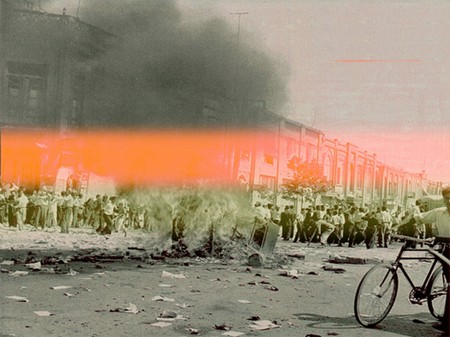
For Dirk Eicken, painting is a medium which lets him engage with different visual densities and compactions, and at the same time concern himself with the shift between social closeness and distance, but also with social re-shaping. In his new group of works, Eicken takes on different current political problems (civil war, refugee movements, third world trade). The expectation that these large-sized political pictures are linked to a distinct message is not met, on the contrary: Dirk Eicken picks out, as a central theme, the impossibility of a distinct statement via the picture. It's not on the surface of the picture that one finds answers, according to Eicken, but in its penetration. The photographic documents that the artist finds for his subjects and which he uses as the models for his pictures do not give an unequivocal answer to the question as to who the Good are, who the Bad are, who the perpetrators are - or the victims. In his confrontation with the over-sized, the viewer is placed at the setting of the happening; he can mingle with the participants and become part of the happening. Eicken paints the settings in a tradition of painting that carves out light, space and volume from a two-dimensional picture via pictorial hints. However, he lets the happenings become visible only through foils or filters, like in faded photographs. At the same time, layers of content and structural layers compete against each other: Eicken draws up pictorial spaces of colour that have no references of content to the happenings, and that accord a different dynamic to the figurative space. He applies pictorial structures that are used as camouflage, or paints coverings that serve as wrappings under which other realities are concealed. Dirk Eicken is not only concerned with contents, but he is interested likewise in the various ways in which we pick up contents, how we merge them from different sources, and how we keep them in our memory.
AXEL LIEBER "Geometrie und Alltag" Opening: Friday, 9th of September, 6-9 pm 10.09. - 17.12.2011
AXEL LIEBER Geometry and daily life
The sculptor Axel Lieber designs his sculptures from materials and shapes derived from our everyday life, mainly from the sphere of living. He either reconstructs these things in an altered shape, or encroaches upon them purposefully in such a way that they are occasionally hardly recognizable . Axel Lieber discovers close to us the Other, the Mysterious, the Strange, the Weird, the Oppositional, the Dreamlike, the Unfathomable, the Counter-rotator, and the Fictional. A shirt, shoes, a ladder, a door or a garden chair made of plastic present themselves in his Berlin exhibition "Geometry and daily life" in changed shape. The artist cut out the cloth between the seams of a white shirt. Left over was a floppy, dangling skeleton-like shape that resembles a shirt with its intact cuffs and collar, but that has now become an independent, sculptural shape. At the sight of the floating, bodiless cloth the child within the viewer is scared of this ghost. The garden chair, too, that has been sawn into pieces by Lieber and set together again in miniature-size with studs, invites the child in us to kneel down, position itself in the worm's-eye view and to perceive the small chair as a pierced monster, like a participant in occult rituals. From the multitude of things in our world, Lieber chooses those that have a personal body and memory contact to us. The difficult sculptural work consists of the transforming of the known shapes into new creatures, that allow us to penetrate, astonished, the open field of associations of our life. Thus the artist succeeds in re-defining the relationship of the viewer to the space and things surrounding him, and to evaluate the forces of outcome and possibilities of outcome in life differently - one of the central functions of sculpture.