|
Gimpel Fils: Alan Davie : The Shaman�s Enigma | Arabella Hope | NEUROTOPOGRAPHICS - 17 Jan 2008 to 23 Feb 2008 Current Exhibition |
||||
|
ALAN DAVIE
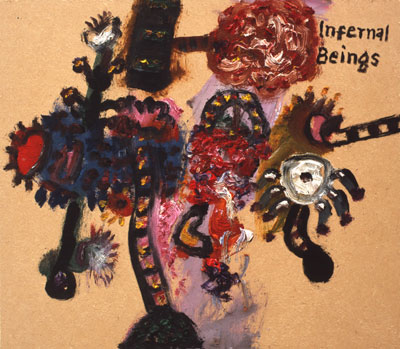
Infernal Beings, 2007 oil on canvas, 11 3/4 x 14 1/2 in/30 x 37 cm |
|||
|
||||
|
||||
|
Alan Davie The Shaman�s Enigma 17 January � 23 February 2008 private view: Wednesday 23 January, 6-8pm �If a work is to be of any value it must convey something of which transcends material.� - Alan Davie Gimpel Fils and James Hyman Gallery are delighted to present a joint exhibition of recent paintings by Alan Davie. The Shaman�s Enigma brings together a collection of Davie�s word paintings made since 2005, which not only attest to his continued artistic output, but also demonstrate the central importance of text in his work. Over the past sixty years, Davie�s vast body of work has followed a distinct stylistic trajectory. Each decade has seen him develop his artistic vocabulary, drawing on a range of life experiences and inspirations. Since his early experiments with Jungian theory in the 1950s, the artist as a Shamanic figure has been central to the development of Davie�s work. The Shaman quickly became an important symbol and channel for expression, and Davie has developed a complex iconography in response to it. Each painting is richly layered with signs, symbols, pictures and text. He has never failed to communicate his constant necessity of keeping in contact with a magical, natural flow, when making work: �I either keep with it, or I get lost� he has stated. Heavily influenced by his international travel Davie cultivated his preoccupation with ethnographic art and culture. Davie�s words and phrases are painted in a variety of different languages, including English, French, Spanish, Portuguese and Latin. Also present in the paintings are scripts incorporated from Aboriginal symbols and Carib petroglyphs. The Shaman�s Enigma traces the shifting nature of Davie�s engagement with words, from the playful to the serious, the surreal to the prosaic, the simple to the complex. A fully illustrated catalogue with an essay by James Hyman will accompany this exhibition. This major exhibition will also travel to France and Ireland. Born in Scotland in 1920, Alan Davie�s first solo show at Gimpel Fils took place in 1950. His last major retrospective exhibition was staged at The Tate St. Ives in 2003-4. Other exhibitions of Alan Davie�s artwork include The Barbican Art Gallery, London (1993), The Scottish National Gallery of Modern Art, Edinburgh (1997), COBRA Museum, Amstelveen (2001). His work can be found in numerous international public collections including Tate Modern, London, The Scottish National Gallery of Modern Art, Edinburgh, the Peggy Guggenheim Collection, Venice, Museum of Modern Art, New York, Stedelijk Museum Amsterdam, and Museu de Arte Contemporanea, S�o Paulo. Arabella Hope 17 January � 23 February 2008 private view: Wednesday 23 January, 6-8pm Arabella Hope�s large-scale paintings explore the intimate spaces of domestic bathrooms. The works of art included in this exhibition encourage us to consider how we experience private places, and how our use and perception of bathrooms shape our thoughts, memories and dreams. Accepting that emptiness is part of our everyday life, Hope�s domestic interiors are devoid of people, and her works open up a space in which we can contemplate the rituals associated with cleaning and washing ourselves. Bathrooms are spaces where we reflect upon our bodies, where we are most vulnerable in our nakedness. They can be places where we find our true selves, or where we create a self that we want the world to see. This changeable, vulnerable aspect of life is translated into an uncanny absence in Hope�s work, but which is balanced by her extraordinary use of colour and texture. A meditative stillness is expressed with an astonishing strength of colour in Hope�s work, and calls to mind the bathroom paintings of Pierre Bonnard. Like the French artist, Hope balances her interest in her subject matter with a concern with form and the practice of painting. Each work of art can be regarded as a field of colour, comprised of overlapping planes and patterns. Areas are balanced between coolness and warmth; the curve of the bathtub contrasts the systematic grids of the rectangular bathroom walls to create images that are both intimate and intense. Hope�s work makes a virtue of empty space and her skill is to keep the surfaces of her paintings meaningful without depicting incidents or activity. Arabella Hope studied at Leith School of Art before graduating from Glasgow School of Art in 2007. She was selected to exhibit in BraveArt, an exhibition of the best Scottish graduates, in September 2007, and more recently included work in the New Graduates 2007 exhibition at Pentagon Gallery, Glasgow. This is her first solo exhibition. NEUROTOPOGRAPHICS 18 � 21 January 2008 Private View: Friday 18 January 6-8pm. Gimpel Fils is pleased to present a groundbreaking exhibition exploring the boundaries of art, architecture and neuroscience by exploring how mysterious patterns of brain cell activity allow us to perceive and remember space. The film installation, Neurotopographics, is the result of a Wellcome Trust funded partnership between neuroscientist Dr Hugo Spiers, artist Antoni Malinowski, and architect Bettina Visman. The exhibition will be accompanied by a short �in conversation� event where the artists, architect and scientist will be joined by lecturer in mental health studies, Dr Chiara Nosarti, and art writer and curator, Jasia Reichart, to discuss what they have learnt from this unique collaboration. Deep in the innermost recesses of our brain are cells that provide us with a mental map of space and a sense of direction. The cells help us remember the past, and are amongst the first to be affected in Alzheimer�s disease. Three distinct types of cell have been identified by their unique activity patterns: �place cells� that provide a �you are here� signal as part of an organised mental map of space; recently discovered �grid cells� signal information about distances travelled; and �head direction cells� provide an internal compass. Collectively they help us to stay oriented and navigate. For the film installation, a scientific model combining place, grid and head direction cells is juxtaposed with the common experience of walking through space. Following the journey of a person through a space, which happens to be the gallery itself, the actor is filmed with two camera viewpoints: a static wide angle one, similar to a surveillance perspective which records the movement and spatial position; and a dynamic point of view, filmed out of the perspective of the actors� eyes, recording subjective impressions of the space and his passage. Both views are combined with a dramatic and intriguing two-dimensional graphic animation, displayed on the floor, indicating assumed brain cell activity patterns. The abstract scientific patterns will be merged on the plan of the room to point out the physical congruence of brain activity and spatial cognition. Artist, architect and neuroscientist in conversation Saturday 19 January 4-7pm followed by drinks Neuroscientist Dr Hugo Spiers will set the scene and explain how new scientific discoveries of how the brain works have helped us to develop our understanding of how we perceive and remember space. Architect Bettina Visman will then explain what the scientific research may mean for the future of architectural practice. Artist Antoni Malinowski will talk about his 20 year long preoccupation with making linear wall drawings, which focus on the intersection of cultural and natural orders and the meeting of architectural space and daylight. Dr Chiara Nosarti, from the Institute of Psychiatry, will discuss psychiatric delusions and hallucinations relating to the perception of space. Art writer and curator, Jasia Reichart, will open up the discussion to the audience and put this project into the context of other collaborative science and arts projects. Biographies Dr Hugo Spiers is a principle investigator at the UCL Institute of Behavioural Neuroscience in the Department of Psychology. His current research is funded by a Wellcome Trust Advanced Training Fellowship and is focused on understanding the neural basis of navigational guidance. More broadly he is interested in how various brain structures allow us to perceive, imagine and remember information in the world around us. Antoni Malinowski is a visual artist who works with pigment, light, movement and time, investigating the dynamic relationship that exists between pictorial and architectural spaces. He makes temporary and permanent interventions into buildings, paints canvases, walls, pavements and ceilings; orchestrates performances through cities, and structures, works with dancers, composers and musicians. Malinowski is best known for his famous Vermilion Wall - a wall painting spanning the 3 floors of the foyer at Royal Court Theatre, Sloane Square, London. Solo exhibitions have included the monumental "Synchrony" at Camden Arts Centre, London and "Thresholdscapes", at Gimpel Fils which included a musical collaboration by Michael Nyman. His works are in many major collections including The British Council and Tate, London. He is represented by Gimpel Fils. Dr Chiara Nosarti is a lecturer in mental health studies and neuroimaging at The Institute of Psychiatry. Her research investigates topics such as the effect of birth complications on brain function and psychosis. Jasia Reichardt is a writer on art and an exhibition organiser. She was Assistant Director of the ICA in London, 1963-71, and Director of the Whitechapel Art Gallery, 1974-76. She has taught at the Architectural Association and other colleges, has written for most of the international art magazines and has contributed to many international exhibitions and conferences throughout the world. She is principally interested in the relationship between art and science, art and technology, art and the history of ideas. Bettina Vismann is an architect running an interdisciplinary practice in Berlin, combining academic research with architectural design. Her initial work with spatial and conceptual models of dust led to further involvement with scientific research of microdimensions. Vismann has used her ongoing creative dialogue with science as a basis for her art installations. She has also presented her particular research in performances, lectures, workshops and publications. The theoretical and artistic work is the underlay for her architecural practice. Bettna Vismann studied at the University of Stuttgart, ETH Z�rich and at Kingston University, London. She has taught architecture at the ETH Z�rich and at the TU Berlin. |
||||
re-title.com
International contemporary art
SIGN UP FOR NEWSLETTERS

 SIGN UP for ARTIST MEMBERSHIP
SIGN UP for GALLERY MEMBERSHIP
SIGN UP for ARTIST MEMBERSHIP
SIGN UP for GALLERY MEMBERSHIP
Click on the map to search the directory